
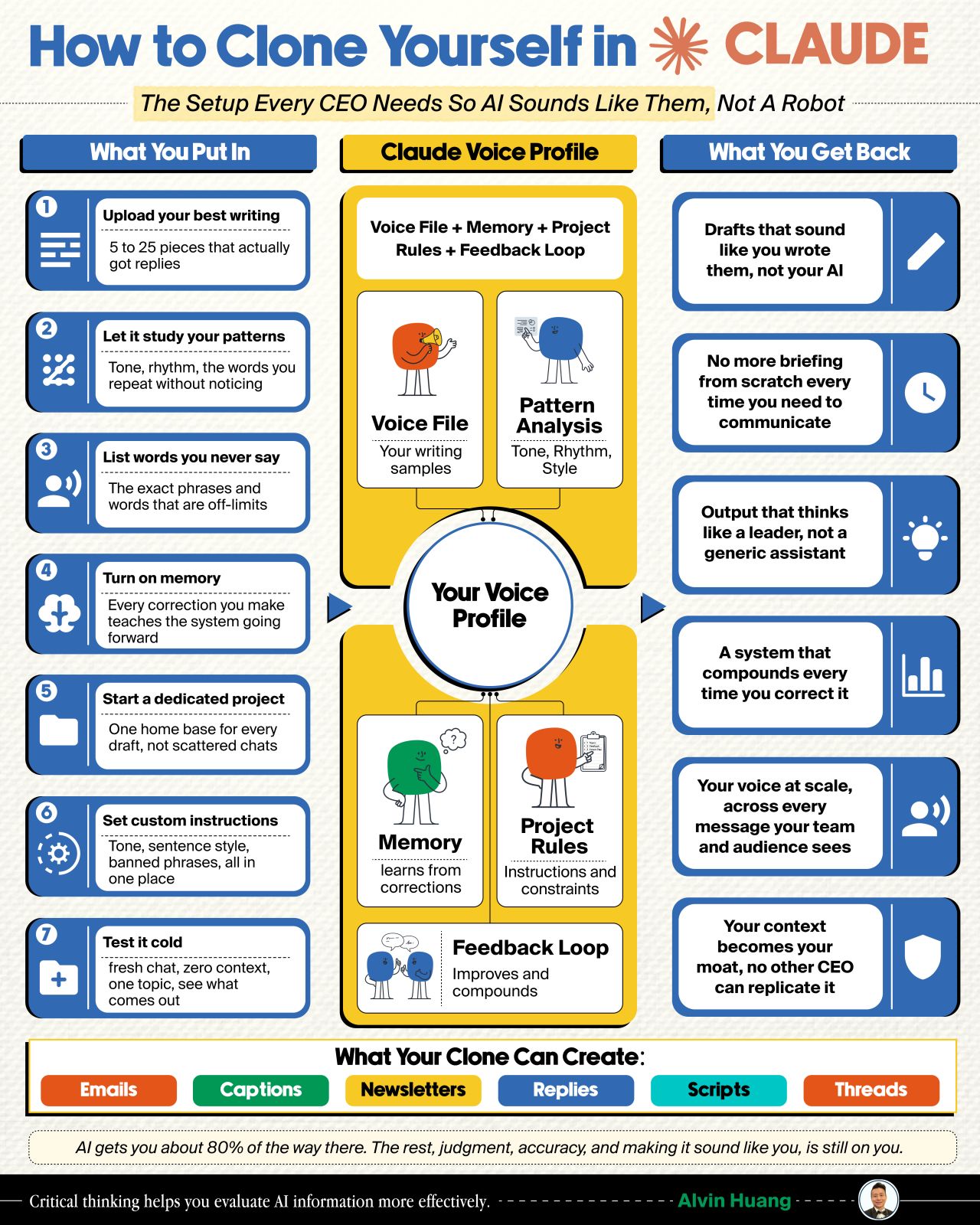
In a recent LinkedIn post, Alvin Huang discusses a novel approach to leveraging AI for professional communication, moving beyond generic assistants to create a personalized “voice clone.” Huang argues that many executives struggle with AI-generated drafts because the tools lack an understanding of their unique writing style, leading to more editing time than starting from scratch.
Huang outlines a structured method for training AI, specifically mentioning Claude, to mimic an individual’s voice. This process involves feeding the AI a curated selection of the user’s best-performing writing, allowing it to study personal patterns in tone, rhythm, and word choice. A key component of this system is explicitly defining words and phrases the user never uses, thereby refining the AI’s output.
“This is the exact setup that turns Claude into a voice clone instead of a generic assistant, broken into three parts: What You Feed It.”
The Importance of Input and Customization
Huang emphasizes that the quality of the AI’s output is directly proportional to the quality and specificity of the input. He provides a step-by-step guide for creating this AI “clone”:
- Upload your best writing: Select 5 to 25 pieces that have historically generated meaningful replies.
- Let it study your patterns: The AI analyzes tone, rhythm, and recurring words.
- List words you never say: Explicitly define banned words and phrases.
- Turn on memory: Ensure every correction made becomes a permanent rule for the AI.
- Start a dedicated project: Consolidate all related drafts in one place for consistency.
- Set custom instructions: Use plain language to define tone, sentence style, and banned phrases.
- Test it cold: Evaluate the AI’s performance with a fresh chat and a single topic, without prior context.
According to Huang, this meticulous setup creates a system where the AI’s profile sharpens with each correction, resulting in drafts that genuinely sound like the user. This approach eliminates the need for repetitive, time-consuming briefing for every new task.
The AI ‘Clone’s’ Output and Limitations
The benefits of this personalized AI system, as detailed by Huang, include receiving drafts that reflect the user’s authentic voice, eliminating the need to brief the AI from scratch, and generating output that aligns with the user’s thought process. Furthermore, the system is designed to improve over time, offering the user’s voice “at scale” and turning their unique context into a competitive advantage or “moat.”
“Your context becomes your moat.”
However, Huang is careful to set realistic expectations. He points out that AI, even when finely tuned, will not produce a perfect first draft. He estimates that the AI gets the user “roughly 80% of the way there,” with the remaining 20% being the crucial element that ensures the output sounds authentic and is accurate.
“It is important to remember that AI won’t nail the first draft. It gets you roughly 80% of the way there, but the last 20% is still your job.”
Huang concludes by highlighting the long-term value of this investment, stating that building a voice profile takes an afternoon but yields benefits for years. In contrast, he notes, skipping this step forces users to write the same, detailed prompts repeatedly.
Building Your AI Voice Profile
Huang suggests that the effort to build this personalized AI system is a worthwhile endeavor. The process, which he estimates takes an afternoon, results in a system that continues to provide value over an extended period. He contrasts this with the alternative of repeatedly writing detailed prompts from scratch.
“A voice profile takes an afternoon to build and keeps paying off for years afterward.”
This approach positions AI not just as a tool for drafting, but as a scalable extension of an individual’s communication capabilities, deeply integrated with their unique professional voice and context. Huang’s insights offer a practical framework for business leaders looking to enhance their efficiency and impact through AI.
📝 About This Content
This article is based on insights shared by Alvin Huang on LinkedIn.
📅 Originally posted on August 9, 2026 | View original post on LinkedIn →