
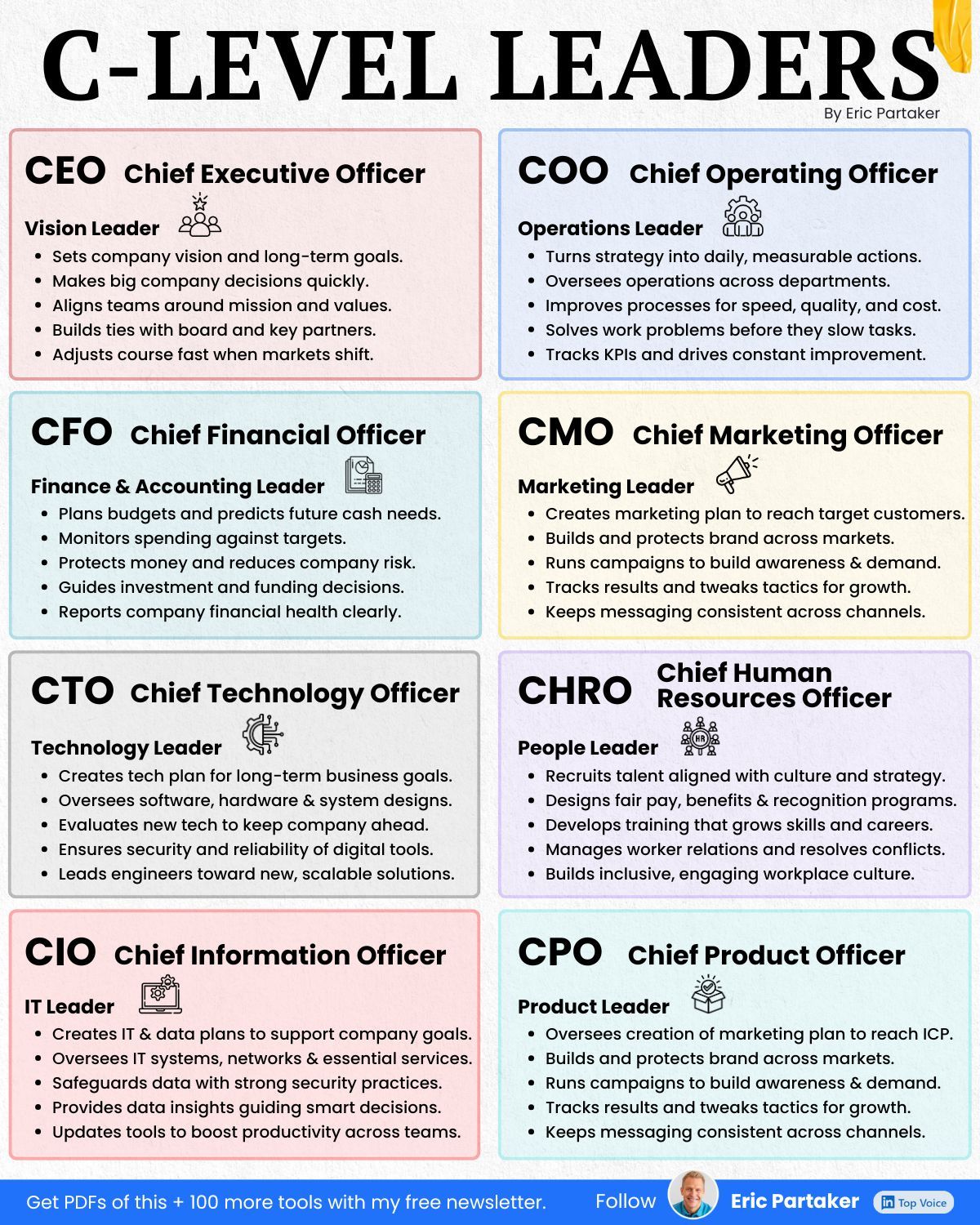
In a recent LinkedIn post, Eric Partaker, a seasoned entrepreneur with over two decades of experience, breaks down the core priorities and motivations of eight critical C-suite roles. His aim is to demystify these executive functions for founders and ambitious professionals alike, offering a roadmap to better understand internal dynamics and foster career advancement.
Partaker emphasizes that grasping these distinct perspectives is crucial for navigating the corporate landscape effectively. He states:
“Each C-level speaks a different language. Learn their language. Understand their pressure. That’s how you become indispensable.”
According to Partaker, this understanding can prevent costly errors for founders and provide a clear path for those looking to climb the corporate ladder. He outlines the primary concerns for each role, providing actionable advice on how to align one’s contributions with their objectives.
The CEO’s Focus: Vision and Survival
For the Chief Executive Officer (CEO), Partaker identifies the overarching concern as long-term survival. He advises professionals to demonstrate how their work contributes to the company’s overarching vision and big-picture strategy.
The COO’s Mandate: Execution and Order
The Chief Operating Officer (COO), described by Partaker as the “Execution Machine,” is focused on transforming chaos into structured operations. To impress a COO, Partaker suggests bringing solutions rather than merely identifying problems.
The CFO’s Lens: Financial Prudence
Partaker highlights that the Chief Financial Officer (CFO) operates with a constant focus on financial metrics. Professionals looking to gain a CFO’s attention should frame their discussions around Return on Investment (ROI), financial runway, and risk assessment, rather than emotional appeals.
“[The CFO] Thinks in: ROI, runway, and risk.”
The CMO’s Mission: Demand Generation
The Chief Marketing Officer (CMO), or “Story Architect” as Partaker terms them, is tasked with creating desire before a purchase occurs. Partaker notes that CMOs value insights that can be directly linked to revenue generation.
The CTO’s Role: Balancing Innovation and Stability
Partaker positions the Chief Technology Officer (CTO) as a “Future Builder” who must balance the drive for innovation with the need for operational stability. Success with a CTO, according to Partaker, comes from demonstrating how technology directly enables business objectives.
The CHRO’s Responsibility: Talent Retention
The Chief Human Resources Officer (CHRO) is framed as the “Culture Guardian,” whose primary responsibility is preventing valuable talent from leaving the organization. Partaker suggests that individuals who actively support and develop their colleagues are more likely to get noticed by the CHRO.
“[The CHRO’s] Real job: Prevent talent from leaving.”
The CIO’s Objective: Data-Driven Decisions
For the Chief Information Officer (CIO), Partaker identifies the goal as making information accessible at the speed of decision-making. A key career hack, he suggests, is illustrating how data directly influences and improves business decisions.
The CPO’s Priority: Customer Loyalty
Finally, Partaker discusses the Chief Product Officer (CPO) as the “Customer Champion,” whose key metric is customer retention over acquisition. His advice for advancing in this area is to consistently bring authentic customer voices and feedback into discussions.
Partaker concludes by reiterating the importance of understanding the unique pressures and communication styles of each C-suite executive. He believes that by learning to “speak their language,” individuals can significantly enhance their value and indispensability within an organization.
📝 About This Content
This article is based on insights shared by Eric Partaker on LinkedIn.
📅 Originally posted on August 14, 2026 | View original post on LinkedIn →