
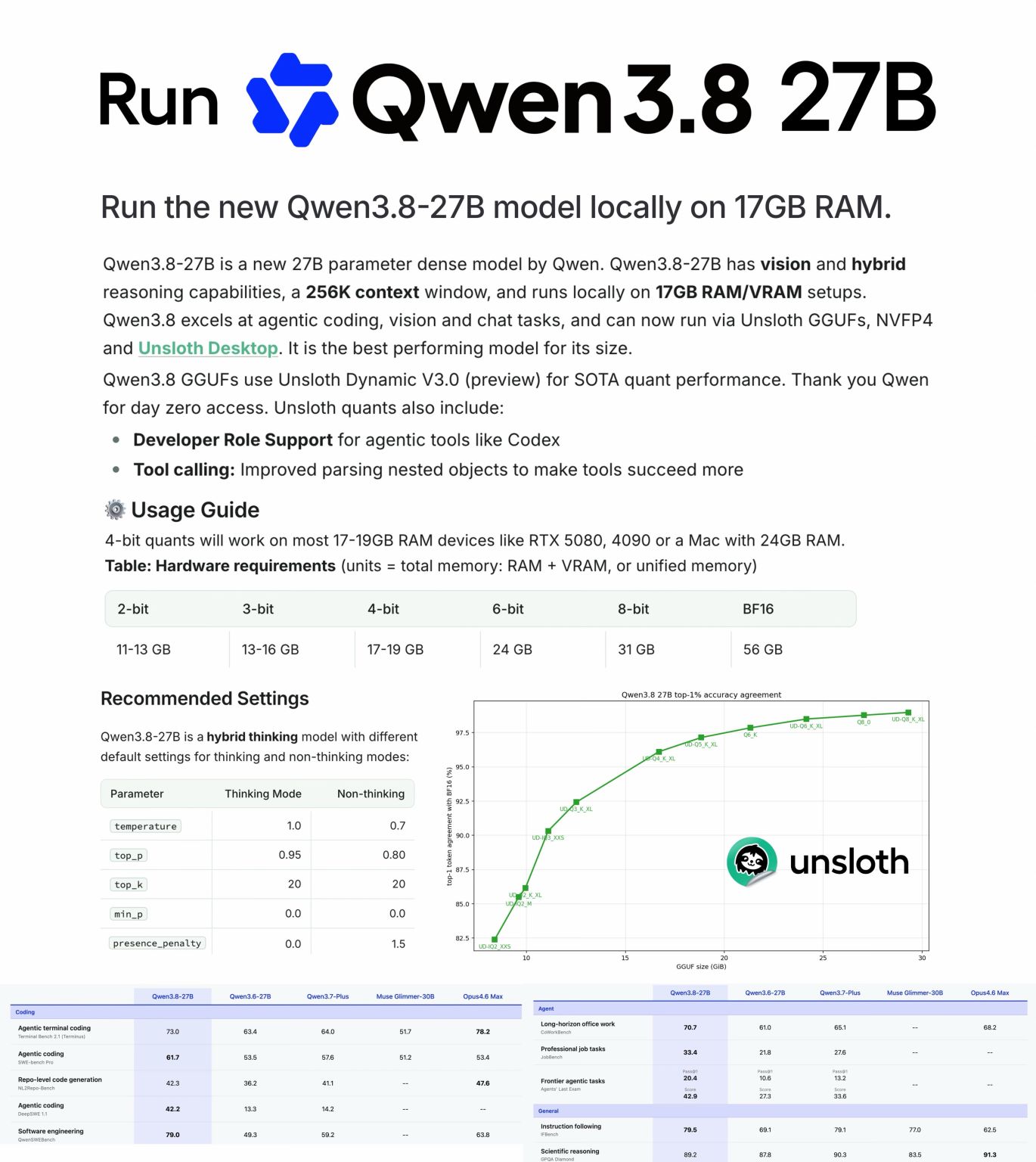
In a recent LinkedIn post, Linas Beliūnas highlights a significant shift in the artificial intelligence landscape, detailing how powerful multimodal AI models are becoming increasingly accessible and runnable on personal hardware. Beliūnas focuses on the new Qwen3.8-27B model from Alibaba, emphasizing its capabilities and the role of Unsloth AI in optimizing its performance for local execution.
Open-Source AI Challenges Cloud Dominance
Linas Beliūnas underscores the impressive advancements made by open-source AI, particularly with the Qwen3.8-27B model. This model, described as a dense native vision-language model, features hybrid attention, configurable reasoning, tool calling, and an extensive native context window, extendable to 1 million tokens. Beliūnas points out its performance benchmarks, stating it significantly outperforms previous Qwen models and even surpasses larger open-source models, as well as some closed-source competitors, in tasks like agentic coding, long-horizon office work, and multimodal applications.
“Qwen3.8-27B is matching Opus 4.6 Max… the model that was the best (and the most expensive) just 6 months ago.”
This comparison, as noted by Beliūnas, puts the open-source Qwen3.8-27B model on par with a previously top-tier, high-cost commercial model, signaling a rapid acceleration in the capabilities and accessibility of open-source alternatives.
The Rise of ‘Owned Infrastructure’ for AI
A key theme in Beliūnas’s analysis is the transition from relying on rented cloud infrastructure to utilizing ‘owned infrastructure’ for AI tasks. He argues that advancements in model optimization, such as Unsloth’s Dynamic GGUFs and NVFP4 quants, are making it feasible to run these powerful models on consumer-grade hardware.
Optimizing for Local Execution
Beliūnas details the memory requirements and how Unsloth’s optimizations make a difference:
- The full BF16 version requires approximately 56GB of memory.
- However, 4-bit versions optimized by Unsloth can run on as little as 17-19GB of total memory.
- Lower-bit options further reduce this to 11-13GB.
- These optimized versions maintain high accuracy and offer day-zero desktop app support for both inference and training.
- Practical implementation is achievable on high-end consumer GPUs like RTX 4090/5080 class cards or Macs with 24GB+ unified memory.
According to Linas Beliūnas, this optimization is crucial for enabling local AI execution. He emphasizes the benefits:
“Your code does not need to leave your machine. Your documents and screen data do not need to hit someone else’s cloud. Your agent does not need to stop because an API bill, rate limit, or policy changed overnight.”
Beliūnas acknowledges that this level of AI capability is not yet for every standard laptop but stresses that the trend is undeniable. He posits that AI is bifurcating into two distinct ecosystems:
- Cloud AI for large-scale operations.
- Local AI for enhanced control and privacy.
Control as a Core Product Feature
For professionals working with sensitive data, such as founders, engineers, and researchers, Beliūnas argues that control over AI operations is paramount. In his view:
“For founders, engineers, researchers, and anyone working with sensitive data, control is not a feature. It is the whole product.”
This perspective highlights the increasing importance of data privacy, security, and operational autonomy as sophisticated AI tools become more decentralized. Linas Beliūnas concludes that the continuous improvement of open-source AI, coupled with practical local deployment options, is fundamentally reshaping how individuals and organizations can leverage artificial intelligence.
📝 About This Content
This article is based on insights shared by Linas Beliūnas on LinkedIn.
📅 Originally posted on August 15, 2026 | View original post on LinkedIn →