
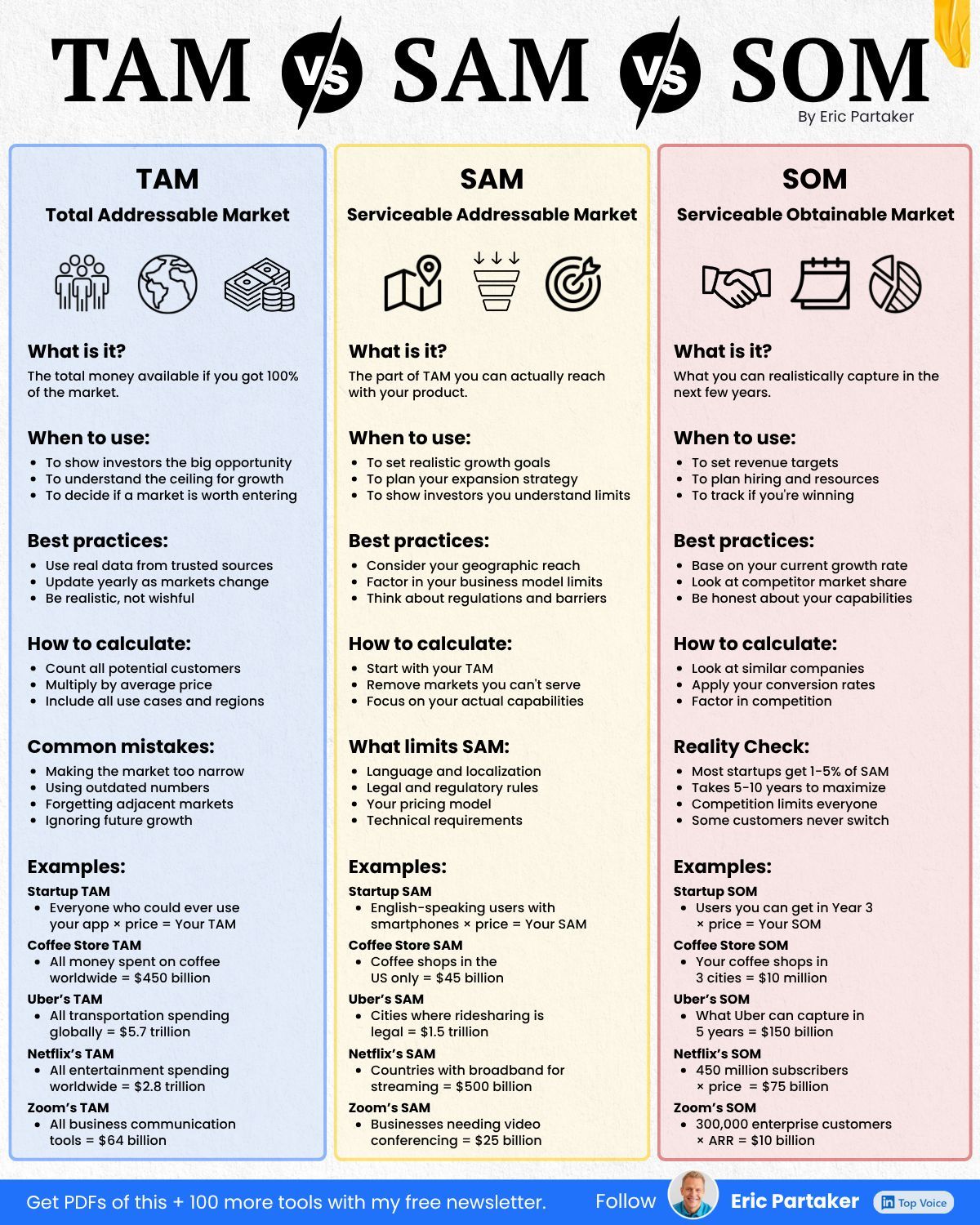
In a recent LinkedIn post, Eric Partaker offers a practical breakdown of Total Addressable Market (TAM), Serviceable Available Market (SAM), and Serviceable Obtainable Market (SOM), emphasizing their critical importance for startups seeking to define realistic goals and attract investment.
Partaker frames these concepts with a clear analogy: TAM is everyone on Earth who could buy pizza, SAM is people in cities where pizza can be delivered, and SOM is the number of houses the business can actually reach within a given year. He stresses that understanding these distinctions is not just an academic exercise but a fundamental requirement for building a viable business.
“Your “billion-dollar idea” might be worth millions. (Or just thousands.)”
The Crucial Distinction Between Market Sizes
The founder and CEO of the Founder & CEO Accelerator uses real-world examples to illustrate the dramatic differences between TAM, SAM, and SOM. For instance, he highlights Uber’s journey, stating its TAM is $5.7 trillion (all transportation), its SAM is $1.5 trillion (legal rideshare cities), and its SOM was initially targeted at $150 billion within a 5-year plan. Similarly, Netflix’s TAM is pegged at $2.8 trillion (all entertainment), SAM at $500 billion (streaming-ready countries), and SOM at $75 billion (aiming for 450 million subscribers).
Partaker points out a consistent pattern across these successful companies: each subsequent market size gets smaller, more realistic, and more achievable. This progression, he argues, is key to strategic planning and execution.
Why Investors Demand These Numbers
According to Partaker, investors require all three figures because they paint a comprehensive picture of a startup’s potential and its grounding in reality. “Investors need all three numbers,” he writes, elaborating that TAM illustrates the grand vision, SAM demonstrates market feasibility, and SOM proves the ability to execute.
Common Pitfalls to Avoid
Partaker warns against several common mistakes that can derail startups. These include using TAM for revenue projections, neglecting competition when defining SOM, setting an unrealistically large SAM, and overlooking regulatory hurdles. He emphasizes that these errors stem from a misunderstanding or misapplication of market sizing principles.
“Most startups capture 1-5% of SAM. It takes 5-10 years. Competition limits everyone. Some customers never switch.”
He further elaborates on the harsh realities, noting that typically, startups capture only a small fraction of their SAM, that market penetration takes years, and that competition and customer inertia are significant factors. “But here’s the secret,” Partaker reveals, “Knowing your real SOM is a superpower.”
SOM as a Strategic Superpower
Partaker argues that a well-defined SOM is instrumental for setting honest goals, securing appropriate funding, hiring the right talent, and choosing the optimal business strategy. He advocates for starting with SOM and working backward, rather than inflating TAM and trying to fit the business into an unachievable market.
“Stop chasing someone else’s TAM. Start building your SOM.”
In conclusion, Eric Partaker’s insights on LinkedIn underscore the importance of rigorous market analysis. By focusing on a realistic and achievable SOM, founders can build more sustainable and impactful businesses, whether they aim for a $10 million enterprise that changes lives or a $100 million venture that creates lasting legacies.
📝 About This Content
This article is based on insights shared by Eric Partaker on LinkedIn.
📅 Originally posted on August 17, 2026 | View original post on LinkedIn →