
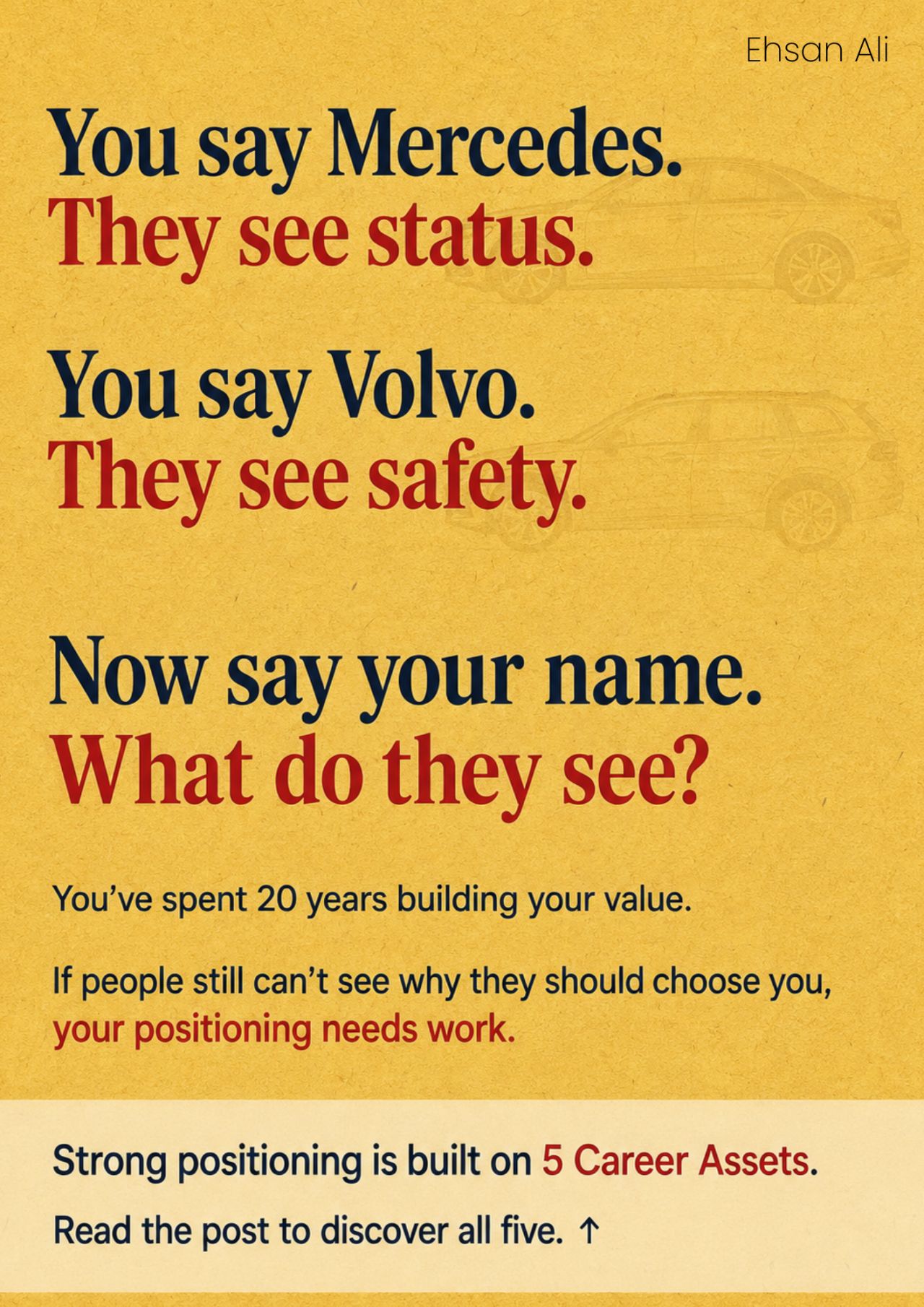
In a recent LinkedIn post, Ehsan Ali explores a common challenge faced by seasoned technology professionals: the difficulty in clearly articulating their value and personal brand to the external market, despite extensive experience. Ali uses the analogy of car brands to illustrate his point, noting how established manufacturers own specific attributes in the consumer’s mind.
“Say status. You see Mercedes. Say safety. You see Volvo. Now say your name. What do people see? For many senior tech pros, even after 20 years, the answer is unclear,” Ali writes.
The post highlights a disconnect between internal recognition and external perception. While colleagues within a company may understand a senior professional’s capabilities, Ali argues that this understanding rarely translates outside the organization’s walls. This lack of external clarity, he suggests, can hinder career advancement and opportunities.
The “Why Not Me?” Problem for Senior Tech Talent
Ali points out that many senior tech professionals, even those with over two decades of experience, often rely on describing their past roles, technical skills, and responsibilities rather than demonstrating tangible business impact. This descriptive approach, he contends, fails to provide a compelling reason for a potential employer to choose them.
“Companies want to see: Revenue created, Money saved, Risk reduced, Change led,” Ali states, contrasting this with the typical self-description of senior professionals. He elaborates that different companies will prioritize different aspects of a candidate’s experience. For instance, a bank might value risk management expertise, while a scaling startup could be more interested in a candidate’s ability to build teams and drive growth.
Defining the Five Career Assets
To address this positioning gap, Ehsan Ali outlines what he terms the “5 Career Assets” that senior professionals should focus on cultivating and communicating:
- CLEAR DIRECTION: Defining specific roles, career levels, desired compensation, and target companies.
- PROOF OF VALUE: Providing concrete evidence of business outcomes achieved.
- A STRONG CAREER STORY: Crafting a narrative that offers a clear and compelling reason for a company to hire them.
- STRATEGIC RELATIONSHIPS: Building connections with the right people who recognize and can advocate for their value.
- AN ACTIVE OPPORTUNITY PIPELINE: Maintaining ongoing conversations and awareness of potential roles before actively seeking a new position.
Ali emphasizes that these assets are crucial for making a candidate’s value proposition easily understandable and attractive to potential employers. He argues that a candidate with less experience but a clearer demonstration of value can often be more successful in securing a role.
Making Experience Easier to Choose
The core message of Ali’s post is a call to action for senior tech leaders to actively manage their personal brand and career narrative. He suggests that while building a career takes years, making that career’s value evident and easy for others to choose is an equally important, yet often overlooked, skill.
“You spent 20 years building yours. Now make it easier to choose,” Ali concludes, urging professionals to translate their extensive experience into a clear, compelling, and easily digestible value proposition for the market.
📝 About This Content
This article is based on insights shared by Ehsan Ali on LinkedIn.
📅 Originally posted on September 4, 2026 | View original post on LinkedIn →