
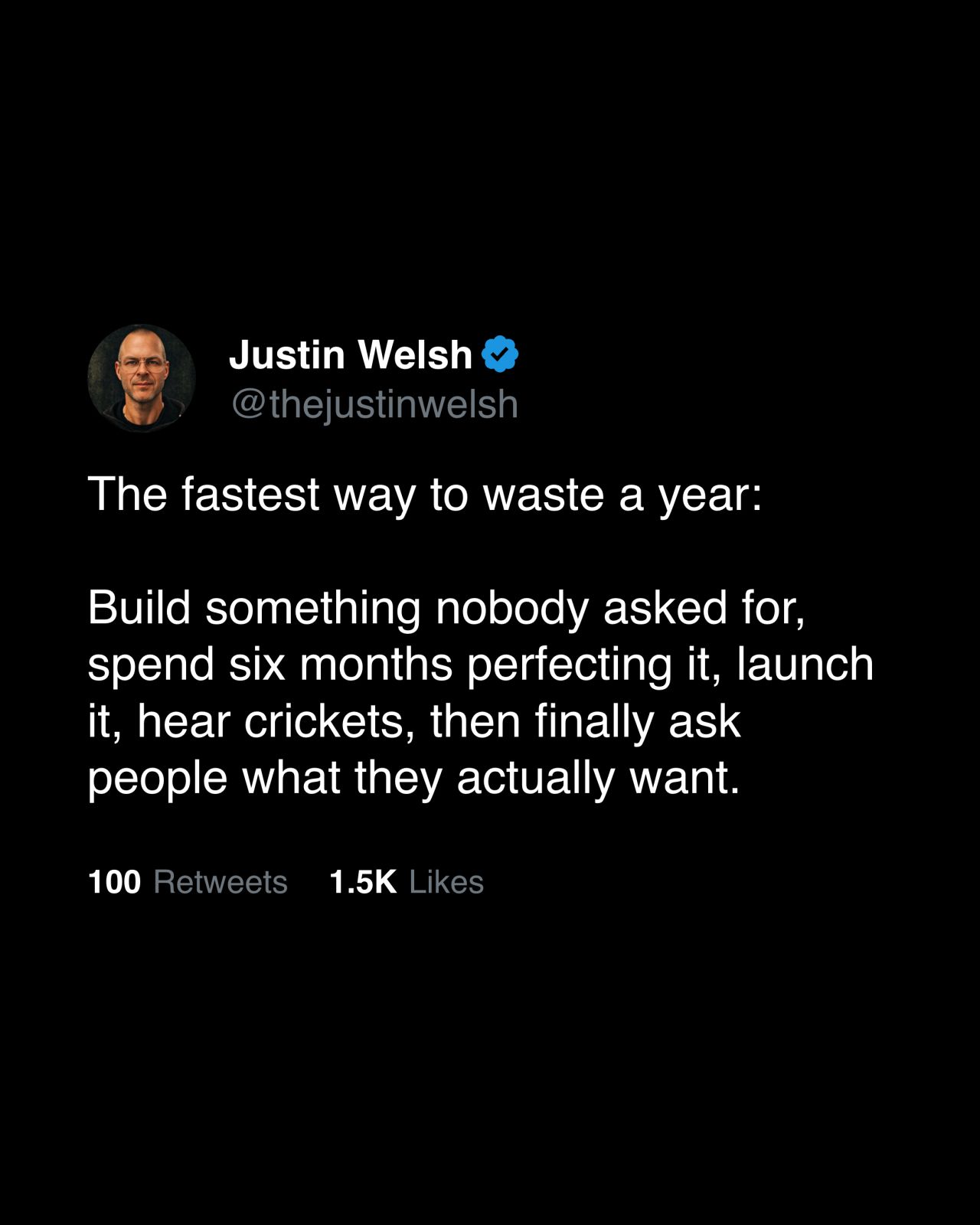
In a recent LinkedIn post, Justin Welsh discusses a critical pitfall for aspiring entrepreneurs: the tendency to spend excessive time building products that lack market demand. Welsh, who has extensive experience building a one-person business to $15 million, argues that excitement about an idea can be a dangerous precursor to wasted effort.
According to Welsh, the core of customer interest lies not in the novelty of the idea, but in its ability to solve a problem effectively and at a justifiable cost. He emphasizes that the customer’s perspective is paramount.
“All they care about is whether your solution solves their problem at an appropriate price. That’s it.”
This perspective leads Welsh to advocate strongly against the common practice of extensive product development before any market validation has occurred.
The Perils of Building Without Validation
Welsh contends that entrepreneurs often fall into the trap of assuming their idea’s obviousness to them translates to customer interest. This can lead to months of development on a product that ultimately fails to gain traction. He points out that the belief an idea is self-evidently good is a common, yet flawed, assumption.
“Just because the idea feels obvious to you doesn’t mean the customer will care.”
He advocates for a more iterative and conversation-driven approach in the early stages. Instead of dedicating significant time to building behind the scenes, Welsh suggests prioritizing direct interaction with potential customers and creating minimal viable versions of the product.
Prioritizing Conversations and Early Revenue
The entrepreneur highlights that real-world feedback from paying customers is an invaluable learning tool, far surpassing hours spent on unvalidated development. He champions a methodology of rapid, low-cost experimentation.
The Value of Quick, Dirty, and Cheap Experimentation
Welsh’s experience, particularly in building his own successful one-person business, has taught him the power of this approach. He outlines a clear strategy for early-stage ventures:
- Test cheaply.
- Learn quickly.
- Double down when the evidence is there.
This methodology, he notes, is one of the seven most crucial skills for individuals starting out. Welsh also offers further insights in a free 30-page guide designed for entrepreneurs, compressing extensive research and experience into a digestible format.
📝 About This Content
This article is based on insights shared by Justin Welsh on LinkedIn.
📅 Originally posted on September 6, 2026 | View original post on LinkedIn →