
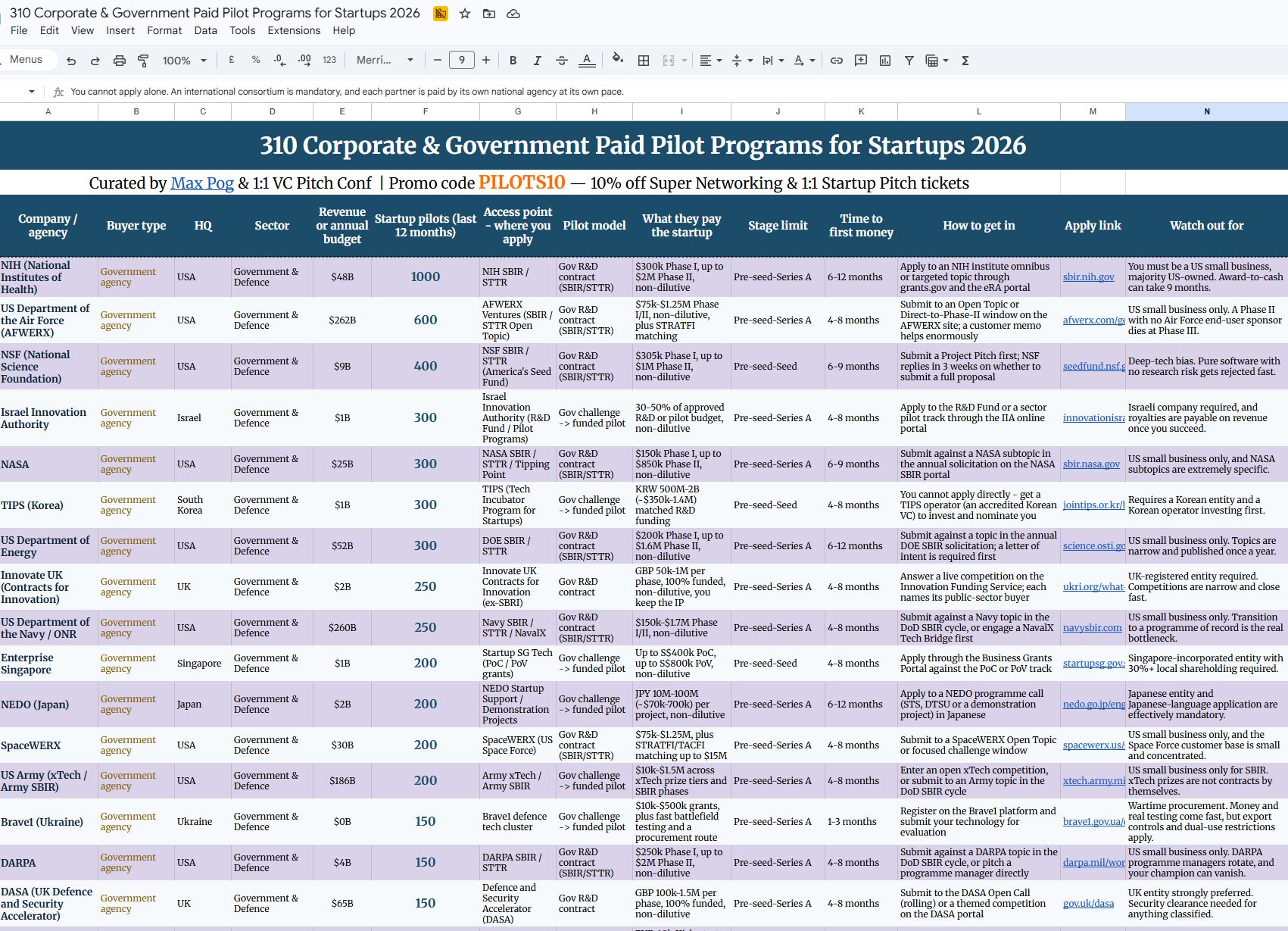
In a recent LinkedIn post, Max Pog shares a comprehensive analysis of corporate and government-backed pilot programs, offering startups a data-driven approach to securing crucial early-stage funding and traction. Pog has compiled and ranked 310 such programs based on the number of startup pilots they have facilitated in the past year, with funding ranging from $25,000 to $5 million.
The core of Pog’s insight lies in providing actionable intelligence for founders and venture capitalists. He highlights the importance of demonstrable traction, noting that investors spend significantly more time scrutinizing these slides in pitches that ultimately fail to secure funding. As Pog states:
Founders & VCs! We ranked 310 corporate and government paid pilot programs (from $25K to $5M) by how many startup pilots each one ran in the last 12 months. Upload this list into your AI to find the top-20 programs that fit your startup.
The Value of Early-Stage Funding and Proof-of-Concept
Pog underscores the significant impact that even modest early funding can have on a startup’s trajectory. He references research from Howell (American Economic Review, 2017) which indicates that an early $150,000 proof-of-concept award can roughly double a startup’s chances of securing venture capital later on. This emphasis on early validation aligns with findings from DocSend, which observed investors dedicating 2.1 times more attention to traction slides in unsuccessful funding rounds, specifically seeking evidence of revenue.
According to Max Pog:
DocSend found investors spent 2.1x as much time on the traction slides of decks that failed to raise. They were looking for revenue and not finding it.
Inside the Pilot Program Database
The free database compiled by Pog offers a wealth of detail for startups looking to navigate the complex landscape of pilot programs. It includes:
- Information on 265 corporations and 45 government programs.
- The number of startup pilots each program has run in the last 12 months.
- Actual payment ranges, from $25,000 to $5 million per pilot.
- Details on the pilot model, such as venture client (paid PoC, no equity), challenge grants, supplier trials, or SBIR/OTA contracts.
- The typical time from application to receiving initial funds.
- Stage limitations to ensure pre-seed startups know if they qualify.
- Critical considerations, like understanding who actually pays (e.g., not Visa directly, but issuing banks) and the specific structure of large organizations (e.g., LVMH’s 75 Maisons).
- Coverage across 28 sectors, from AI and finance to healthcare and hospitality.
- Direct application links.
- A secondary tab detailing 17 co-sell programs from major tech players like AWS, SAP, Salesforce, and ServiceNow.
Pog also provides practical advice, cautioning founders about potential pitfalls within these programs. For instance, he points out that the paying entity might not always be the most obvious one, and understanding the internal structure of large corporations is key to successful engagement.
Access and Community Engagement
Max Pog is offering free access to this valuable database. He invites interested individuals to comment on his LinkedIn post to request access. Furthermore, he is incentivizing community sharing by offering a chance to win a business book to those who repost his announcement within 72 hours, fostering broader dissemination of this critical information within the startup ecosystem.
As Pog concludes his post:
👉 Let me know in the comments if you’d like free access.
This initiative by Max Pog provides a much-needed, data-backed resource for founders seeking to gain traction and funding through corporate and government pilot programs, simplifying a process often characterized by opacity and complexity.
📝 About This Content
This article is based on insights shared by Max Pog on LinkedIn.
📅 Originally posted on September 7, 2026 | View original post on LinkedIn →