
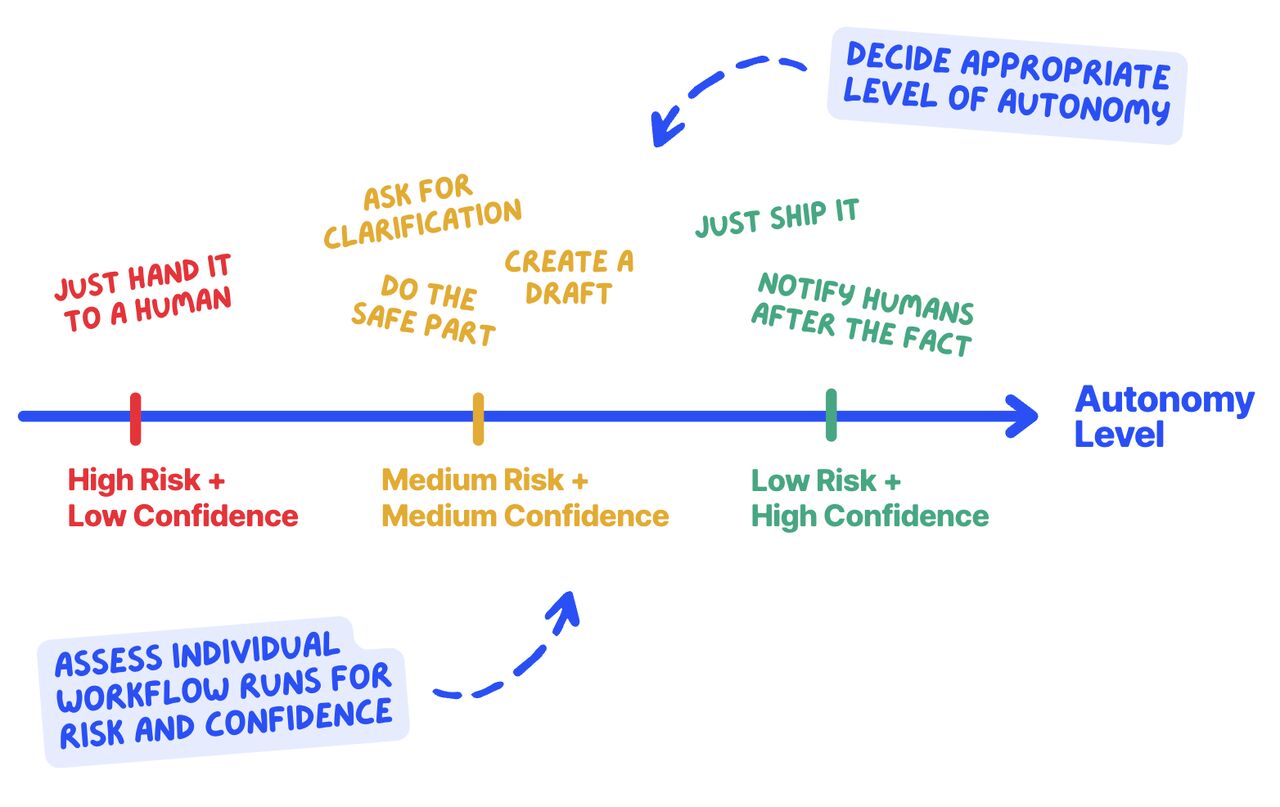
In a recent LinkedIn post, 🌀 Luca Rossi explores a nuanced approach to AI workflow management, challenging the conventional understanding of the “autonomy slider.” Rossi proposes a dynamic system where the level of AI autonomy is not fixed but adjusts based on real-time risk and confidence scores.
Rossi introduces the core concept, stating:
“For any given process, you should design how much leeway to give to the AI vs how much humans should intervene (and when, and where).”
This foundational idea sets the stage for a more sophisticated model than a static, one-size-fits-all approach to human-AI collaboration.
The Limitations of Static Autonomy
Traditionally, AI workflows have operated on a spectrum of autonomy, often involving “humans-in-the-loop” to interrupt or guide AI processes. However, Rossi points out the inherent difficulties in hard-coding human intervention points into dynamic workflows.
According to 🌀 Luca Rossi, this static approach leads to a critical dilemma:
“You constantly risk having either: Safe work unnecessarily waiting in queue, or Risky work getting through when it should have been stopped and inspected first”
This highlights the challenge of balancing efficiency with necessary oversight in complex operational environments.
Introducing Dynamic Autonomy Scores
Drawing insights from the team at Unblocked, Rossi advocates for a dynamic autonomy slider. This system scores each run based on risk and confidence, using these scores to dictate the AI’s autonomy and the necessity of human involvement at that specific moment.
🌀 Luca Rossi explains this adaptive mechanism:
“Such a score guides how much autonomy the agent gets at that time, and where a human has to step in.”
This flexible concept, Rossi suggests, is applicable across a range of critical business processes.
Applications in Code Shipping and Incident Management
Rossi illustrates the application of this dynamic model with examples such as shipping code, intercepting incidents, and processing bug reports. For instance, when a bug report is generated, the AI assesses two key questions: the confidence in the job being real and the AI’s capability to handle it, and the potential risk associated with the task.
Based on these evaluations, the AI determines the next action:
- High risk, low confidence: A ticket is created, and the task is handed over to a human.
- Moderate risk/confidence (50-70%): A team member is alerted via Slack, provided with the context, and can offer further guidance.
- Low risk, high confidence: The AI proceeds to write the code directly and opens a pull request (PR).
This same principle is applied to PRs, where low-risk changes can be automated, while high-risk ones trigger human review. 🌀 Luca Rossi emphasizes that this dynamic approach allows for greater agility and precision in managing AI-driven workflows, preventing both unnecessary delays and the bypassing of critical safety checks.
📝 About This Content
This article is based on insights shared by 🌀 Luca Rossi on LinkedIn.
📅 Originally posted on September 7, 2026 | View original post on LinkedIn →