
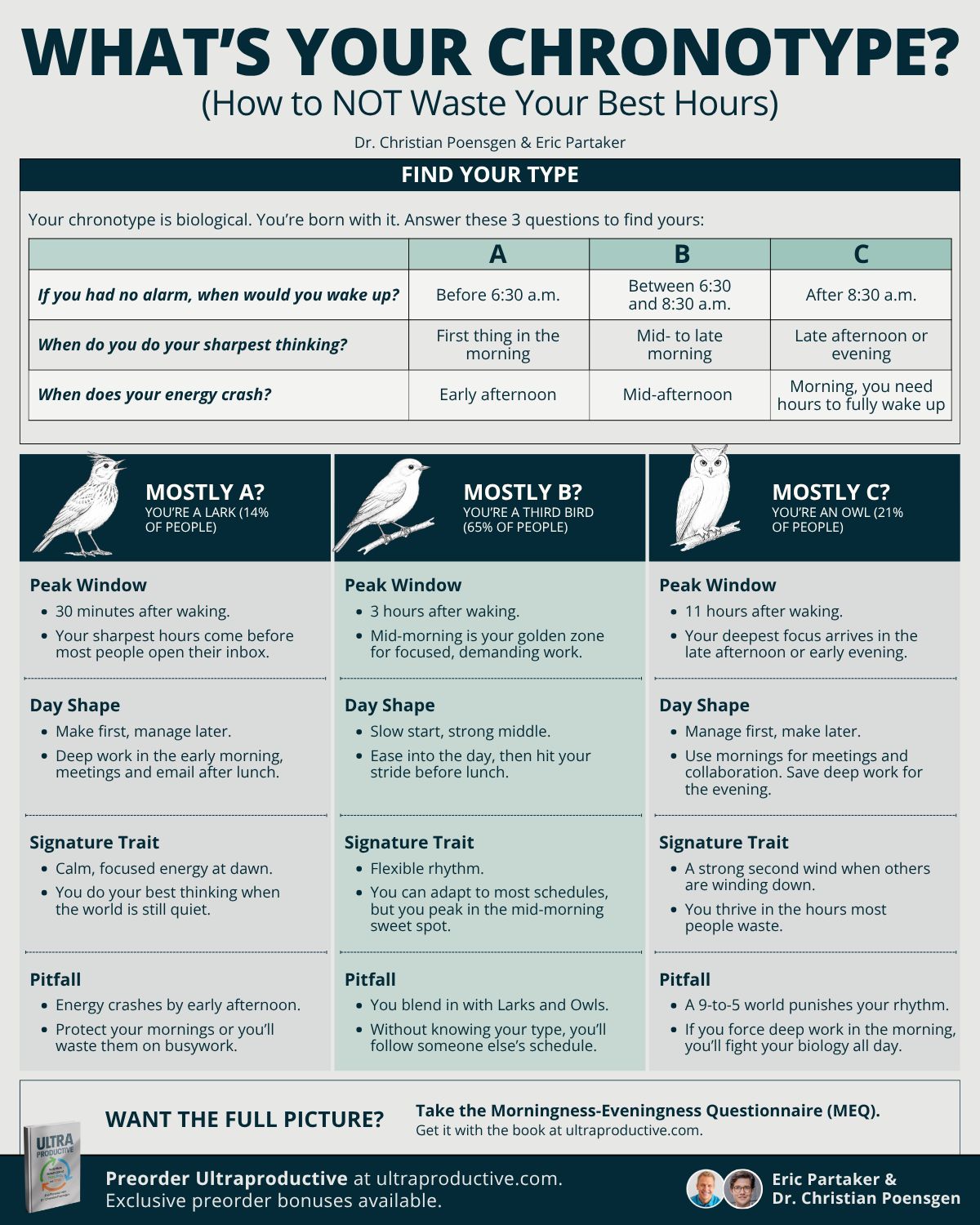
In a recent LinkedIn post, Eric Partaker sheds light on the concept of chronotypes and how understanding one’s natural biological rhythm can significantly impact productivity. Partaker, co-author of the upcoming book “Ultraproductive,” challenges the conventional notion of “discipline” for hard tasks, suggesting that many individuals may be scheduling their most demanding work at suboptimal times.
Partaker introduces the idea that individuals fall into one of three chronotypes: Larks, Third Birds, or Owls. He emphasizes that this is not a matter of willpower but a fundamental biological predisposition.
“Turns out you’re born one of three types: A Lark, a Third Bird, or an Owl.”
According to Partaker, each chronotype possesses a distinct peak window for deep focus, and a lack of awareness about these natural cycles can lead to perceived concentration problems.
Understanding the Three Chronotypes
Partaker breaks down the characteristics of each chronotype, providing specific insights into their peak performance times:
Larks
For the approximately 14% of the population who are Larks, their peak focus hits about 30 minutes after waking. Partaker notes that this means their most productive hours often occur before many others even begin their workday.
Third Birds
The largest group, comprising about 65% of people, are Third Birds. Partaker explains that their peak focus arrives roughly three hours after waking, making mid-morning their prime time for engaging in demanding tasks.
“Mid-morning is your golden zone for demanding work.”
Owls
Representing about 21% of the population, Owls experience their deepest focus much later in the day, with their peak hitting 11 hours after waking. Partaker highlights that their most intense concentration periods may fall in the late afternoon or evening.
The Impact of Scheduling Mismatches
Partaker argues that a common pitfall for many professionals is the misalignment of their work schedule with their natural chronotype. This mismatch can lead to frustration and a feeling of inadequacy, even when applying what is perceived as discipline.
“If you feel like you can never concentrate, it might not be a focus problem. You might just be scheduling your hardest work at your worst time.”
He posits that by identifying one’s chronotype and adjusting task scheduling accordingly, individuals can achieve greater output without necessarily working longer hours.
Identifying Your Chronotype
To help individuals pinpoint their specific chronotype, Partaker recommends the Morningness-Eveningness Questionnaire, developed by Horne and Östberg in 1976. He describes it as the enduring standard for chronotype assessment.
“Match your peak window to your most important tasks. The hours stay the same. The output changes.”
Partaker mentions that this questionnaire takes about 10 minutes to complete and is available as a bonus for those who preorder his new book, “Ultraproductive,” at ultraproductive.com. He also highlights additional preorder bonuses, including a chance to work with him.
By understanding and working with their inherent biological rhythms, Partaker suggests that individuals can unlock higher levels of productivity and focus.
📝 About This Content
This article is based on insights shared by Eric Partaker on LinkedIn.
📅 Originally posted on September 8, 2026 | View original post on LinkedIn →