
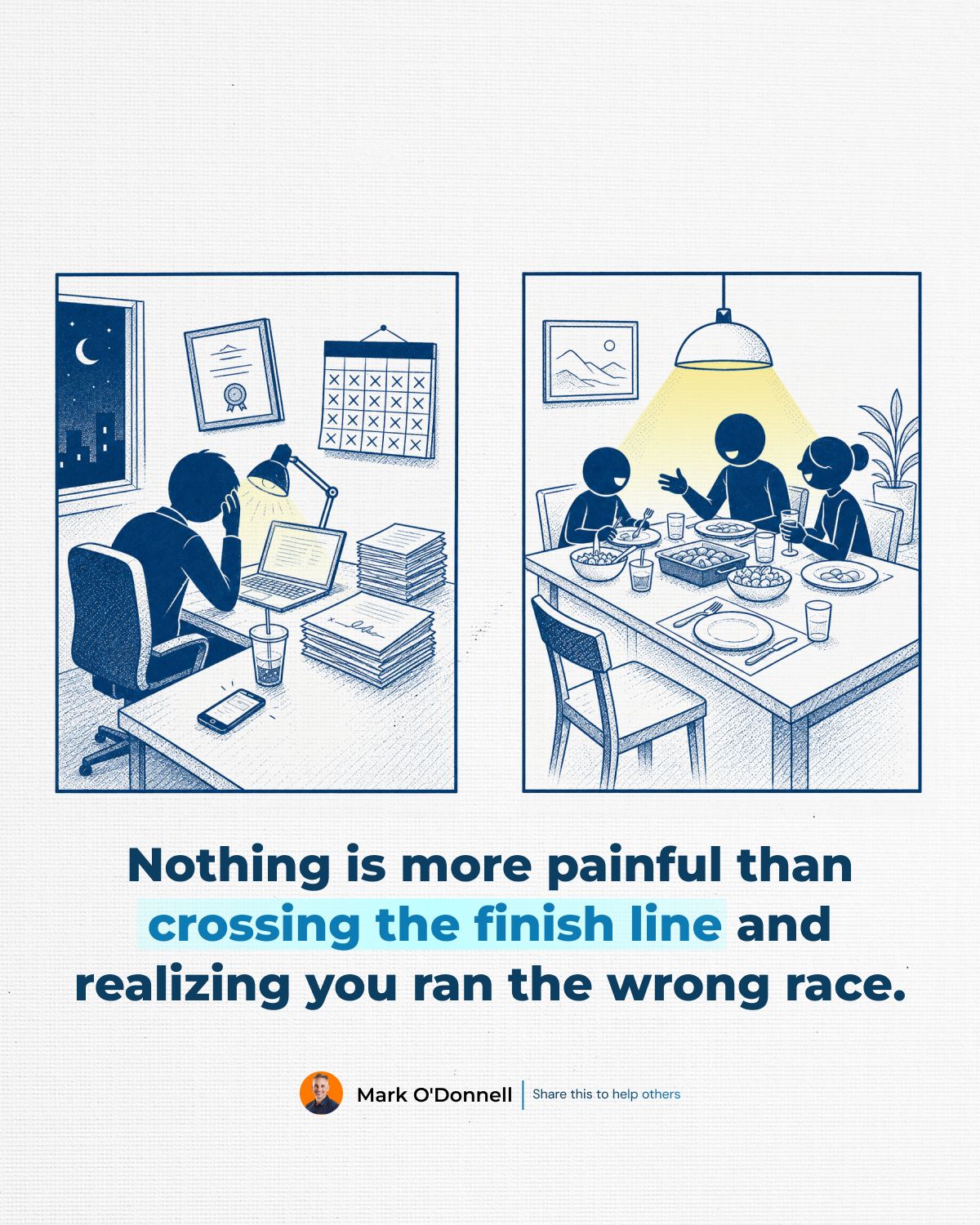
In a recent LinkedIn post, Mark O’Donnell discusses the often-unseen consequences of building a successful service-based business that relies entirely on the founder’s personal time and effort. O’Donnell highlights how seemingly small, reasonable decisions made consistently over time can lead to significant personal and familial sacrifices.
He illustrates this point with a powerful visual metaphor: two rooms representing the same evening. On one side, a business owner is at their desk late at night, handling administrative tasks for a thriving practice. On the other, their family is midway through dinner, with an empty chair at the table.
“Nobody sits down and decides to miss ten years of dinners. It just adds up, one perfectly reasonable Tuesday at a time.”
O’Donnell is careful to frame this not as a story of failure, but as a consequence of a business model that, while successful and respected, is fundamentally dependent on the owner’s constant presence. As he explains, the business “just only works when he’s in the room.” This model, he argues, limits growth to simply acquiring more clients, conducting more sessions, traveling more, and enduring more evenings like the one depicted.
The Math of Solopreneurship
According to Mark O’Donnell, the core issue for many successful solopreneurs is the inherent mathematical limitation of trading time for money. “If you’re selling your own hours to one client at a time, every bit of income you make needs you sitting there in person,” O’Donnell writes. He contends that no amount of calendar protection can overcome this fundamental constraint; growth in this model inevitably leads to more of the owner’s time being consumed.
“You can protect your calendar all you want, but you’re arguing with the math.”
The true cost, as O’Donnell points out, isn’t a single missed dinner but the cumulative effect over years. “It’s that nobody ever adds them up, and then one day it’s been ten years and that’s just how your family works now.” This gradual erosion of personal time, he suggests, is often overlooked until it becomes a deeply ingrained reality.
Shifting the Business Structure
O’Donnell clarifies that the solution is not simply to work fewer hours, but to fundamentally change the underlying structure of the business. “You do not fix this by working fewer hours. You have to change what’s sitting underneath,” he asserts.
He advocates for building a business that can operate independently of the owner’s constant, direct involvement. “You need something that can keep running when you’re not standing in the middle of it,” O’Donnell explains. He presents the path of becoming an EOS (Entrepreneurial Operating System) Implementer as one viable method for achieving this structural shift.
The EOS Implementer Model
Mark O’Donnell suggests that the EOS Implementer framework offers a structured approach for service professionals to scale their impact without replicating the solopreneur trap. He highlights the benefits of a “proven process” that is “already written down” and supported by a community of peers. This allows implementers to focus on adding clients rather than constantly redesigning their service delivery model.
“It’s the same work you’re already good at, with a very different structure holding it up.”
In essence, O’Donnell’s post serves as a call to action for business owners who find themselves trapped by their own success, urging them to consider structural changes that allow for both professional growth and personal well-being. He and Kelly Knight are hosting a free session to discuss this further on the 15th.
📝 About This Content
This article is based on insights shared by Mark O'Donnell on LinkedIn.
📅 Originally posted on September 11, 2026 | View original post on LinkedIn →