
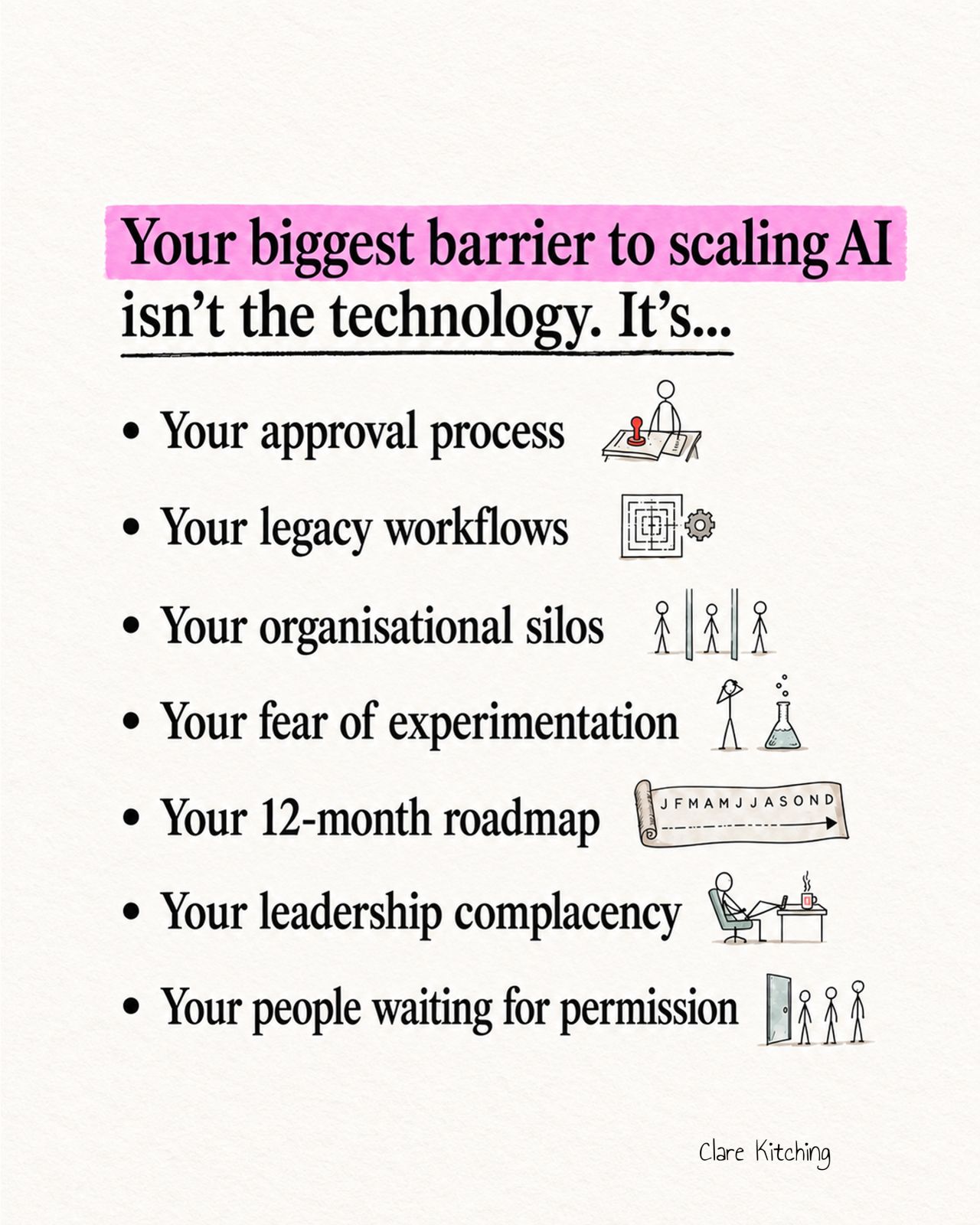
In a recent LinkedIn post, Clare Kitching discusses the primary obstacles preventing businesses from effectively scaling Artificial Intelligence initiatives. Contrary to common assumptions that technological limitations or tool availability are the main culprits, Kitching argues that internal organizational structures and processes are the true barriers.
Kitching highlights that many teams are waiting for external factors, such as superior tools or the perfect hire, to enable their AI adoption. However, she posits that the technology itself is often sufficiently advanced for many use cases. The real challenge, according to Kitching, lies within the organization’s own established systems and culture.
“The models are already good enough. The organisation is usually the constraint.”
Kitching then outlines seven specific organizational roadblocks and offers actionable advice for dismantling them. She emphasizes that simply bolting AI onto existing, inefficient workflows will not yield the desired results.
Redesigning Workflows Before Automation
One of Kitching’s key points is the necessity of addressing legacy workflows. She warns that automating broken processes only accelerates the creation of a mess. Instead, businesses should focus on redesigning their workflows first and then implementing AI to automate the optimized new process.
As Kitching explains:
“AI bolted onto a broken process speeds up the mess. Redesign the workflow first, then automate the new version.”
Overcoming Silos and Fostering Experimentation
Organizational silos are identified as another significant impediment. Kitching notes that the most valuable AI use cases often span multiple departments, leading to a lack of ownership. Her proposed solution is to establish a cross-functional team with a shared objective.
Furthermore, Kitching addresses the fear of experimentation, advocating for a structured approach that limits potential downsides. This includes setting small budgets, conducting short pilots, and defining clear criteria for discontinuing projects. She stresses the importance of learning from pilots, even those that are terminated.
Addressing Leadership and Employee Inertia
Kitching also points to leadership complacency and employees waiting for permission as critical issues. She argues that leaders must visibly use AI tools themselves to encourage adoption among their teams. Regarding employees who hesitate to use AI, Kitching suggests that a lack of explicit permission can be interpreted as a prohibition. To counter this, she recommends publishing a clear, concise list of approved AI tools and their appropriate uses.
The Role of Agile Roadmapping
In her post, Kitching challenges the efficacy of long-term, fixed AI roadmaps. Given the rapid pace of technological advancement, she advises planning in shorter, 90-day blocks. This agile approach allows for regular reprioritization and adaptation to the evolving AI landscape.
According to Kitching:
“The technology shifts every quarter. A fixed annual plan gets stale. Plan in 90-day blocks and re-prioritise at each one.”
In conclusion, Clare Kitching’s analysis underscores that successful AI scaling is less about acquiring the latest technology and more about cultivating an adaptable, streamlined, and experimental organizational environment. She asserts that companies achieving rapid AI adoption often possess the same technology as their slower counterparts but have succeeded in removing more internal hurdles.
📝 About This Content
This article is based on insights shared by Clare Kitching on LinkedIn.
📅 Originally posted on September 12, 2026 | View original post on LinkedIn →