
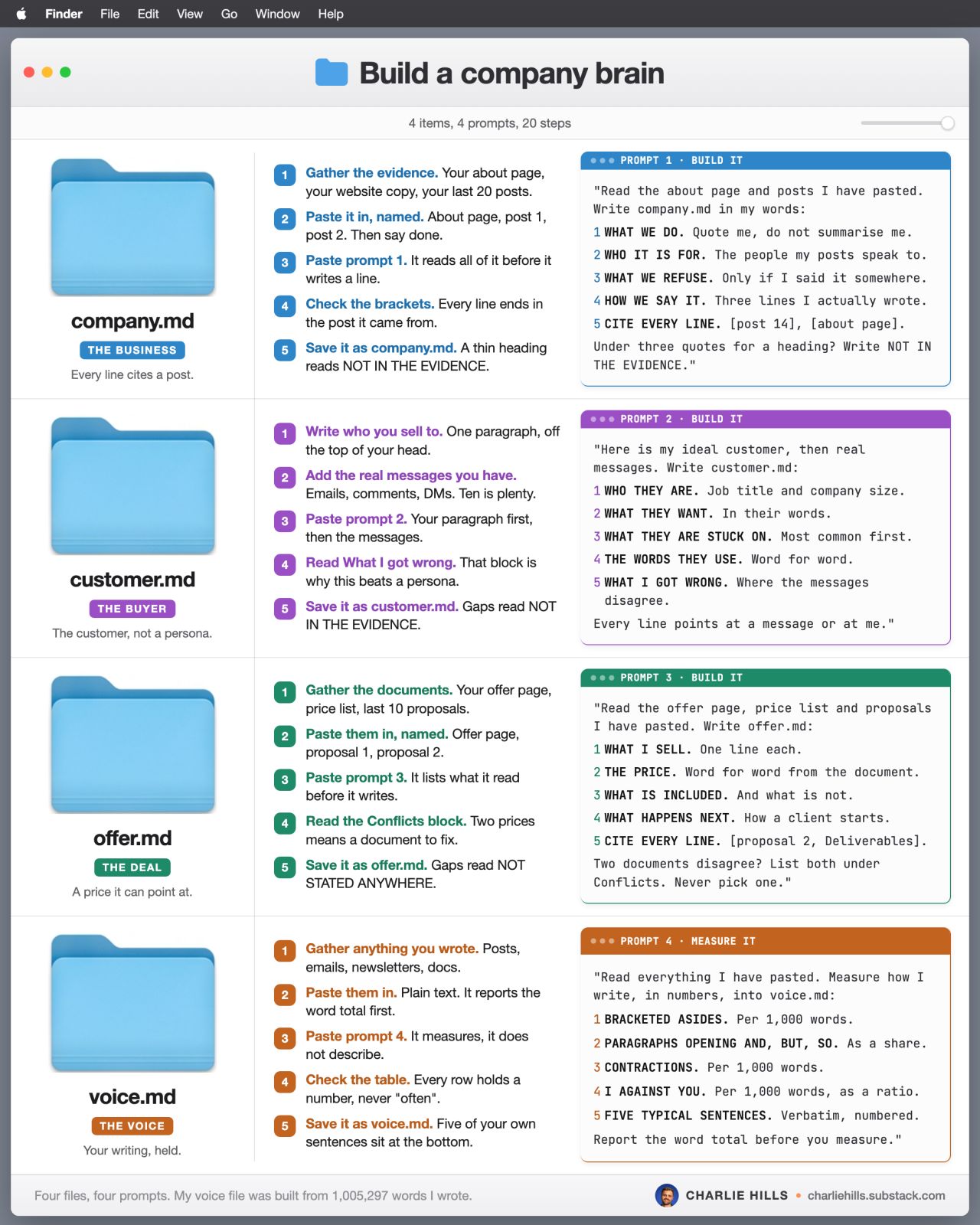
In a recent LinkedIn post, Charlie Hills 🦩 discusses a critical challenge facing businesses leveraging artificial intelligence: the risk of AI “guessing” about the company’s true nature. Hills 🦩 proposes a practical, file-based system to provide AI with concrete evidence, thereby grounding its understanding in factual business operations.
The Problem of AI Guesswork
Hills 🦩 highlights that without proper grounding, AI models can operate on assumptions rather than reality. This can lead to AI-generated content or strategies that are misaligned with the actual business. The core issue, according to Hills 🦩, is the lack of direct, verifiable input fed into the AI systems.
“Your AI is guessing what your business is.”
This statement underscores the potential disconnect between AI capabilities and business actuality. Hills 🦩 argues that this guesswork can be detrimental, leading to inefficiencies and misdirected efforts.
A Four-File Solution for AI Grounding
To combat this, Charlie Hills 🦩 outlines a structured approach involving four key files that serve as the “evidence” for the AI. This method aims to replace conjecture with concrete data.
1. customer.md: Defining the Real Buyer
Hills 🦩 emphasizes the importance of defining the actual customer base rather than relying on generalized personas. The customer.md file should document “who actually buys, not a persona.” This direct focus ensures AI understands the true market segment.
2. voice.md: Measuring Written Output
The voice.md file is dedicated to cataloging and measuring all written content produced by the business. As Hills 🦩 notes, this involves tracking “everything you’ve written, measured.” This data helps AI understand and potentially replicate the company’s authentic communication style and tone.
3. offer.md: Precisely Defining the Offer
Clarity around the product or service offering is crucial. Hills 🦩 insists that the offer.md file should detail the offer page, including exact pricing. “your offer page, priced exactly” is the directive, ensuring AI has a clear, factual understanding of what the business sells and at what cost.
4. company.md: Articulating the Company’s Identity
Finally, the company.md file is for the company’s own narrative. Hills 🦩 states it should contain “your about page, in your words.” This file provides the AI with the company’s authentic story and mission, directly from the source.
Implementing the System
The process, as described by Hills 🦩, is straightforward: “Paste the evidence in. The prompt writes the file.” This suggests an iterative approach where factual data from these files informs and shapes the AI’s output. Hills 🦩 also provides links to further resources for those interested in implementing the full system.
“Prompts here → [link] Full system here → [link]”
By using these structured files, businesses can move beyond AI’s tendency to guess and instead leverage AI that is accurately informed by their specific operational realities. Hills 🦩 encourages sharing this knowledge, as indicated by his call to “Repost ♻️ to help someone in your network.” This initiative aims to empower more businesses to effectively integrate AI by ensuring it operates on a foundation of truth.
📝 About This Content
This article is based on insights shared by Charlie Hills 🦩 on LinkedIn.
📅 Originally posted on September 13, 2026 | View original post on LinkedIn →