
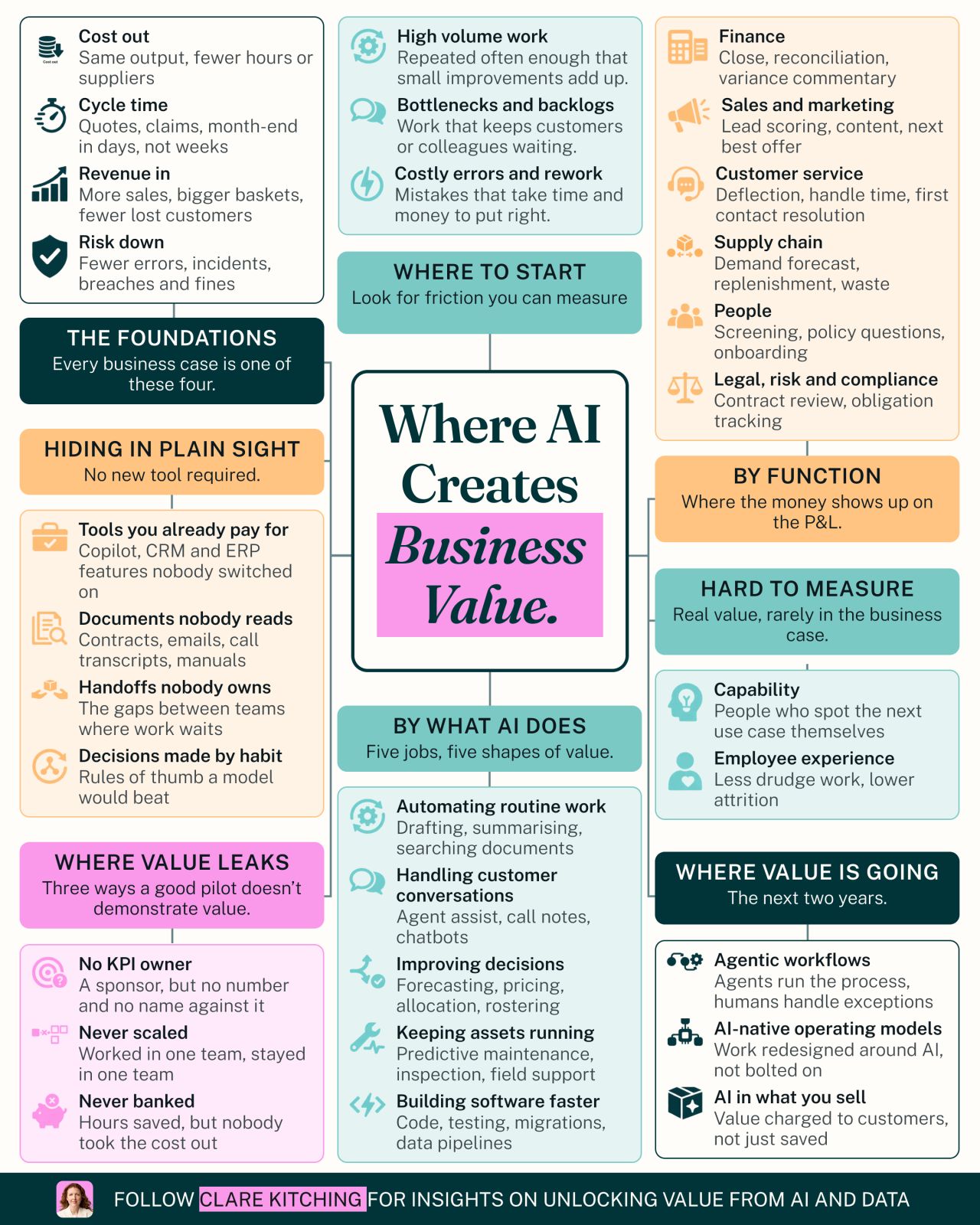
In a recent LinkedIn post, Clare Kitching offers a practical framework for identifying high-value Artificial Intelligence (AI) opportunities, suggesting that they often lie within the most tedious and complaint-generating aspects of daily business operations. Kitching frames these often-overlooked tasks as prime candidates for AI-driven transformation.
As Kitching highlights, the path to discovering AI’s potential value isn’t always through groundbreaking innovation, but rather by focusing on the persistent friction points that employees and customers frequently encounter. She points to specific examples that resonate with many in the business world:
“The quote that takes a week. The customer who has to explain their problem twice. The report someone spends Friday copying and pasting. The handover where everything stops.”
These scenarios, Kitching argues, represent not just inefficiencies but also fertile ground for AI intervention. She emphasizes that while businesses can often identify the fundamental business case drivers for AI – such as reducing costs, shortening cycle times, increasing revenue, and mitigating risk – the real challenge lies in pinpointing precisely where to apply these solutions.
Identifying AI Opportunities in Operational Friction
Clare Kitching suggests a strategic approach to uncovering these AI opportunities. Instead of searching for the next big technological leap, she advises leaders to look inward at their existing processes. Kitching identifies three key areas to focus on:
- High-volume tasks where even minor efficiencies can yield significant cumulative benefits.
- Bottlenecks that create waiting periods and impede workflow.
- Errors that necessitate costly and time-consuming remediation.
By concentrating on these operational pain points, Kitching posits that businesses can move beyond simply acknowledging problems to actively seeking AI-powered solutions. She encourages a proactive questioning approach: “Then ask, what would improving this actually change?” This question, according to Kitching, is crucial for translating identified inefficiencies into tangible value propositions for AI initiatives.
Mapping the Path from Problem to AI Solution
Kitching further elaborates on the process of moving from identifying a problem to implementing an AI solution. She notes that finding a promising use case is merely the initial step. The subsequent phases involve strategic planning and execution to ensure that the AI implementation genuinely delivers the anticipated improvements.
“Because finding a promising use case is only the beginning.”
According to Kitching, the core value proposition of AI in these contexts is its ability to address the foundational business metrics. She explains that AI can directly impact:
- Cost Reduction: Automating repetitive tasks reduces labor costs and operational overhead.
- Cycle Time Improvement: Streamlining processes shortens the time it takes to complete tasks or deliver products/services.
- Revenue Generation: Faster response times, better customer experiences, and improved product development can lead to increased sales.
- Risk Mitigation: Reducing errors and improving compliance can lower the risk of costly mistakes or regulatory issues.
Clare Kitching’s insights provide a compelling argument for businesses to re-evaluate their most mundane and frequently criticized processes as potential sources of significant AI-driven value. By focusing on these ‘unhappy paths,’ organizations can more effectively identify and implement AI solutions that deliver measurable business outcomes.
📝 About This Content
This article is based on insights shared by Clare Kitching on LinkedIn.
📅 Originally posted on September 14, 2026 | View original post on LinkedIn →