
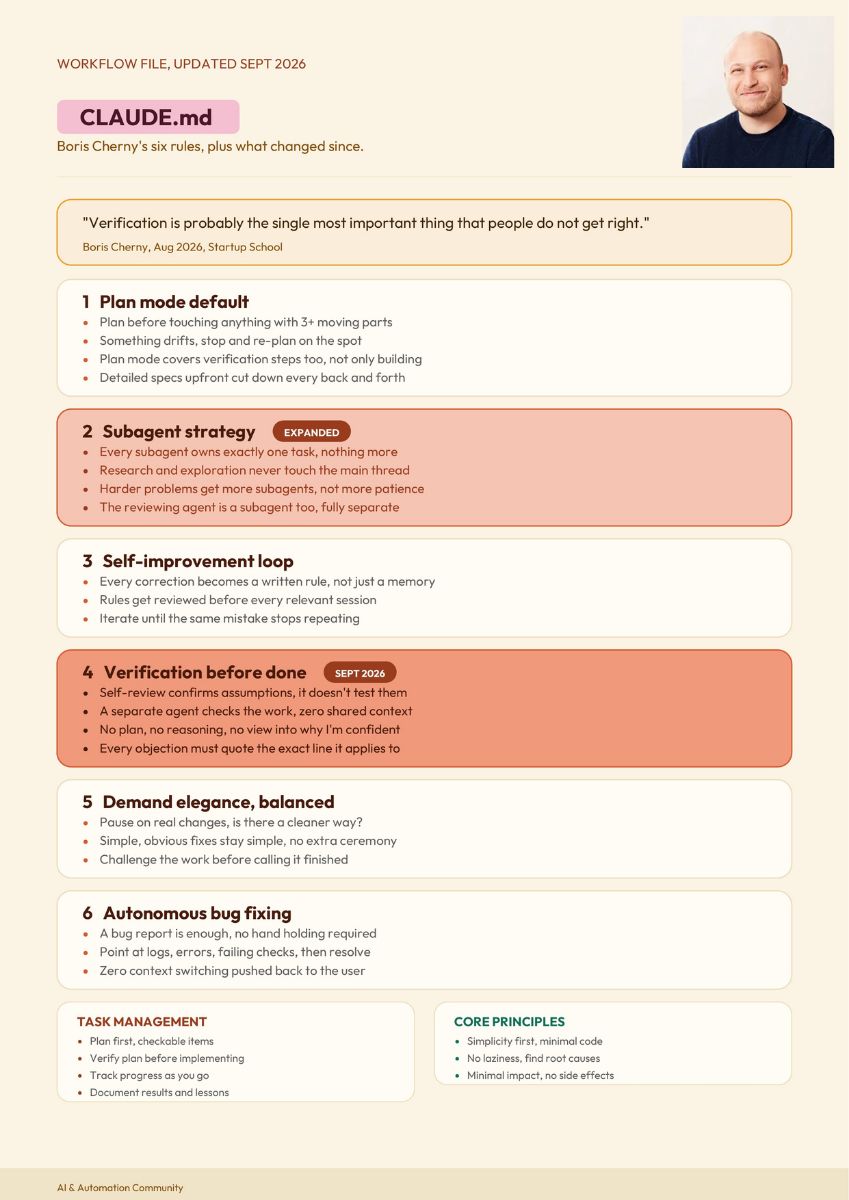
In a recent LinkedIn post, Itay Hacmon offers a detailed breakdown of effective strategies for interacting with and optimizing the performance of AI models, specifically referencing the Claude AI. Hacmon, drawing from extensive experience, shares insights into structuring prompts and managing AI workflows for enhanced results. He emphasizes that mastering these techniques is crucial in an era where execution is increasingly handled by AI, shifting human value to precise planning and verification.
Hacmon begins by highlighting the importance of a structured approach, advocating for a ‘Plan mode’ as the default for any task involving multiple steps. This initial planning phase, he argues, is often overlooked but is fundamental to achieving desired outcomes. The AI’s execution capabilities mean that the human’s primary role is in meticulous planning.
“For any task with three or more steps, first enter planning mode, don’t build directly. This is something many people miss, even though it seems obvious. In an era where the execution phase is becoming increasingly ‘simple’ and the model’s responsibility – much of our power lies in precise planning.”
The Power of Sub-Agents and Context Management
A core element of Hacmon’s strategy revolves around the concept of sub-agents. He clarifies that sub-agents are not merely tools for dividing labor but are essential for maintaining the clarity and focus of the main conversational context. By offloading tasks like research, testing, and parallel analysis to separate sub-agents, the primary conversation remains uncluttered.
According to Hacmon, each sub-agent should ideally handle a single task. For complex problems, leveraging multiple sub-agents can harness more computational power than attempting to consolidate everything into a single, monolithic process. This approach also directly supports more robust verification methods.
“A sub-agent is not just for ‘dividing work’. It’s for keeping the main context window clean from research and tests that don’t need to stay there. Research, tests, and parallel analysis work – all of these are moved to a separate sub-agent and do not remain in the primary conversation.”
Implementing Self-Improvement and Verification Loops
Hacmon also stresses the significance of a ‘self-improvement loop.’ Any corrections or modifications made during an interaction should be codified as rules to train the system for future tasks, preventing repetitive errors. This is a key aspect of working intelligently within an agentic environment.
Furthermore, he emphasizes the critical step of verification before finalizing any output. Drawing a parallel to a sentiment expressed by Boris Cherny, Hacmon notes the paramount importance of verification, stating, “verification is probably the single most important thing that people do not get right.” He specifies that the verifying agent should be distinct from the task-performing agent and operate with different configurations, receiving only a focused context from the main agent.
“Verification before ‘signing off’ on the product. This is newer, and relates to something Boris Cherny was asked in August about what’s most important today, and he answered: ‘verification is probably the single most important thing that people do not get right.'”
Striving for Efficiency and Simplicity
Beyond these structured elements, Hacmon touches upon the pursuit of efficiency and ‘elegance’ in AI interactions. He suggests pausing to consider more elegant solutions before implementing complex changes. However, he cautions against over-philosophizing every detail, advocating for practicality.
Finally, Hacmon points to the importance of autonomous troubleshooting and adhering to core principles such as simplicity, zero laziness, and minimal change. He also mentions less-discussed aspects like task management (written plans, tracking, lessons learned) and fundamental principles like simplicity and minimal change, underscoring a holistic approach to AI collaboration.
📝 About This Content
This article is based on insights shared by Itay Hacmon on LinkedIn.
📅 Originally posted on September 14, 2026 | View original post on LinkedIn →