
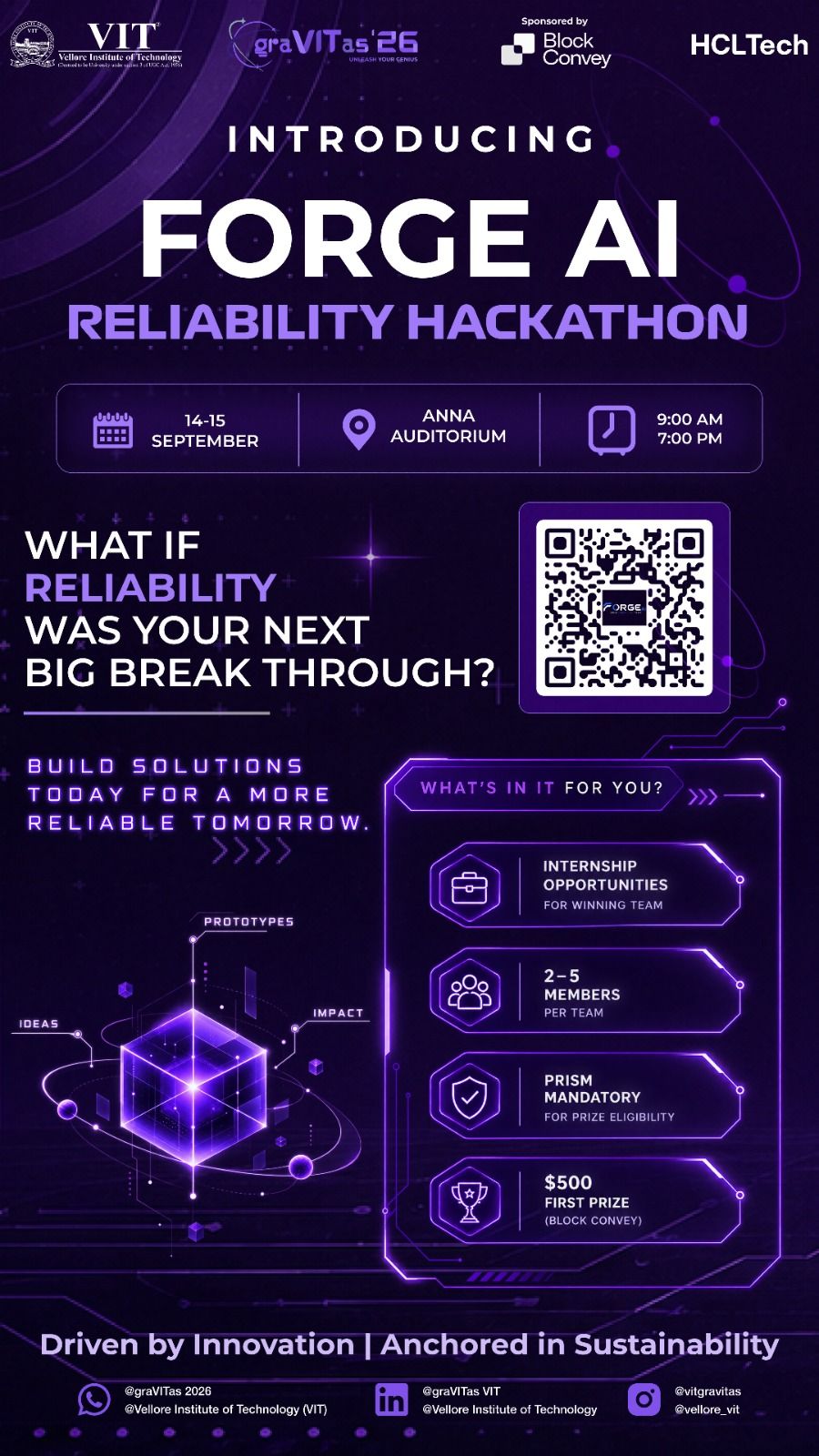
In a recent LinkedIn post, Arun P. discusses the upcoming FORGE AI Reliability Hackathon, which he is hosting at the Vellore Institute of Technology (VIT) as part of the graVITas VIT Vellore ’26 event. The initiative aims to immerse students in the practical aspects of building and testing artificial intelligence systems.
Arun P. outlines the core objective of the hackathon: students will be tasked with constructing AI systems and then subjecting them to real-world scenarios. A key component of this process involves utilizing PRISM by Block Convey, a tool designed to help participants understand the behavior of their AI systems, identify failure points, and explore methods for enhancing reliability.
“Students will spend the hackathon building AI systems, putting them through real scenarios, and using PRISM by Block Convey to understand how those systems behave, where they fail, and what could make them more reliable.”
Focus on Practical AI Development and Observability
The hackathon serves a dual purpose, according to Arun P. Beyond providing students with hands-on experience, it offers a valuable opportunity for the PRISM platform itself to evolve. Arun P. views the event as a crucial testing ground for PRISM, enabling direct feedback from a significant group of developers.
As Arun P. notes, the team behind PRISM is keen to observe how the student builders interact with the platform. This engagement is expected to reveal what aspects of PRISM are most useful, identify any missing functionalities, and gather insights that can directly inform future improvements to the tool.
“For us, this is also a great opportunity to put PRISM in the hands of a large group of builders, learn what they find useful, see what is missing, and use that feedback to make the platform better.”
Cultivating Future AI Talent and Innovation
The initiative underscores a commitment to nurturing emerging talent in the field of artificial intelligence. By providing students with advanced tools and challenging them with practical problems, Arun P. and the organizers aim to foster a deeper understanding of AI reliability and observability.
Arun P. expresses anticipation for the outcomes of the hackathon, looking forward to seeing the innovative solutions developed by the student teams and how they push the capabilities of the PRISM platform. He also extends gratitude to the VIT team and all individuals involved in organizing the event.
“Looking forward to seeing what the teams build and how they push the platform.”
The event is set to bring together a community of student builders focused on the critical aspects of AI development, particularly in areas such as AI agents, AI observability, and generative AI. The collaboration between academic institutions like VIT and industry tools like PRISM highlights a growing trend in practical, skills-based learning within the tech sector.
Acknowledgements and Community Engagement
Arun P. specifically acknowledged several individuals who are instrumental in making the hackathon a reality, including K Mohammed Kaif, Parth Hingad, Kousthub Eswar Reddy Gadikota, Dhruvi Desai, Pavan M., Aishwarya Birla, Kritin D Madhavan, and Khushi Ranganatha. This collaborative spirit is central to the success of such educational and developmental initiatives.
The FORGE AI Reliability Hackathon represents a significant effort to bridge the gap between academic learning and the practical demands of the AI industry, emphasizing the importance of reliability and robust testing in the development of artificial intelligence systems.
📝 About This Content
This article is based on insights shared by Arun P. on LinkedIn.
📅 Originally posted on September 14, 2026 | View original post on LinkedIn →