
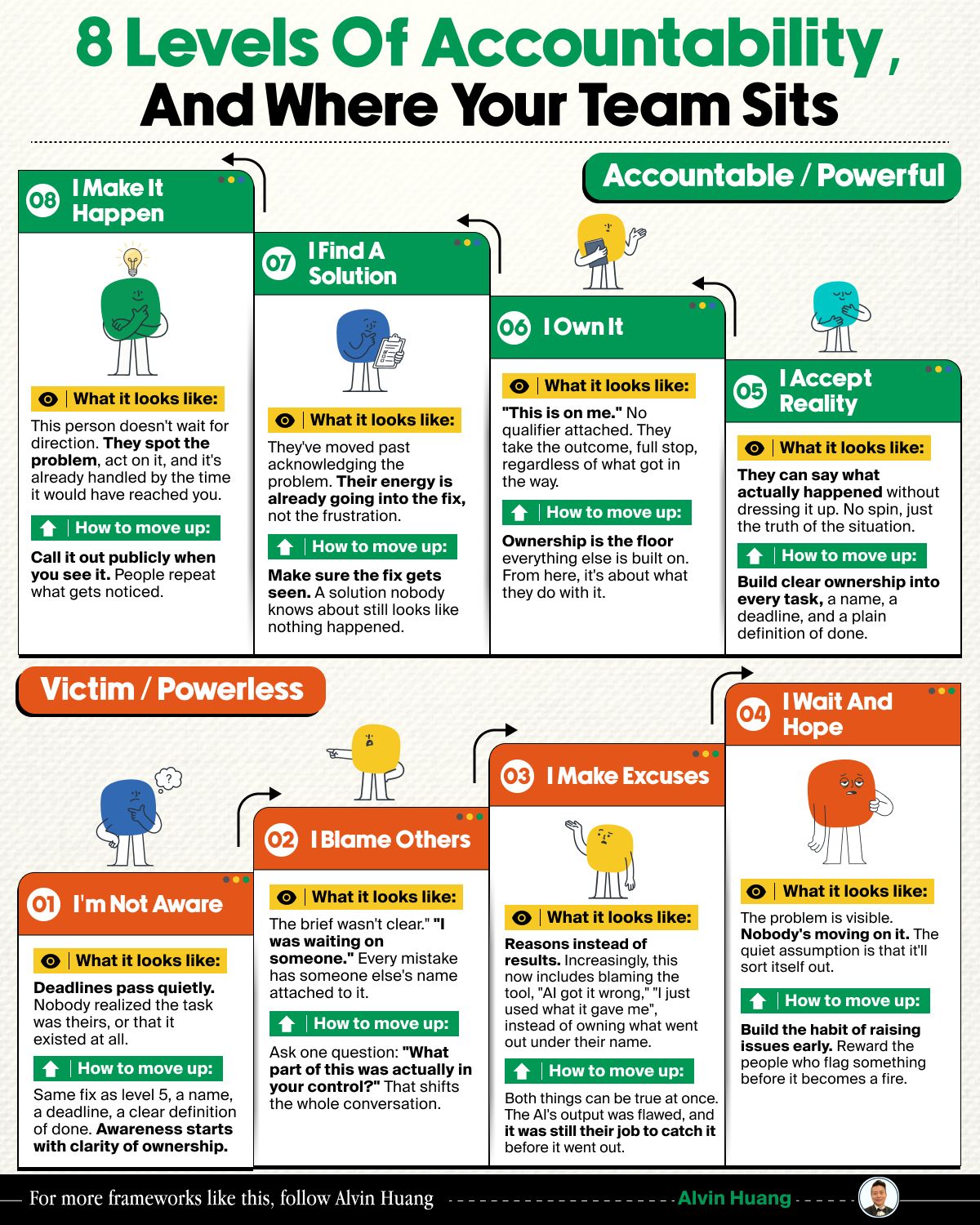
In a recent LinkedIn post, Alvin Huang discusses a framework for understanding and improving team performance through accountability. Huang introduces an “8-rung ladder” that he believes dictates how effectively a team operates, and he notes that the rise of AI has introduced new challenges to this dynamic.
Huang initially perceived accountability as a binary trait but has since developed a more nuanced view. “The more people I’ve hired and managed, the clearer it’s gotten that it’s actually a ladder, and most problems trace back to knowing exactly which rung someone is stuck on,” he writes. This perspective emphasizes that identifying the specific level of accountability an individual is struggling with is key to addressing performance issues effectively.
Understanding the Accountability Ladder
Huang outlines his 8-rung ladder, moving from the bottom rung, “I’m Not Aware,” to the top, “I Make It Happen.” Each rung represents a distinct stage in an individual’s approach to responsibility and problem-solving. According to Huang, understanding these stages allows for more targeted conversations and interventions.
The Lower Rungs: Awareness and Blame
The initial rungs focus on a lack of awareness or a tendency to deflect responsibility. At the lowest level, “I’m Not Aware,” tasks and deadlines can be missed simply because individuals do not realize they are responsible or that the task exists. Huang suggests moving up this rung by providing clear ownership, deadlines, and definitions of “done.” Following this is “I Blame Others,” where mistakes are attributed to external factors or other people. Huang proposes a single question to shift this mindset: “What part of this was in your control?”
Mid-Rungs: Excuses, Hope, and Acceptance
The middle of the ladder involves more complex psychological barriers. “I Make Excuses” is a stage where individuals offer reasons for failures rather than results, increasingly using tools like AI as a scapegoat. Huang addresses this by stating, “The AI’s output was flawed, and it was still their job to catch it before it went out.” This highlights that tools can contribute to issues, but ultimate ownership remains with the individual. Next is “I Wait and Hope,” where problems are visible but unaddressed, with an assumption they will resolve themselves. Huang advises fostering a habit of early issue-raising. “I Accept Reality” signifies the ability to state what happened without embellishment or spin.
Upper Rungs: Ownership and Solutions
As individuals ascend the ladder, their focus shifts towards proactive problem-solving. “I Own It” represents taking full responsibility for an outcome, regardless of obstacles. Huang views this as the fundamental basis for further development. Moving higher, “I Find a Solution” involves actively working on fixes rather than dwelling on the problem. He cautions, however, that “A solution nobody knows about still looks like nothing happened,” emphasizing the need for visibility. The pinnacle is “I Make It Happen,” where individuals proactively identify issues, act on them, and resolve them before they even reach management.
The Impact of Accountability on Growth
Huang concludes that the collective position of a team on this accountability ladder directly impacts business growth. “Every rung someone gets stuck on becomes a ceiling for what they’re trusted with next,” he asserts. By identifying and addressing where individuals are stuck, leaders can break through these ceilings and foster a more dynamic and high-performing team.
📝 About This Content
This article is based on insights shared by Alvin Huang on LinkedIn.
📅 Originally posted on September 14, 2026 | View original post on LinkedIn →