
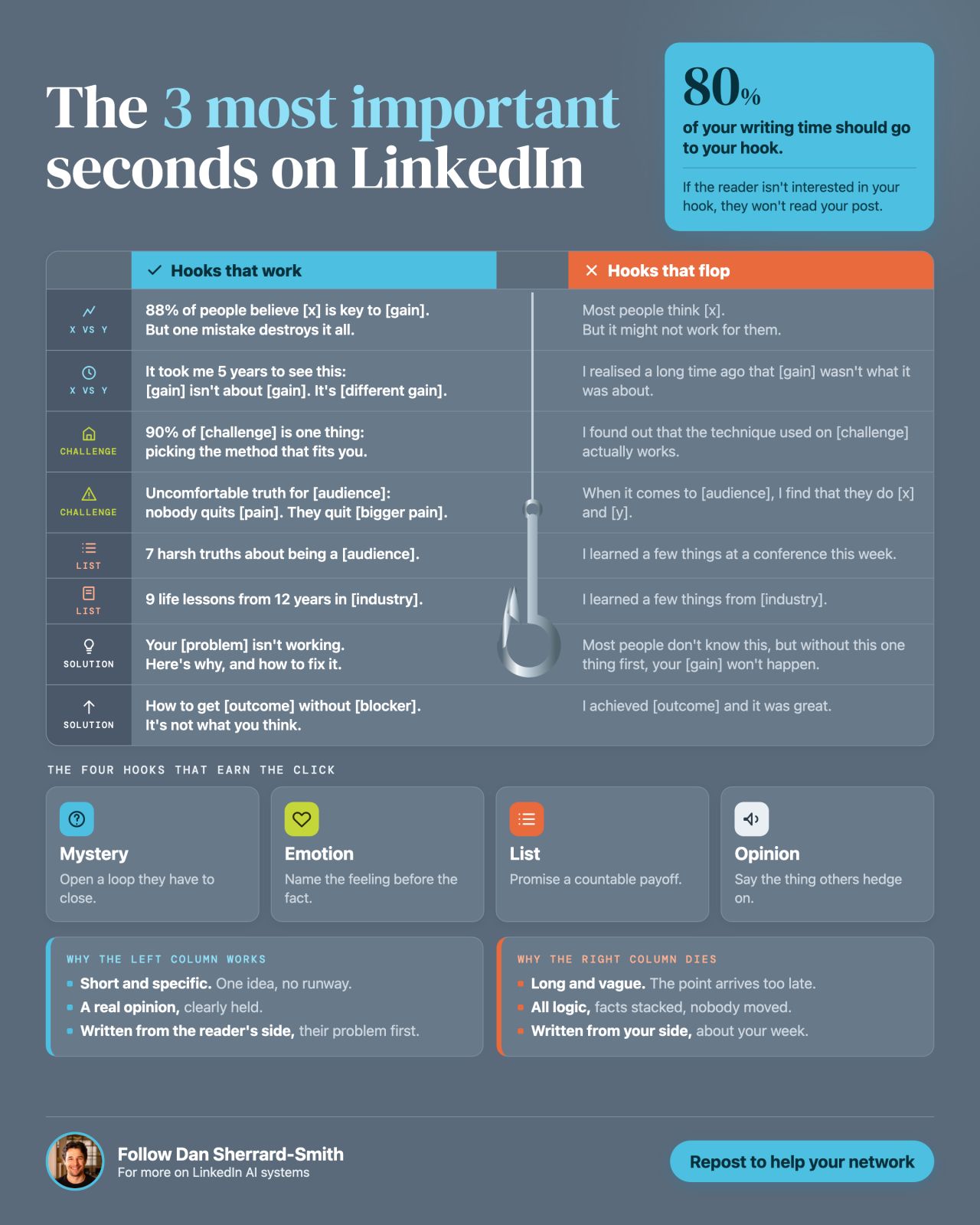
In a recent LinkedIn post, Dan Sherrard-Smith explores the critical importance of the initial moments a user engages with content on the platform, particularly focusing on the “hook” of a post. Sherrard-Smith emphasizes that the first three seconds, which typically encompass the first three lines of text, are paramount in capturing a reader’s attention and encouraging them to delve deeper into the content.
According to Sherrard-Smith, a compelling hook is not merely a nice-to-have but a necessity for any content to reach its intended audience. He warns that a weak hook can render even the most valuable information ineffective, leading to a lack of engagement.
“If a hook draws the reader in, then your post has a chance to get in front of your ideal clients. If a hook is bad, you could be giving your entire service away for free and no one would know.”
The Anatomy of an Effective Hook
Sherrard-Smith proposes a straightforward yet powerful three-word formula for crafting effective hooks: Curiosity, Tension, and Specificity. He breaks down each element, explaining how it contributes to drawing readers in.
1. Curiosity
The first step, as outlined by Sherrard-Smith, is to “open a loop the brain needs to close.” This involves presenting a statement or question that piques the reader’s interest, making them want to find the answer or resolution within the post. An example he provides is, “Most founders post consistently and still get zero leads.” This statement creates a clear gap between a common practice and an undesirable outcome, prompting the reader to seek the ‘how-to’ for achieving leads through consistent posting.
2. Tension
Following curiosity, Sherrard-Smith advocates for creating tension. This is achieved by highlighting the “gap between where they are and where they want to be.” He illustrates this with the example, “You’re posting 5x a week. Buyers still aren’t finding you.” This sentence, according to Sherrard-Smith, presents a specific, uncomfortable truth that resonates with individuals experiencing that exact problem, making them more receptive to the solution that the rest of the post might offer.
3. Specificity
The final component of Sherrard-Smith’s formula is adding a specific number or detail. He argues that “Vague hooks die. Specific hooks get attention.” To illustrate, he offers the example, “I spent 3 hours building a lead system. It now runs every week without me.” This level of detail makes the hook more tangible and credible, capturing the reader’s attention far more effectively than a general statement.
“The first 3 seconds of reading time is the most important for a LinkedIn post. It covers the first 3 lines of the post. And it’s called the hook.”
The Crucial Role of Hook Development
Sherrard-Smith observes that many LinkedIn users fail to give adequate attention to their post’s hook. He identifies two common pitfalls: either writing the hook as an integral part of the main content without dedicated review, or treating it as an afterthought. In his view, the process should be inverted.
“The key here is to spend 80% of your writing time on the hook. Not just writing, but researching, looking at other posts to see what worked and what didn’t.”
He stresses that the hook is the gatekeeper; if it doesn’t successfully prompt the “see more” click, the rest of the post’s content, no matter how valuable, will likely go unread. Sherrard-Smith’s insights provide a clear framework for content creators aiming to maximize their reach and impact on LinkedIn by focusing on what truly matters in the initial seconds of engagement.
📝 About This Content
This article is based on insights shared by Dan Sherrard-Smith on LinkedIn.
📅 Originally posted on September 14, 2026 | View original post on LinkedIn →