
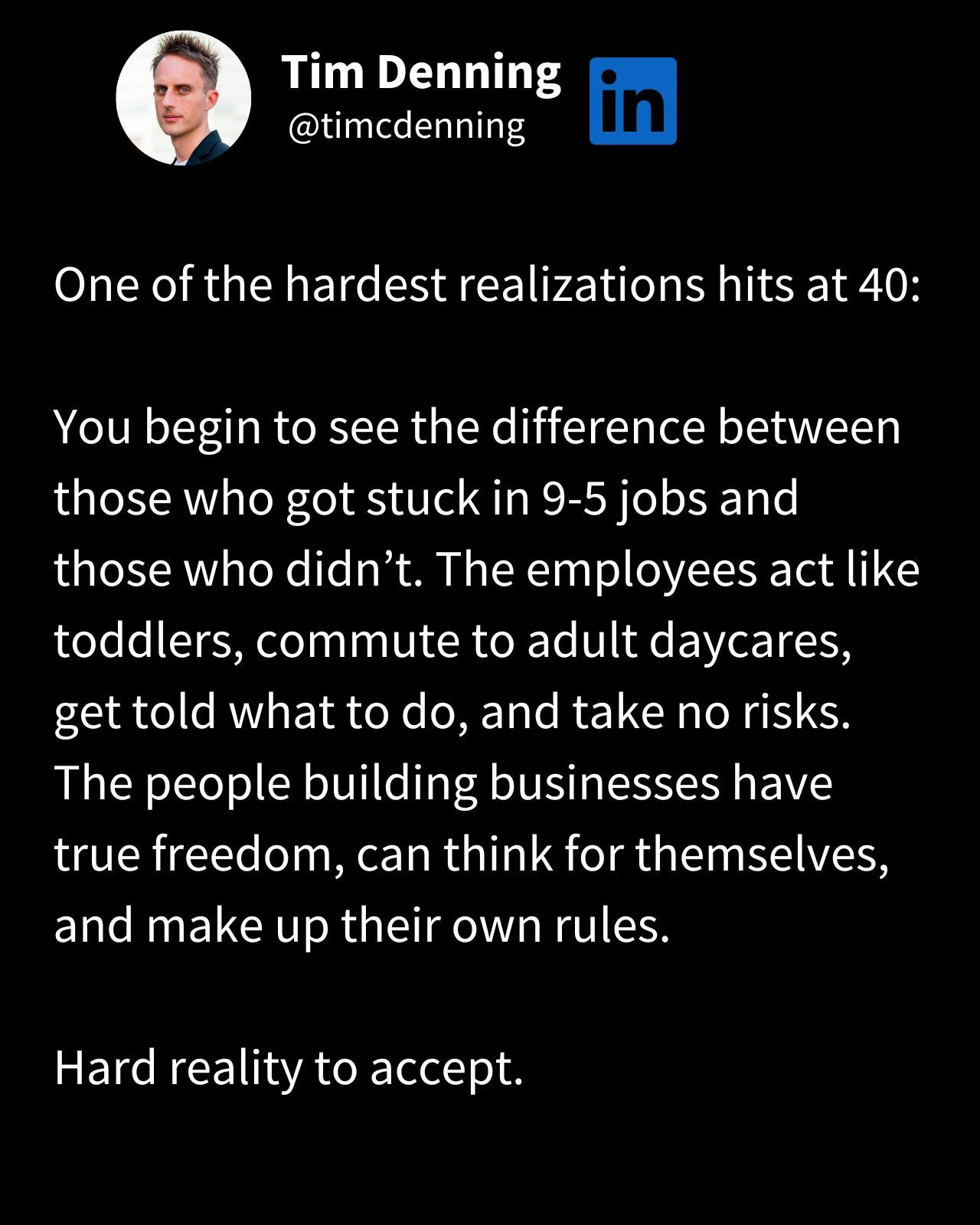
In a recent LinkedIn post, Tim Denning explores the stark realities many face upon reaching their 40s, challenging the long-held belief that corporate success equates to true security and autonomy. Denning argues that the perceived stability of professional careers can, in fact, lead to a form of arrested development, often masked by titles and salaries.
Denning’s post begins by recounting a common disillusionment: the realization that many individuals in positions of apparent authority are still operating with a lack of genuine independence. He highlights his own decade-long experience in corporate environments, observing colleagues who, despite their professional achievements, lacked the agency to make basic personal decisions.
“I spent 10 years working in corporate. I watched brilliant men and women in their 40s sit in air-conditioned boardrooms and ask another human being for permission to attend their kid’s sports carnival.”
This anecdote serves as a central pillar of Denning’s argument, illustrating a profound disconnect between outward professional markers and inner freedom. He paints a picture of individuals bound by strict schedules and oversight, likening their daily existence to an “adult daycare.” As Denning points out, this environment dictates arrival times, work assignments, and even the duration of breaks, fostering a culture of dependency.
The Illusion of Corporate Security
Denning posits that this situation is a direct consequence of a lifetime spent avoiding risk. By outsourcing personal responsibility for survival and success, individuals trade their autonomy for the predictable comfort of a regular paycheck. This trade-off, he contends, leads to a surrender of agency that becomes increasingly apparent with age.
“When you refuse to take responsibility for your own survival, you outsource your agency. You accept the trade. You surrender your sovereignty in exchange for a predictable direct deposit every two weeks.”
According to Tim Denning, those who deviate from this corporate path often inhabit a different reality. These individuals, he writes, are typically engaged in building their own ventures, creating content online, and actively developing leverage. Their financial success is a direct result of taking full accountability for their income. When challenges arise, they are equipped to adapt and overcome, rather than seeking external guidance or protection.
Courage as the Differentiating Factor
The critical distinction between these two life trajectories, Denning argues, is not intelligence or luck, but courage. He contrasts the “cycle of compliance” chosen by those who prioritize comfort with the “genuine autonomy” earned by those who embrace uncertainty.
“The gap between these two lives is not about intelligence or luck. It comes down to courage.”
By the age of 40, Denning suggests, the cumulative impact of these choices becomes undeniable. He differentiates between employees who become dependent and easily destabilized by minor changes, and “dangerous, capable operators” who possess the ability to generate value independently. Ultimately, Denning concludes, true security is not found in external structures but in one’s own capacity to create value on demand.
📝 About This Content
This article is based on insights shared by Tim Denning on LinkedIn.
📅 Originally posted on September 15, 2026 | View original post on LinkedIn →