
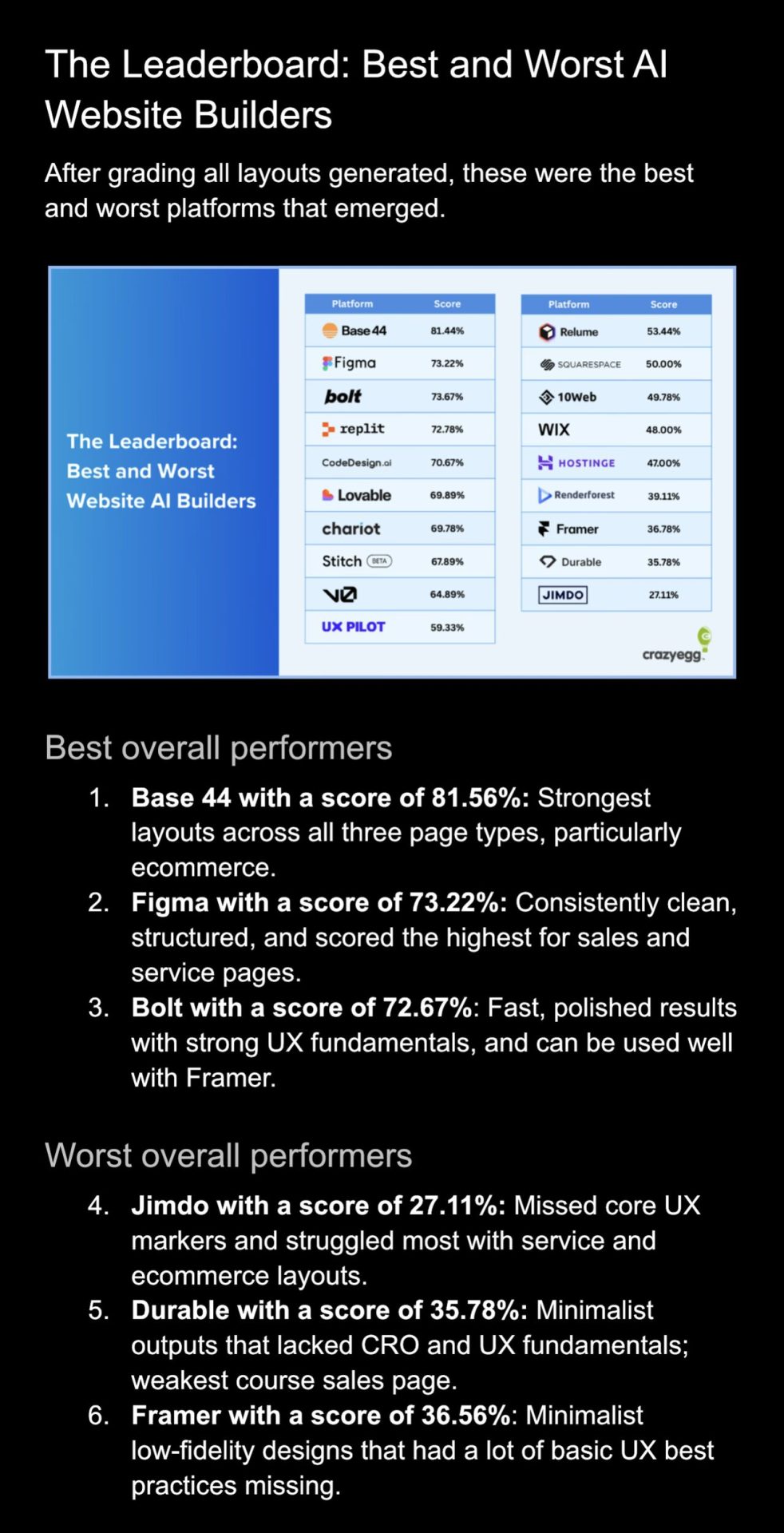
The rapid advancement of Artificial Intelligence has introduced a new wave of tools promising to revolutionize website creation. AI website builders, in particular, are being touted as a quick and easy solution for businesses. However, a recent deep dive into 19 such platforms reveals a more nuanced reality. While these tools can generate content at an impressive speed, they often fall short on the critical details that define a successful website.
The AI Website Builder Test: Speed vs. Substance
To understand the capabilities and limitations of current AI website builders, a comprehensive test was conducted. This involved evaluating 19 different platforms, generating a total of 51 landing pages. These pages were then rigorously scored against 60 key criteria spanning User Experience (UX), Conversion Rate Optimization (CRO), and Search Engine Optimization (SEO).
Common Shortcomings in AI-Generated Websites
The findings indicate that a significant number of AI website builders struggle with fundamental elements essential for user trust and effective marketing. Many failed to incorporate crucial components such as:
- Testimonials: Lacking social proof that builds credibility.
- Pricing Clarity: Obscuring costs, leading to user frustration and lost conversions.
- Brand Identity: Neglecting to establish a consistent and recognizable brand presence.
These omissions highlight a gap between generating a visually passable draft and creating a functional, persuasive website.
The Standouts: Prompt-to-Code Platforms Lead the Pack
While many tools produced superficial results, a few emerged as more promising. The top performers, including Base44, Figma, and Bolt, were not conventional website builders. Instead, they are classified as “prompt-to-code” platforms. These advanced tools demonstrated a better understanding of underlying layout logic, enabling them to generate more coherent and structured outputs.
The distinction is significant: these platforms leverage AI to translate natural language prompts into functional code, offering a more robust foundation than typical drag-and-drop builders that rely heavily on pre-defined templates.
The Verdict: AI Excels at Drafting, Humans Perfect the Details
The core insight from this extensive testing is clear: AI website builders are exceptionally adept at creating initial drafts. They can quickly assemble layouts and populate content, mimicking the speed of an “intern on caffeine.” However, they often lack the foresight and attention to detail that experienced professionals bring to the table.
Elements like strategic calls-to-action, compelling copy, refined user flows, and ensuring brand consistency require human judgment and expertise. The AI can provide the raw material, but it is the human element that refines it into a polished, effective, and conversion-driving website.
In essence, while AI offers a powerful starting point, businesses must still rely on human oversight to ensure their websites meet essential UX, CRO, and SEO standards, ultimately driving business success.
This article is based on insights from Hiten Shah’s original LinkedIn post.
📝 About This Content
This article is based on insights shared by Hiten Shah on LinkedIn.
📅 Originally posted on October 14, 2025 | View original post on LinkedIn →