
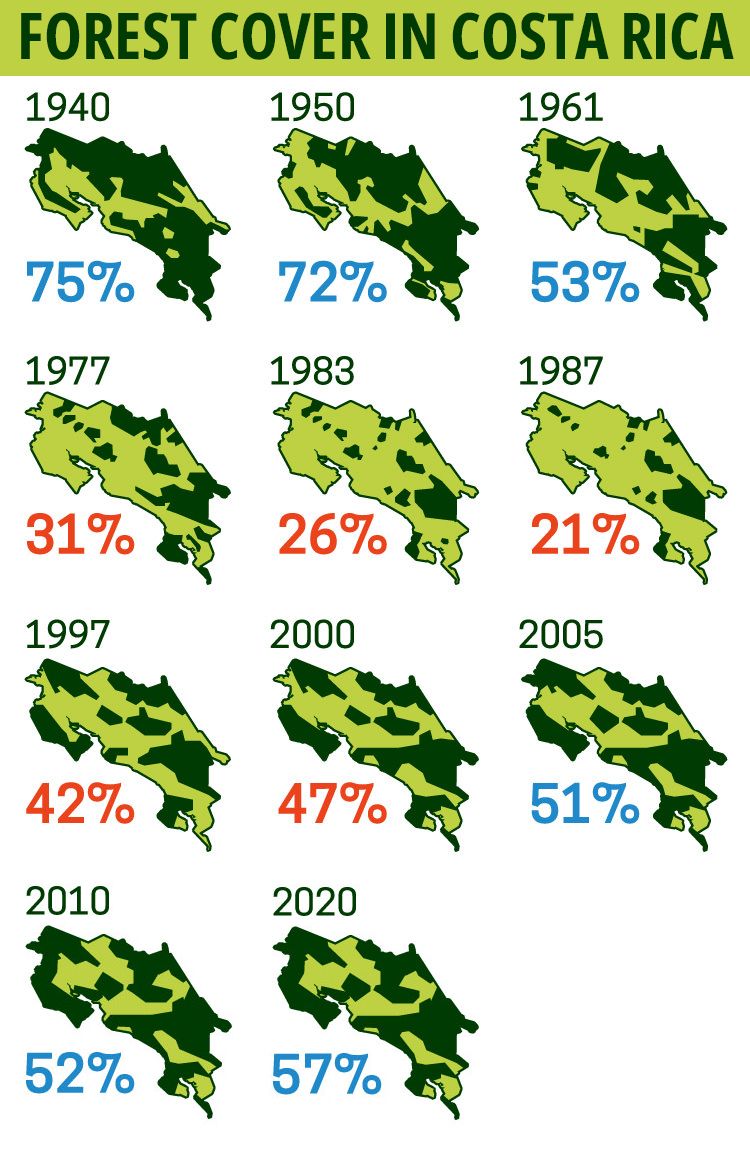
In a remarkable turnaround, Costa Rica transformed its environmental landscape, witnessing a staggering increase in forest cover from a mere 21% to a thriving 57% in just 33 years. This success story, born from a radical idea to incentivize conservation, offers a powerful blueprint for balancing economic development with ecological preservation. The journey from ecological decline to a biodiversity hotspot is a testament to innovative thinking and strategic policy implementation.
The Decline and the Radical Idea
In the 1980s, Costa Rica faced severe environmental degradation. Deforestation was rampant, with vast tracts of land converted for cattle ranching. The soil quality deteriorated to the point where it could barely support one cow per hectare, yet ranching remained more profitable than allowing the forests to recover.
This dire situation called for a bold intervention. Enter Alvaro Umaña, a visionary who proposed a groundbreaking concept: paying farmers to protect existing trees. The incentive was simple yet revolutionary – an annual payment of $64 per hectare, equivalent to the income they would typically earn from cattle ranching. This initiative was ingeniously funded by a tax levied on fossil fuel consumption, directly linking environmental damage to conservation efforts.
Implementing the Vision: Success and Funding Mechanisms
The proposal was met with skepticism, deemed
📝 About This Content
This article is based on insights shared by Dan Sherrard-Smith on LinkedIn.
📅 Originally posted on October 25, 2025 | View original post on LinkedIn →