
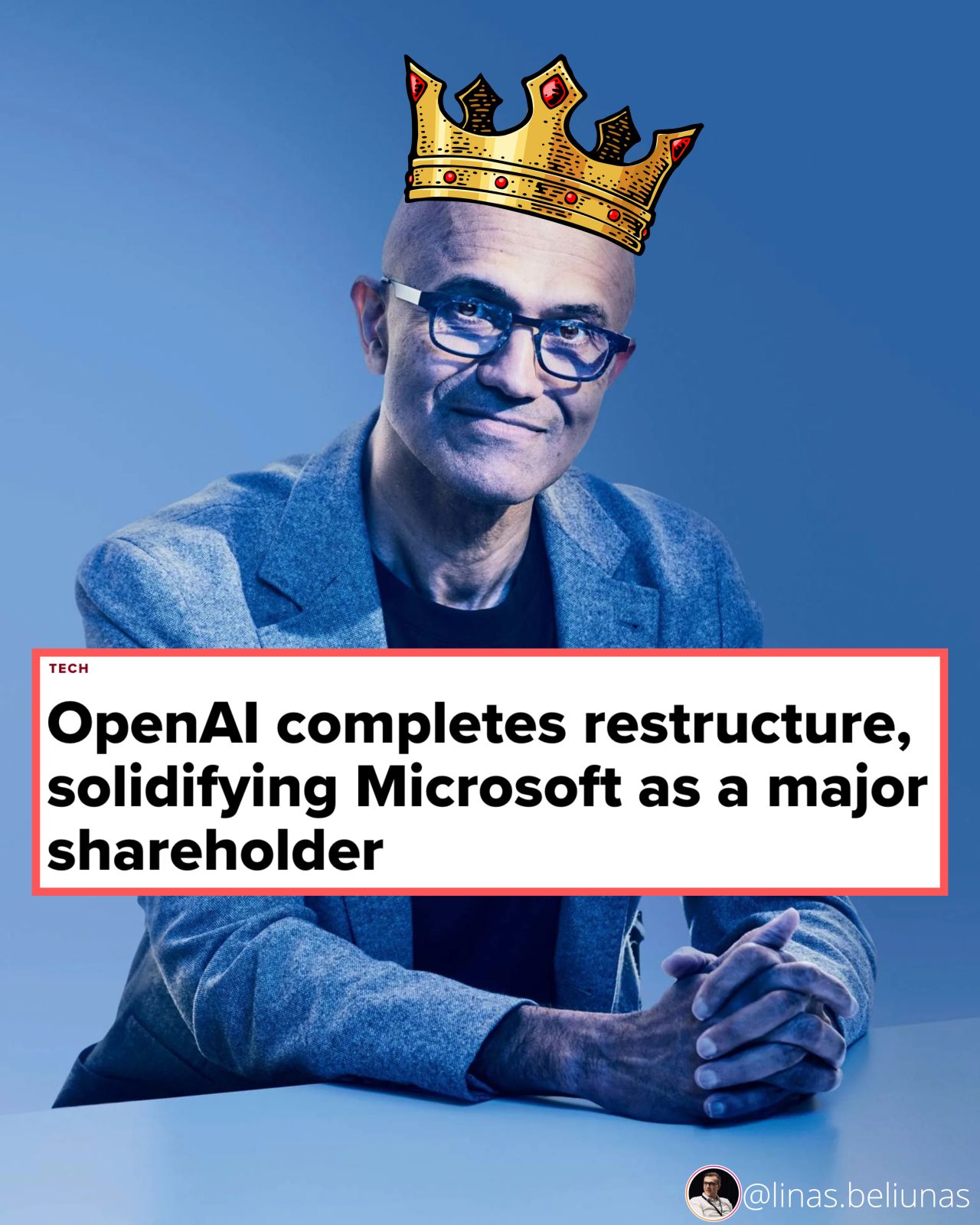
In a move that has sent ripples through the tech world, Microsoft CEO Satya Nadella has once again demonstrated his strategic brilliance. The recent restructuring of OpenAI into a for-profit Public Benefit Corporation (PBC), valued at an astonishing $500 billion, has been hailed as one of the smartest deals in tech history. This complex maneuver not only secures Microsoft’s position in the burgeoning AI landscape but also provides a robust hedge against the uncertainties of Artificial General Intelligence (AGI) development.
The implications of this deal extend far beyond a simple partnership. Microsoft’s strategic stake and revenue commitments position them to capitalize regardless of OpenAI’s AGI timeline, while OpenAI gains the financial flexibility it desperately needed. Let’s delve into the intricate layers of this transaction and understand why it’s a paradigm shift in AI governance and monetization.
Decoding the OpenAI Restructure: Microsoft’s Strategic Advantage
The newly formed OpenAI PBC, valued at $500 billion, sees Microsoft emerge with a significant 27% stake, estimated at $135 billion. Crucially, Microsoft has also secured $250 billion in guaranteed Azure revenue and retains rights to OpenAI’s intellectual property until AGI is achieved or by 2030. This isn’t merely a partnership; it’s a multi-faceted strategy designed to mitigate risk and maximize long-term gains.
1. Hedging Against AGI Uncertainty
One of the most astute aspects of the deal is Microsoft’s hedge against potential delays or failures in OpenAI’s pursuit of AGI. Should the development of artificial general intelligence take another decade or prove more challenging than anticipated, Microsoft remains in a highly profitable position. The $250 billion in guaranteed Azure revenue ensures that compute power will be in demand, and that demand will be met by Microsoft’s cloud infrastructure, irrespective of OpenAI’s specific AGI milestones.
2. OpenAI’s Escape from its Own Constraints
The previous hybrid non-profit model, while ideologically driven, presented significant hurdles for OpenAI, particularly in attracting substantial investment and scaling its operations. By transitioning to a Public Benefit Corporation, OpenAI can now freely raise the billions required for advanced AI research. However, this newfound financial freedom comes with a critical caveat: Microsoft now holds considerable sway over OpenAI’s intellectual property, cloud infrastructure, and overall governance structure.
3. The Ingenious “Independent AGI Panel”
The establishment of an “independent AGI panel” is a stroke of strategic genius. Instead of OpenAI unilaterally declaring the advent of AGI, its verification will now fall to an independent board. This mechanism is designed to carefully manage the timeline of AGI’s
📝 About This Content
This article is based on insights shared by Linas Beliūnas on LinkedIn.
📅 Originally posted on October 28, 2025 | View original post on LinkedIn →