
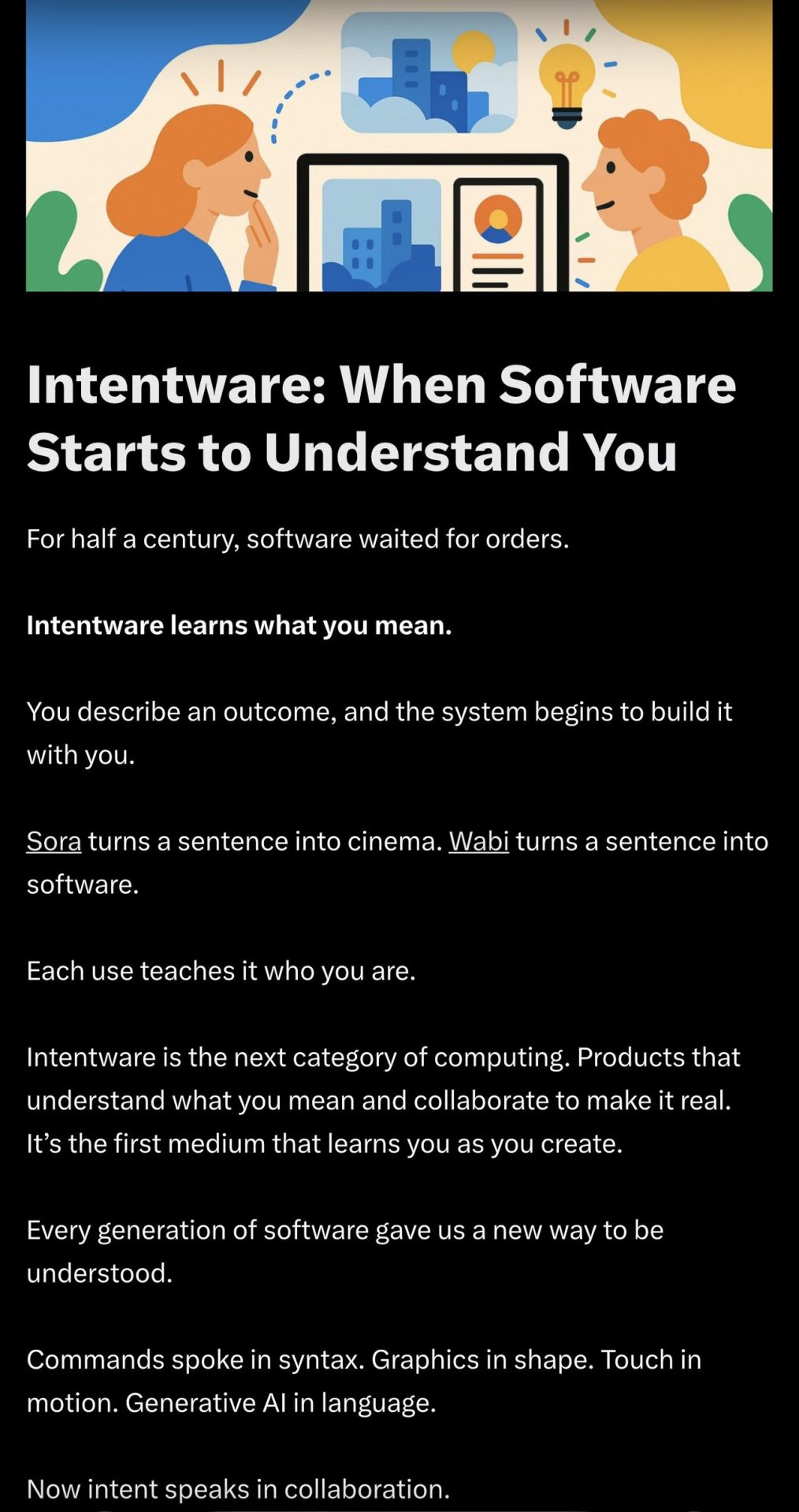
The history of computing is marked by profound shifts, each driven by a fundamental change in how we express our intentions to machines. Hiten Shah, in a recent thought-provoking post, traces this evolution, revealing how we’ve moved from rigid commands to a new era of intuitive collaboration.
The Era of Obedience: Command Lines and Syntax
In the nascent days of computing, interaction was starkly literal. Users had to think like the machine, mastering complex syntax and commands to instruct the primitive systems. Power was synonymous with memorizing the machine’s language, a testament to the interface of pure obedience.
The Graphical Revolution: Seeing and Doing
The advent of the graphical user interface (GUI) marked a paradigm shift. Icons replaced arcane commands, and the desktop metaphor transformed abstract logic into visible layouts. While this revolution made work tangible and allowed users to ‘see’ their actions, it still focused on the ‘what’ rather than the ‘why,’ making work visible but not necessarily personal.
Touch and Intuition: Computing Becomes Tactile
The introduction of touchscreens fundamentally altered the user experience. The cursor gave way to the direct manipulation of the hand, turning the interface ‘skin-deep.’ Gestures like swiping and pinching replaced explicit commands, making computing feel intuitive and personal. We transitioned from telling computers what to do to showing them, shrinking the digital world to the size of our thumbs.
The Age of Prediction: Feeds and Optimization
The rise of the feed introduced a new dynamic: the screen began anticipating user needs. Algorithms analyzed patterns, clicks, and hesitation to predict desires, offering convenience at an unprecedented scale. However, this predictive power, while efficient, often led to a superficial understanding of habits rather than true intent, potentially stifling curiosity under layers of optimization.
Generative AI: The Spark of Conversation
Generative AI has begun to thaw the ice of passive consumption. For the first time in decades, users can describe desired outcomes in natural language, turning prompts into prototypes and text into films or interfaces. Creation has evolved into a conversation, with AI learning and adapting through each interaction, transforming the ‘feed’ into a ‘studio’ and making the medium feel vibrantly alive.
The Dawn of Intentware: Listening and Understanding
Shah posits that we are now entering the age of interpretation, a new layer of computing he terms ‘Intentware.’ Unlike previous interfaces that executed orders, Intentware is designed to understand them. It meets users halfway, learns from corrections, and refines subsequent outputs based on user preferences. This new paradigm focuses on understanding intent, not just literal commands.
The Future of Collaboration
Intentware listens before it acts, learning the rhythm of a user’s work and tracing the underlying meaning behind their words. Each interaction becomes a real-time research effort, leading to an interface that fades into the background, leaving only pure understanding. This represents a monumental leap: from tools that obey (command line), to those that show (GUI), feel (touch), speak (generative AI), and now, listen (Intentware).
As Hiten Shah concludes, when tools begin to truly listen, they inevitably begin to learn us back, paving the way for a future of genuine collaboration.
This article is adapted from a LinkedIn post by Hiten Shah.
📝 About This Content
This article is based on insights shared by Hiten Shah on LinkedIn.
📅 Originally posted on October 29, 2025 | View original post on LinkedIn →