
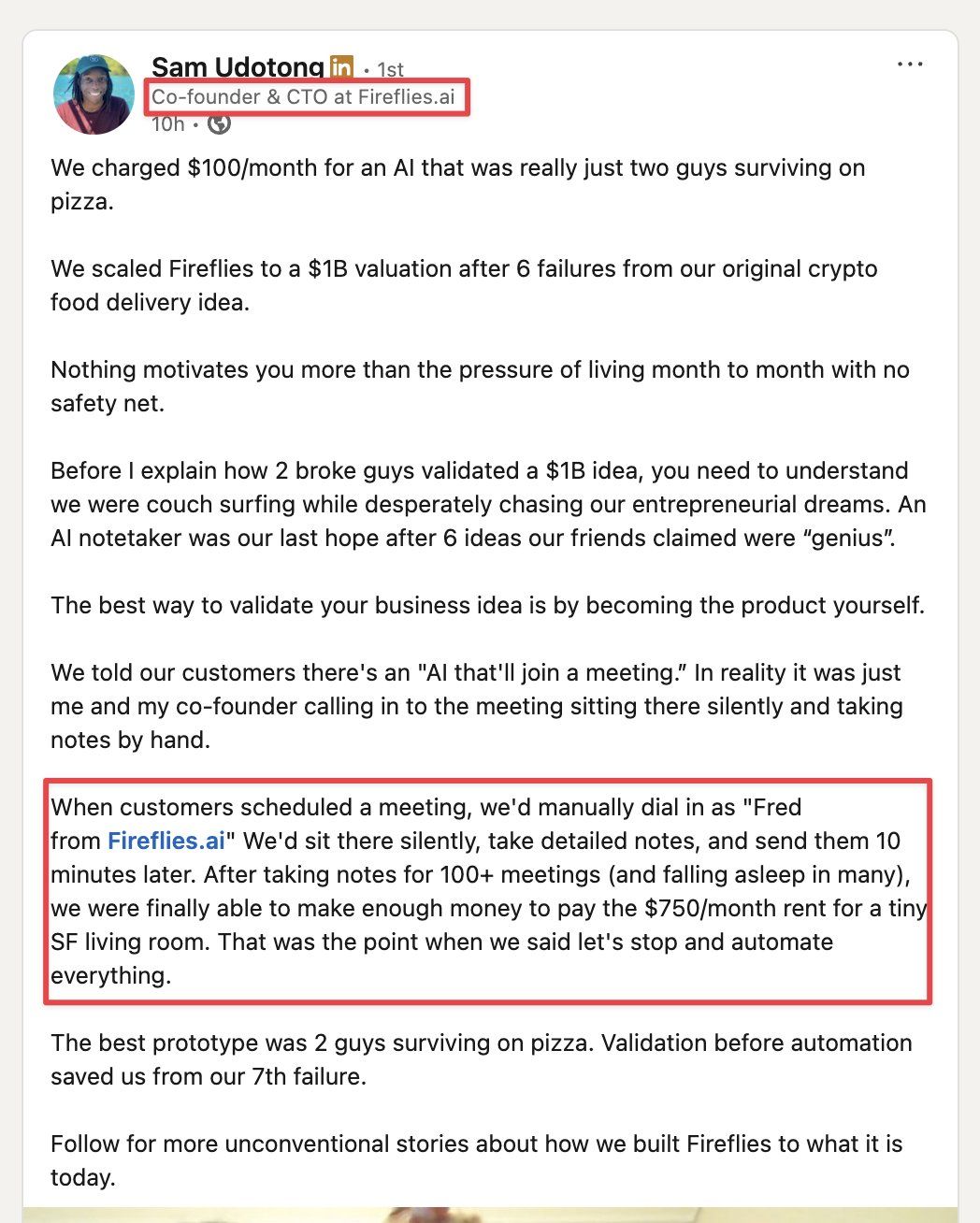
In a recent LinkedIn post, Linas Beliūnas discusses the unconventional early development of the AI meeting assistant Fireflies.ai, prompting a conversation about validation, deception, and the role of human effort in achieving product-market fit.
Beliūnas highlights the surprising revelation that the initial version of Fireflies.ai did not actually employ AI. Instead, the founder manually joined calls, took notes, and synthesized summaries for users who believed they were interacting with an artificial intelligence.
“Wild: Turns out the first version of AI meeting assistant Fireflies didn’t even have any AI 😳 It was just the founder joining the calls, taking notes manually, and sending the summary back.”
This approach, Beliūnas suggests, is an extreme example of Paul Graham’s principle, “Do Things That Don’t Scale.” The manual hustle served as a crucial bridge to eventual automation, proving demand before the technology was fully realized.
The Razor’s Edge: Validation vs. Deception in the AI Era
The story of Fireflies.ai’s genesis, as shared by Beliūnas, brings to the forefront a complex ethical question: when does the drive to validate a product concept cross the line into deception? He notes the polarized reactions to this strategy.
“Some call it genius. Others call it fraud,” Beliūnas writes. He elaborates on the challenge in the current AI landscape, where the terms “automation” and “authenticity” are increasingly intertwined, making the distinction between innovative validation and misleading practices exceptionally fine.
“And in the AI era – where “automation” and “authenticity” collide – that line is razor-thin 🤖”
While Fireflies.ai has since clarified that early AI technology was indeed present behind the scenes, Beliūnas emphasizes that the initial manual effort was a deliberate strategy to bridge the gap to full automation. This narrative, he argues, exposes a truth that many founders are reluctant to confront.
Beyond Code: The Imperative of Human Grit for Product-Market Fit
Linas Beliūnas posits that achieving product-market fit cannot be solely accomplished through coding or technological solutions. Instead, it requires an immersive, deeply personal commitment from the founders.
“You can’t code your way to product-market fit. You have to live it. Bleed for it. Be the product before you build it,” Beliūnas states, underscoring the necessity of intense founder involvement and dedication.
He further distills his takeaway into three core principles for aspiring entrepreneurs navigating the complexities of product development and market entry:
- Validation before automation
- Transparency before scale
- Trust before hype
Beliūnas concludes with a reflective thought, suggesting that perhaps the most significant form of intelligence in the startup journey is not artificial, but rather the inherent human grit and perseverance of the founders.
“Maybe the real artificial intelligence was human grit all along.”
This perspective challenges the prevailing narrative around AI-driven innovation, reminding readers of the foundational human effort that often underpins even the most technologically advanced successes.
📝 About This Content
This article is based on insights shared by Linas Beliūnas on LinkedIn.
📅 Originally posted on November 11, 2025 | View original post on LinkedIn →