
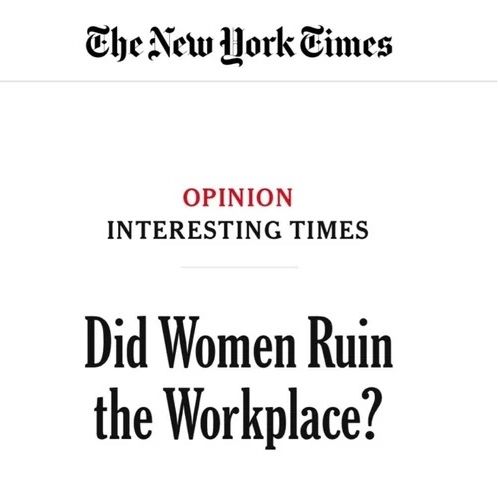
In a recent LinkedIn post, Emily Lyons tackles the provocative question of whether women have “ruined” the workplace, offering a powerful counter-narrative to criticisms often leveled against women in professional environments. Lyons reframes the idea of “ruining” the workplace not as a negative act, but as a necessary dismantling of outdated and inequitable systems.
Lyons directly confronts the notion, stating:
“Maybe we did. We ruined the part where harassment was ‘just locker room talk.’ We ruined the part where speaking up meant ‘you can’t take a joke.’ We ruined the part where asking for equal pay was ‘not being a team player.’ We ruined the workplace that was only working for some people. And honestly? We’re not sorry.”
Challenging the Status Quo
The core of Lyons’ argument is that women have actively dismantled aspects of the workplace that were inherently flawed and exclusionary. She contends that the changes attributed to women are not about creating problems, but about rectifying existing ones that benefited a select few. Lyons highlights specific areas where this “ruin” has been beneficial, including the eradication of tolerance for harassment, the validation of speaking up against injustice, and the pursuit of equal pay.
According to Lyons, these changes are not about women asking for too much, but about addressing the fundamental instability of workplaces that were not built for everyone.
Building More Equitable Environments
Lyons shares her experience building companies with predominantly female teams, drawing insights from these ventures. She posits that when organizations move away from treating employees as mere cogs in a machine and instead value judgment alongside output, and when direct communication doesn’t necessitate cruelty, excellence becomes the norm rather than the exception.
In her post, Lyons elaborates on this, writing:
“When you stop treating humans like machines… When you value judgment as much as output… When being direct doesn’t require being cruel… Excellence isn’t the exception. It’s the standard.”
This perspective suggests a fundamental shift in leadership and operational philosophy, where human-centric values foster higher performance.
Identifying True Fault Lines
Lyons asserts that the current struggles within some workplaces are not a result of women demanding too much, but rather an indication that these environments were built on shaky foundations. She argues:
“The workplaces falling apart right now aren’t collapsing because women asked for too much. They’re collapsing because they were built on fault lines. Women didn’t create the cracks. We just stopped pretending we couldn’t see them.”
This framing positions women not as agents of destruction, but as catalysts for necessary change, exposing pre-existing weaknesses in organizational structures. Lyons concludes by pointing out that leaders who struggle to differentiate between constructive feedback and personal attacks are the ones who represent the true problem, a problem that is now more visible and addressable.
📝 About This Content
This article is based on insights shared by Emily Lyons on LinkedIn.
📅 Originally posted on November 13, 2025 | View original post on LinkedIn →