
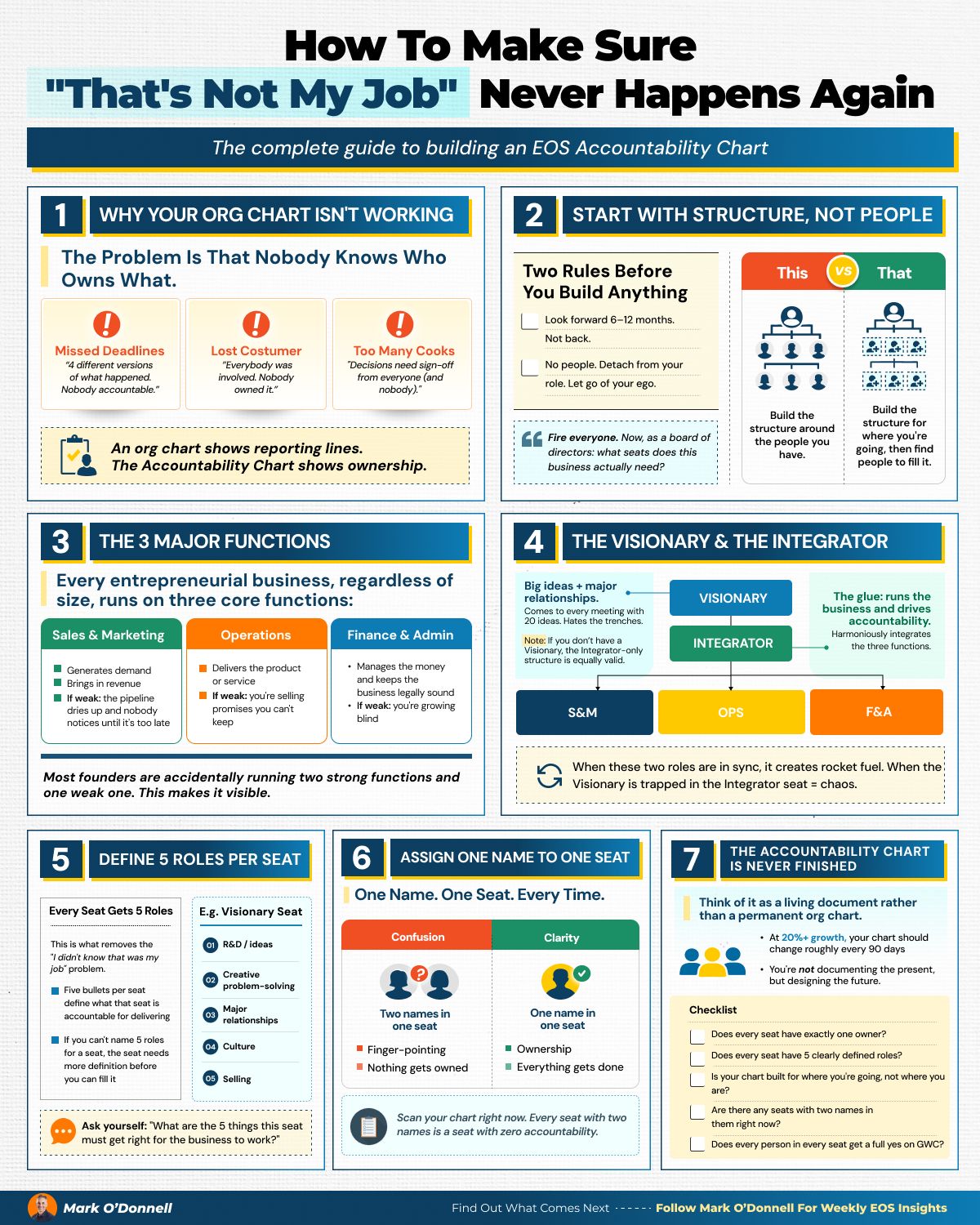
In a recent LinkedIn post, Mark A Odonnell tackles a fundamental challenge faced by many organizations: a lack of clear accountability, which he argues is often mistaken for a lack of employee care. Odonnell asserts that teams don’t fail because they are unmotivated, but because the ownership of critical tasks and problems remains ambiguous.
The Root of the Problem: Ambiguous Ownership
Odonnell prompts leaders to consider a crucial question: “Who is accountable for your biggest open problem right now?” He suggests that if a leadership team cannot provide a single, clear answer, or if there’s hesitation and shared glances, the core issue isn’t the problem itself, but the absence of definitive ownership. Traditional organizational charts, he explains, are insufficient as they merely illustrate reporting lines rather than assigning responsibility.
“An org chart won’t fix that. Org charts only tell you who reports to who. On the other hand, The EOS Accountability Chart tells you who owns what.”
This distinction is central to Odonnell’s argument. He advocates for a more robust system, like the EOS Accountability Chart, which is designed to clarify who is responsible for delivering specific outcomes.
Building an Accountability Chart: A Step-by-Step Approach
Odonnell outlines a structured process for creating an effective Accountability Chart, emphasizing forward-thinking and strategic design:
1. Establish Forward-Looking Rules
The first step involves looking ahead 6-12 months to identify the business’s future needs, rather than being constrained by the current structure. Odonnell stresses that the structure should be built first, with personnel filling the roles afterward. The guiding principle is identifying what the business requires to reach its next level of growth.
2. Focus on Three Core Functions
He advises structuring the organization around three essential functions: Sales and Marketing, Operations, and Finance. Odonnell points out that a weakness in any one of these core areas can negatively impact the entire organization. This framework helps founders, who often excel in two areas while neglecting a third, to identify and address critical gaps.
3. Differentiate Visionary and Integrator Roles
Odonnell highlights the importance of clearly defining the roles of the Visionary and the Integrator. The Visionary is responsible for big ideas, key relationships, culture, and creative solutions, while the Integrator focuses on execution, accountability, and ensuring alignment across functions. He warns that having one person occupy both roles can lead to chaos.
“The Visionary = big ideas, major relationships, culture, creative problem-solving. The Integrator = accountability, execution, keeping the functions aligned.”
4. Define Five Key Roles Per Seat
To ensure clarity, Odonnell recommends defining five specific roles or deliverables for each seat on the chart. These should be clear outcomes that the person in that seat is accountable for achieving. If a seat cannot be defined by five distinct roles, it indicates that the seat itself is not sufficiently defined.
5. Assign One Name Per Seat
A critical rule Odonnell emphasizes is that each seat should have only one name assigned to it. Having multiple people accountable for the same responsibility effectively means no one is truly accountable. While one person can occupy multiple seats, two people should never be assigned to the same seat.
“Two people accountable for the same thing means nobody is accountable.”
6. Design for Future Growth
The Accountability Chart is not a static document. Odonnell states that for businesses experiencing significant growth (over 20%), the chart should be reviewed and updated approximately every 90 days. This ensures the structure evolves to meet the company’s future needs.
7. Implement a Final Checklist
The process concludes with a checklist to ensure the chart is effective. Key questions include whether every seat has a clear owner and defined roles, if the chart is built for future growth, and if every individual is a strong fit for their designated seat (GWC – Get It, Want It, Capacity to do it).
Odonnell concludes that many issues perceived as people problems are, in fact, structural issues stemming from a lack of accountability. By implementing a well-defined Accountability Chart, organizations can resolve many of these underlying problems.
📝 About This Content
This article is based on insights shared by Mark A Odonnell on LinkedIn.
📅 Originally posted on May 28, 2026 | View original post on LinkedIn →