
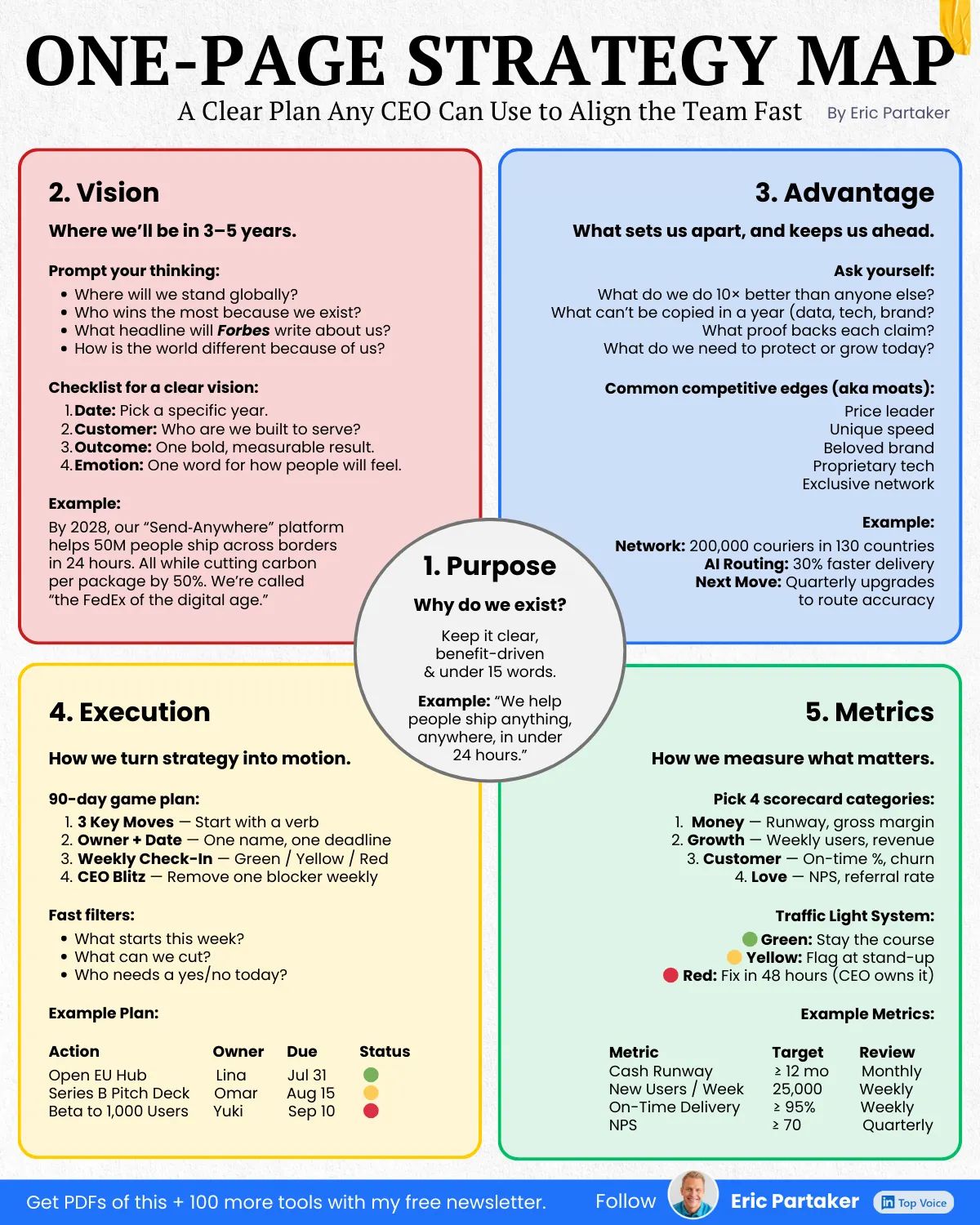
In a recent LinkedIn post, Eric Partaker discusses a common pitfall in business: team misalignment stemming not from a lack of effort, but from working with divergent strategies. Partaker, a prominent figure in CEO development, argues that many organizations spin their wheels because each executive operates with a unique perspective on the company’s direction, leading to diffused energy and stalled progress.
The Root Cause: Divergent Strategies
Partaker posits that the issue isn’t necessarily a lack of alignment, but rather the presence of multiple, uncoordinated strategies. He highlights that different leaders naturally view the business through distinct lenses, and when these views aren’t harmonized, the collective effort becomes inefficient. This lack of a unified direction can be a significant impediment to growth and success.
“Most teams aren’t misaligned. They’re just working off 9 different strategies.”
According to Partaker, the solution lies in establishing profound clarity. He outlines a five-step framework designed to bring a team together under a single, cohesive strategic umbrella. This framework moves beyond lengthy, complex strategy documents to a more actionable, one-page playbook.
Partaker’s Five Pillars of Strategic Clarity
Eric Partaker breaks down the essential components for achieving strategic alignment. He emphasizes that these elements, when clearly defined, create a shared understanding and a unified path forward:
1. Purpose: The ‘Why’
Partaker stresses the importance of a singular, impactful statement defining the organization’s reason for existence. This foundational element should be concise and focused on the ultimate impact the company aims to achieve.
2. Vision: The ‘Where’
Looking three to five years ahead, the vision should be ambitious, measurable, and compelling. As Partaker notes, it needs to be a destination that is genuinely worth striving for.
“Think 3–5 years out. Make it bold, measurable, and worth chasing.”
3. Advantage: The ‘Why We Win’
This pillar focuses on identifying and articulating the company’s unique edge—what makes it distinct and defensible. Partaker advises defining what sets the business apart and protecting those competitive advantages.
4. Execution: The ‘How’
Partaker proposes focusing on a maximum of three key initiatives to drive progress. Crucially, each initiative needs clear ownership and weekly progress reviews to ensure momentum is maintained.
“Focus on 3 key moves. Assign owners. Check progress weekly.”
5. Metrics: The ‘How We Know’
To track success effectively, Partaker recommends selecting four critical numbers that monitor key areas such as financial health, growth, customer satisfaction, and overall sentiment or ‘love’ for the brand.
From Fluff to Focus: The One-Page Playbook
Partaker contrasts traditional, often unwieldy, strategy presentations with his proposed ‘one-page playbook.’ He argues that true strategic execution is not about extensive documentation but about delivering clarity, focus, and speed. This concise format ensures that the entire team can understand and actively engage with the strategy.
“Alignment isn’t a 50-slide deck. It’s a 1-page playbook your whole team can run with. No fluff. Just clarity, focus, and speed.”
By distilling strategy into these core components, Eric Partaker offers a practical and actionable approach for leaders seeking to overcome internal misalignment and drive their organizations toward shared goals with greater efficiency and impact.
📝 About This Content
This article is based on insights shared by Eric Partaker on LinkedIn.
📅 Originally posted on January 10, 2026 | View original post on LinkedIn →