
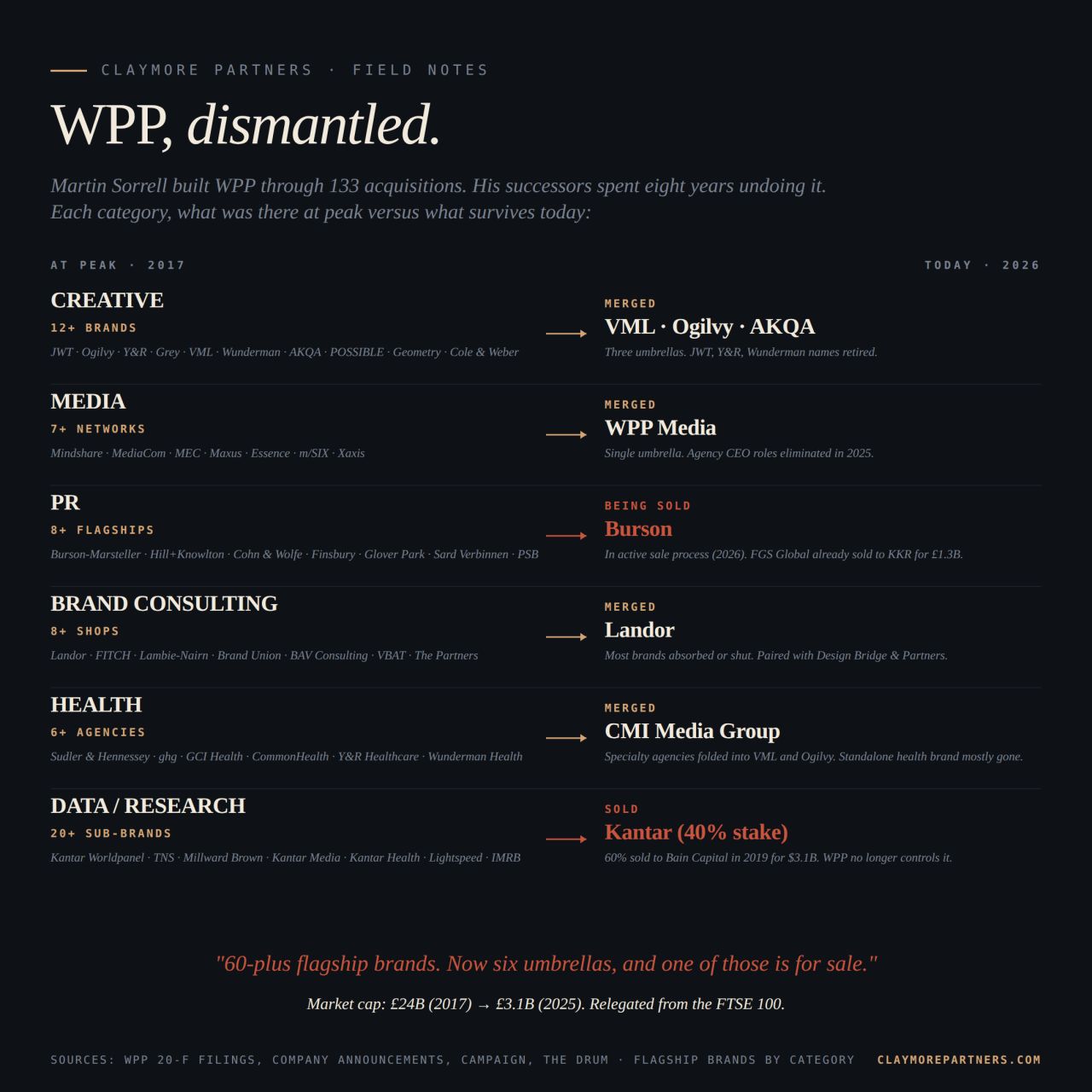
In a recent LinkedIn post, Lee McCabe offers a critical analysis of the agency holding company model, using WPP as a case study for the pitfalls of aggressive acquisition strategies. McCabe argues that the historical approach of building large, complex organizations through numerous mergers can lead to significant business challenges, likening the eventual outcome to ‘archaeology’.
McCabe highlights WPP’s trajectory, noting its extensive history of acquisitions under Martin Sorrell. He points out that the sheer scale and complexity of the conglomerate, which once boasted over 60 flagship brands across various marketing disciplines, may have masked underlying issues.
“WPP is the world’s most expensive lesson in why agency roll-ups eventually turn into archaeology.”
The Unraveling of Agency Conglomerates
The post details a series of recent consolidations and divestitures within WPP, including the merging of VML, Ogilvy, and AKQA, the folding of media units, and the sale of brands like Burson and Kantar. This restructuring effort, McCabe suggests, is a response to a business model that is struggling to adapt to modern market demands.
McCabe contrasts the past needs of clients – geography, headcount, and fragmented ‘integrated capabilities’ – with the present realities. He asserts that current market forces are indifferent to historical agency structures.
AI, Procurement, and CMO Priorities
According to Lee McCabe, the evolving landscape is driven by factors that do not prioritize legacy agency architectures. He states:
“AI does not care about your agency architecture.
Procurement does not care about your legacy brands.
CMOs do not care that you bought a boutique in 2008 and still have the founder’s name on the door.”
McCabe emphasizes that modern business leaders, including CMOs and boards, are focused on tangible outcomes: revenue, margin, and measurable growth. This focus, he implies, makes the complexity of large, multi-brand agency groups increasingly untenable.
A Different Path: Publicis’s Technology-Centric Model
In contrast to WPP’s approach, McCabe points to Publicis as having pursued a different strategy, one centered on data, technology, and identity. He characterizes Publicis’s model not as a ‘cathedral’ of agencies, but more as an ‘operating system’, suggesting a more integrated and streamlined approach.
“Publicis made a different bet. More data, more technology, more identity, more connected execution. Less agency cathedral. More operating system.”
This strategic divergence, McCabe suggests, positions Publicis more favorably in a market that increasingly values technological integration and measurable performance over traditional agency structures.
Lessons for Private Equity
Lee McCabe concludes by drawing a clear lesson for private equity firms engaged in similar roll-up strategies. He argues that the success of such models is contingent on customer willingness to pay for complexity. When that willingness wanes, the meticulously built platform can quickly devolve into a disorganized collection of assets.
As McCabe puts it:
“Roll-ups work until the customer stops paying for complexity. Then the beautiful platform becomes a junk drawer with a logo.”
His analysis underscores a significant shift in the marketing and advertising industry, where agility, technological prowess, and demonstrable client results are becoming paramount, challenging the long-standing dominance of the traditional agency holding company model.
📝 About This Content
This article is based on insights shared by Lee McCabe on LinkedIn.
📅 Originally posted on June 23, 2026 | View original post on LinkedIn →