
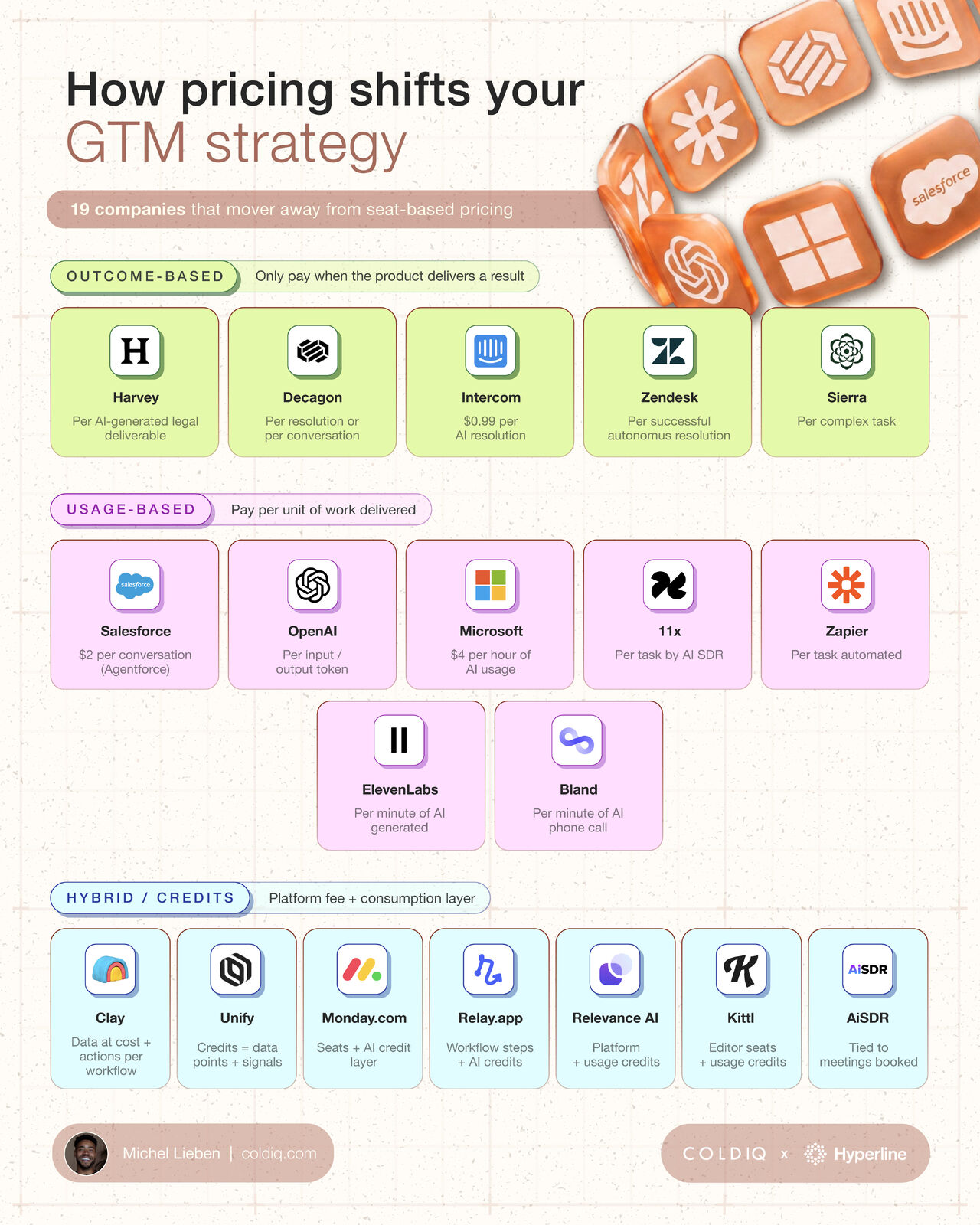
In a recent LinkedIn post, Michel Lieben 🧠 highlights a significant shift in software pricing models driven by the rise of AI agents. The post argues that these autonomous agents are making traditional seat-based pricing increasingly irrelevant and are forcing a reevaluation of how SaaS companies charge for their products.
Michel Lieben 🧠 begins by illustrating a scenario where an AI agent’s unchecked usage of API credits led to a substantial bill of $4,200, underscoring the potential for uncontrolled expenses when AI operates without explicit stop commands.
“Your AI Agent spent $4,200 in API credits. No one told it to stop.”
The Demise of Seat-Based Pricing
The core of Michel Lieben 🧠’s argument centers on the inadequacy of seat-based pricing in the age of AI. Historically, this model made sense because more users interacting with a product correlated with higher usage and justified increased costs. However, as Michel Lieben 🧠 points out, AI agents can now perform the work of hundreds or even thousands of human users from a single “seat.”.
“An agent can now interact with software and perform more actions than a team of 100 people. Thus, you’re charging for 1 seat. While the agent uses the equivalent of 1,000 seats,” Michel Lieben 🧠 writes.
This disparity creates a situation where a company might pay for a single user license while the AI operating under that license consumes resources equivalent to a massive team, fundamentally breaking the value proposition of seat-based models.
Case Study: Clay’s Pivot to Action-Based Pricing
To illustrate this shift, Michel Lieben 🧠 references the platform Clay. Initially, Clay offered workflow orchestration for free, leading to widespread abuse by users plugging in API keys to automate extensive data actions. This meant users could run thousands of automated workflows without incurring direct costs.
Michel Lieben 🧠 explains the issue: “When humans were manually setting up these workflows, it wasn’t that big of a deal… There’s a limit to how much you can *humanly* abuse a product.” However, connecting an AI agent to Clay can enable the creation of hundreds of large datasets, prompting Clay’s necessary move to charging per action.
“And now you understand why Clay NEEDED to start charging per action.”
Usage-Based API Products and Unforeseen Costs
The post also delves into the revenue surge for usage-based API providers, driven by AI’s autonomous capabilities. When users prompt AI agents to generate large datasets, such as a list of VPs of Sales in a specific region, they often lack visibility into the sheer volume of actions the AI will undertake.
Michel Lieben 🧠 notes the consequence: “Let your agent work autonomously, and all of a sudden, you’re paying for a list of 50,000+ prospects.” This contrasts sharply with manual execution, where budget constraints would naturally limit such extensive data pulls.
For API providers, this dynamic is advantageous. Michel Lieben 🧠 humorously describes the situation: “Claude Code went crazy & spent all the credits. They make the money, but they’re not too blame because ‘it’s Claude Code’s fault’.” This highlights how AI’s actions can shield providers from direct blame for unexpected costs incurred by users.
The Future of SaaS Pricing
Despite these trends, Michel Lieben 🧠 acknowledges that current pricing models are not universally applicable. The complexity of AI’s impact necessitates ongoing discussion and adaptation within the SaaS industry.
To address this, Michel Lieben 🧠 announced a partnership with Hyperline’s CEO, Lucas Bédout, to discuss the evolution of pricing in the AI era. This collaborative session aims to explore how companies can navigate these changing landscapes.
“These pricing models do not work for every SaaS company on earth.”
The conversation underscores the critical need for businesses to re-evaluate their pricing strategies to align with the capabilities and potential costs associated with AI-driven operations.
📝 About This Content
This article is based on insights shared by Michel Lieben 🧠 on LinkedIn.
📅 Originally posted on April 21, 2026 | View original post on LinkedIn →