
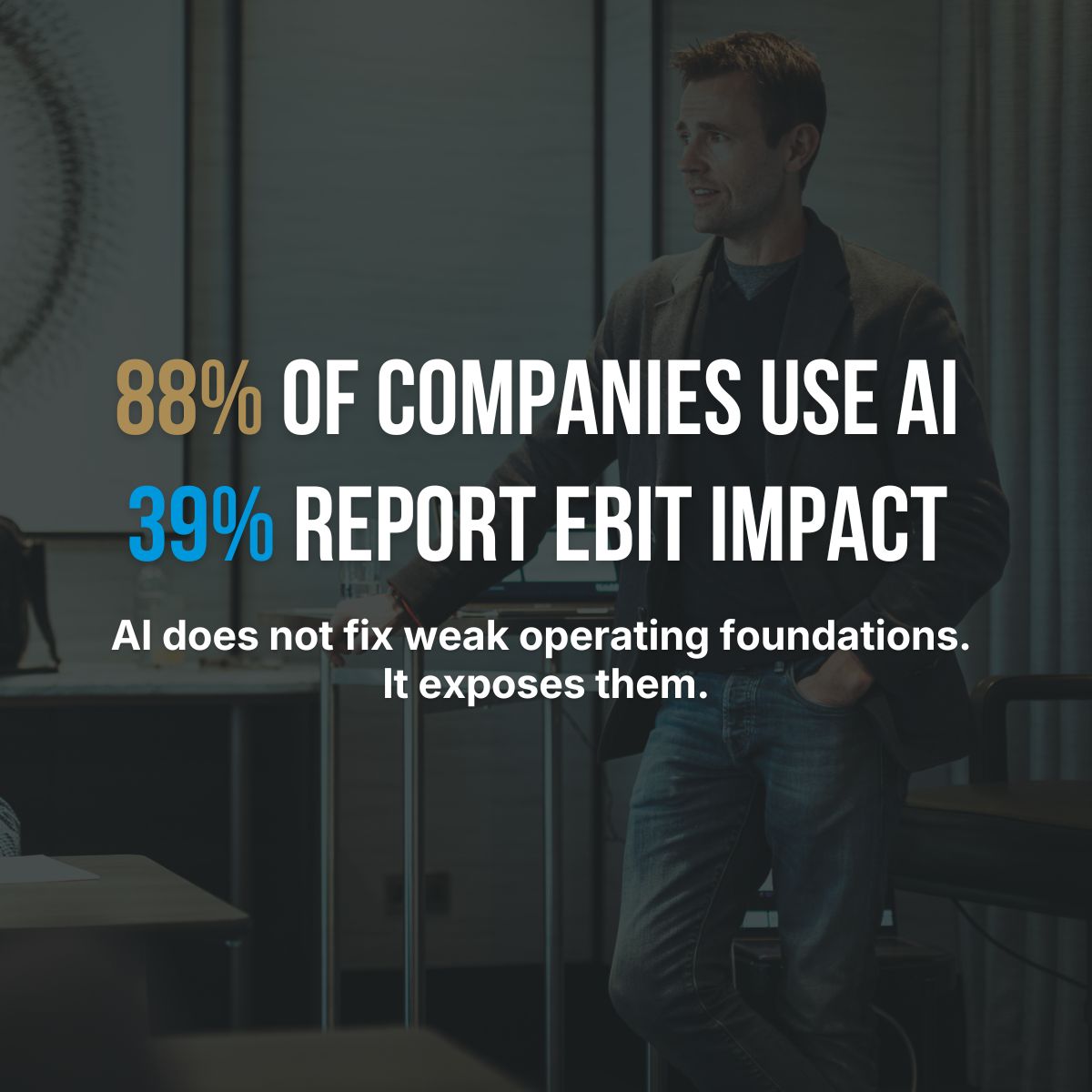
In a recent LinkedIn post, Nick Bradley discusses the common misconception that Artificial Intelligence (AI) can solve fundamental business operational weaknesses, arguing instead that AI often exposes and amplifies existing flaws. He emphasizes that true value from AI is only realized when built upon a solid operational foundation.
AI Exposes Weaknesses, It Doesn’t Solve Them
Bradley begins by stating a core principle: “AI does not fix weak operating foundations. It exposes them.” This sets the stage for his argument that many businesses are overestimating AI’s potential impact because they lack the necessary underlying structure. He highlights a significant disconnect between AI adoption and tangible business results, citing statistics that show a large percentage of companies using AI but a much smaller fraction reporting a positive impact on earnings before interest and taxes (EBIT).
“That gap is the difference between adopting AI and actually creating value with it.”
As Bradley points out, the current business narrative often treats AI as a strategy in itself. “At the moment, a lot of businesses talk about AI as if saying the word is progress. It isn’t,” he writes. This perception is further fueled by investor expectations, where an “AI plan” is becoming a standard requirement, regardless of a company’s readiness.
The Operational Truth Behind AI Adoption
Bradley delves into the reality faced by many businesses, particularly investor-backed ones, where generating basic operational data is a Herculean task involving fragmented spreadsheets, CRM exports, and manual data consolidation. He describes this struggle vividly:
“most still cannot produce basic operational truth without pulling data from spreadsheets, CRM exports, inboxes, and someone from finance quietly losing the will to live.”
He reiterates that in such environments, adding AI will not provide leverage but rather “faster confusion.” The businesses that stand to gain the most from AI are those that can leverage it to enhance existing strengths, such as compressing decision cycles, improving visibility, removing friction, and increasing execution quality. Conversely, those with weak foundations risk using AI simply to “decorate chaos.”
Technology Amplifies, It Doesn’t Create
The critical takeaway, according to Bradley, is that technology, including AI, is an amplifier. “Technology does not create value by itself. It amplifies the quality of the operating model underneath it,” he asserts. This means that before companies can effectively implement AI strategies, they must first ensure their operational model is robust.
“Is the business operationally strong enough for AI to make us better — or just more confident in bad decisions?”
Bradley suggests a more effective question for founders to ask is not about their AI strategy, but about their operational readiness. This reframing encourages a focus on building a strong, data-driven operational core before layering advanced technologies like AI. He concludes that the outcome with AI – whether it leads to genuine improvement or amplified chaos – is entirely dependent on the strength of the business operations beneath it.
📝 About This Content
This article is based on insights shared by Nick Bradley on LinkedIn.
📅 Originally posted on April 20, 2026 | View original post on LinkedIn →