
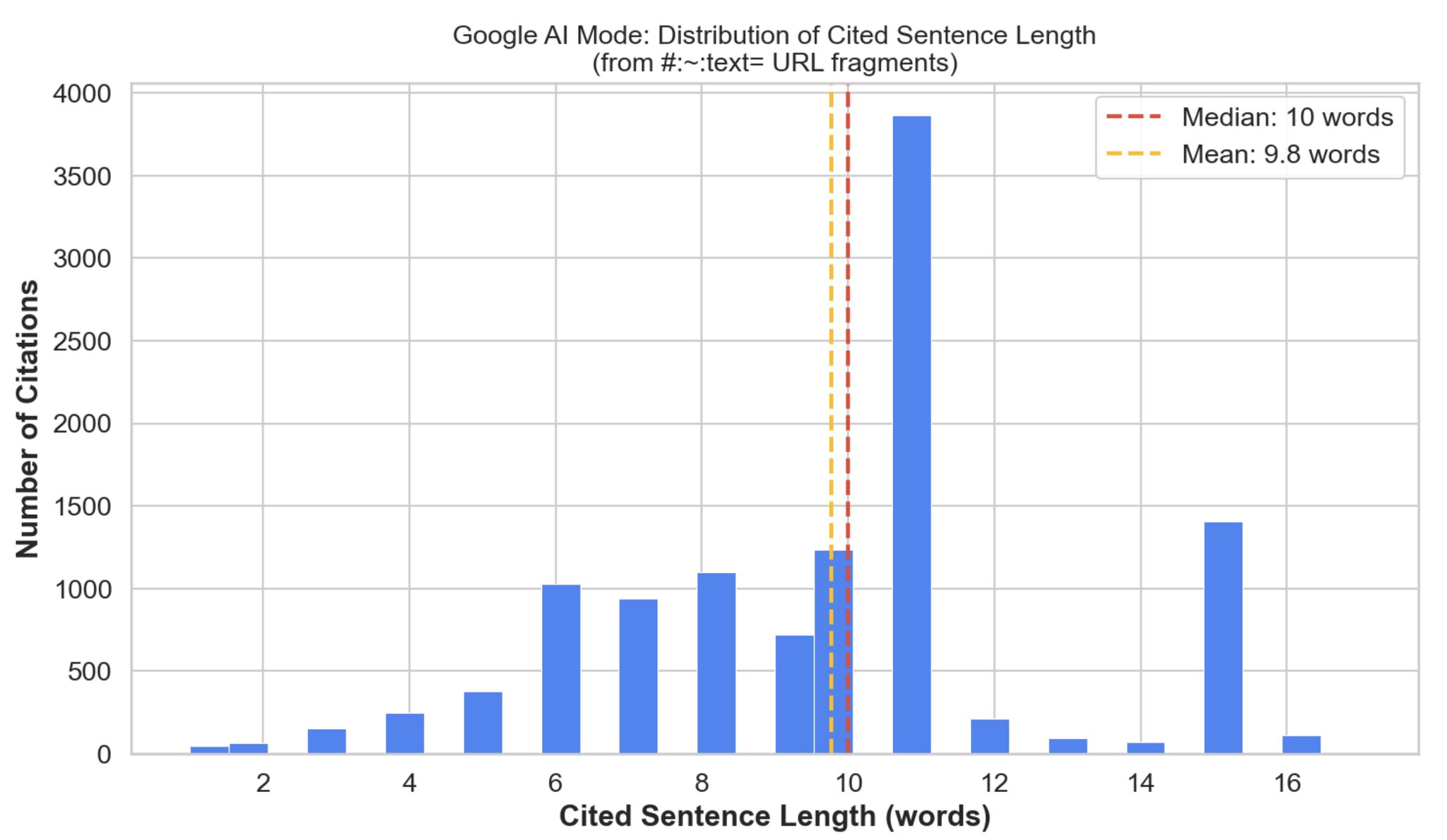
In a recent LinkedIn post, Ann Smarty discusses a new study that delves into the mechanics of AI citations, specifically focusing on AI Mode and Gemini’s use of text fragments that highlight exact sentences within cited content. Ann Smarty explains that this study, conducted by Daniel Shashko, reverse-engineered these citations to understand what content AI models prioritize and why.
As Ann Smarty highlights, the study uncovered several critical findings regarding the source of AI citations:
“Most citations come from the first 35% of the page (this aligns with Kevin Indig’s study)”
This initial finding suggests that the placement of information within a webpage significantly impacts its likelihood of being referenced by AI models. Ann Smarty emphasizes that this pattern is consistent with previous research, reinforcing the importance of front-loading key information.
Understanding AI’s Content Preferences
Ann Smarty further breaks down the study’s insights into the structural characteristics of cited content. According to the analysis shared by Ann Smarty, AI Mode and Gemini demonstrate a preference for specific types of sentences.
Sentence Structure and Length
The study, as relayed by Ann Smarty, found that AI citations are precise and avoid fragmentation:
“No single extraction starts or ends in the middle of a sentence”
This indicates that AI models are designed to pull complete thoughts rather than partial ones. Furthermore, Ann Smarty points out the significance of sentence conciseness:
“The median cited sentence is 10 words. Concise, declarative statements dominate. Nothing longer than 17 words was cited in the entire dataset.”
This observation is crucial for content creators aiming to have their material cited by AI. Ann Smarty stresses that brevity and clarity are paramount, with declarative statements being favored over complex or lengthy prose.
The Concept of the ‘Atomic Fact’
Ann Smarty elaborates on a key actionable takeaway from the study concerning ‘atomic facts’ within the context of Retrieval-Augmented Generation (RAG) systems. An atomic fact, as explained by Ann Smarty, is a self-contained sentence that conveys a single claim and makes sense independently.
The study identifies a ‘sweet spot’ for these atomic facts, aligning with the previously mentioned word count. Ann Smarty provides illustrative examples:
- Cited Example: “Intermittent fasting cycles between periods of eating and fasting.” (8 words) — cited ✅
- Non-Cited Example: “Studies have suggested that intermittent fasting may, depending on the individual’s metabolic profile, produce varying results in terms of weight management outcomes when compared with continuous caloric restriction approaches.” (31 words) — never cited ❌
Ann Smarty clarifies that the first example is a clear, atomic fact, whereas the second is hedged, compound, and cannot stand alone easily. According to Ann Smarty, Google’s content pipeline rewards the former and bypasses the latter, highlighting the importance of structuring information in a digestible and singular manner for AI consumption.
This analysis, shared by Ann Smarty, offers valuable guidance for SEO professionals and content creators seeking to optimize their material for AI-driven search and information retrieval.
📝 About This Content
This article is based on insights shared by Ann Smarty on LinkedIn.
📅 Originally posted on March 4, 2026 | View original post on LinkedIn →