
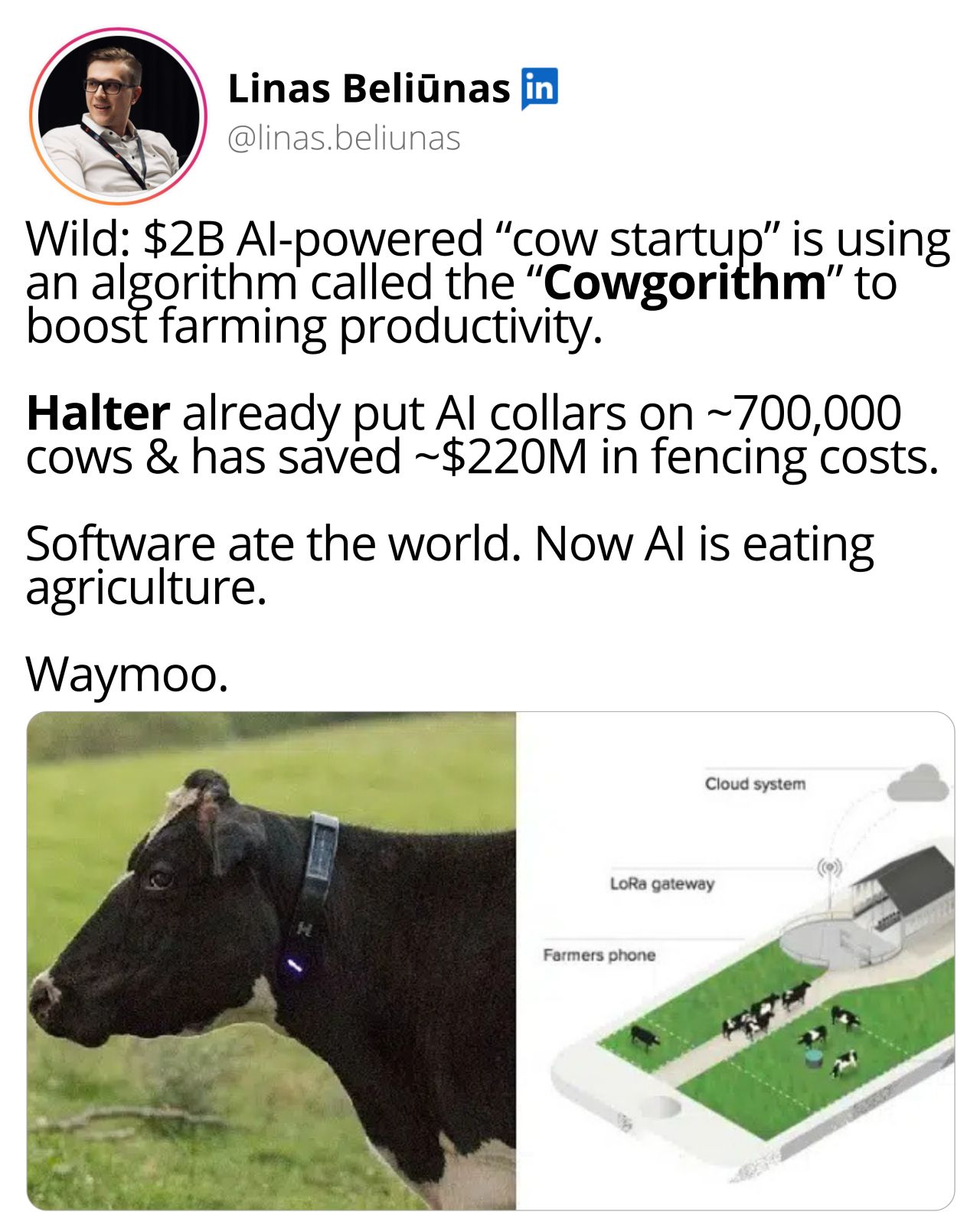
In a recent LinkedIn post, Linas Beliūnas explores the transformative impact of artificial intelligence on the agricultural sector, highlighting a New Zealand startup that is leveraging AI to fundamentally change how farms operate. Beliūnas introduces Halter, a company that has developed an AI-powered system, nicknamed the “Cowgorithm,” to manage livestock and boost farm productivity.
Beliūnas emphasizes the scale and effectiveness of this technology, noting that it’s not merely a concept but a working solution already deployed on a significant scale. He shares key metrics from Halter’s implementation:
“$5-8 per cow/month subscription → ~20-40 hours of labor saved per week → ~$220M saved in US fencing costs → +6-100% more pasture utilization → Real-time health + fertility tracking (6,000+ data points/min per cow)”
The core innovation, as described by Beliūnas, lies in equipping cows with AI collars that allow farmers to control entire herds with simple digital commands, eliminating the need for traditional methods like fences, dogs, and manual herding, especially at inconvenient hours.
The ‘Cowgorithm’: Training Animals with AI
Linas Beliūnas details the sophisticated yet effective training method employed by the “Cowgorithm.” This algorithm trains animals within days using a combination of sound and vibration, requiring minimal ongoing human intervention. This approach transforms the traditional farm into a more integrated system.
As Beliūnas puts it:
“Each cow becomes a node. Each farm becomes a system.”
This perspective underscores a significant paradigm shift in agriculture, where biological entities are managed through technological systems, akin to how software has reshaped other industries.
From Software to Agriculture: A New Era
Beliūnas draws a parallel between the widespread adoption of software in various sectors and the current advancements in agriculture. He suggests that AI and advanced software solutions are now making significant inroads into farming, a sector often perceived as traditional.
He elaborates on this trend:
“Software ate the world. Now, software & AI is eating agriculture.”
This statement encapsulates the accelerating pace at which technology is disrupting and optimizing even the most established industries. The application of AI, as highlighted by Beliūnas’s coverage of Halter, signifies a move towards data-driven, efficient, and less labor-intensive farming practices.
Furthermore, Beliūnas touches upon the broader implications of such technological integration, including enhanced animal health and fertility tracking, which can provide farmers with unprecedented insights into their livestock’s well-being and productivity. The system’s ability to collect thousands of data points per minute per cow offers a level of detail previously unimaginable.
Linas Beliūnas’s post serves as a compelling overview of how cutting-edge technology is not just entering but actively reshaping the future of farming, making operations more efficient, cost-effective, and data-rich.
📝 About This Content
This article is based on insights shared by Linas Beliūnas on LinkedIn.
📅 Originally posted on March 22, 2026 | View original post on LinkedIn →