
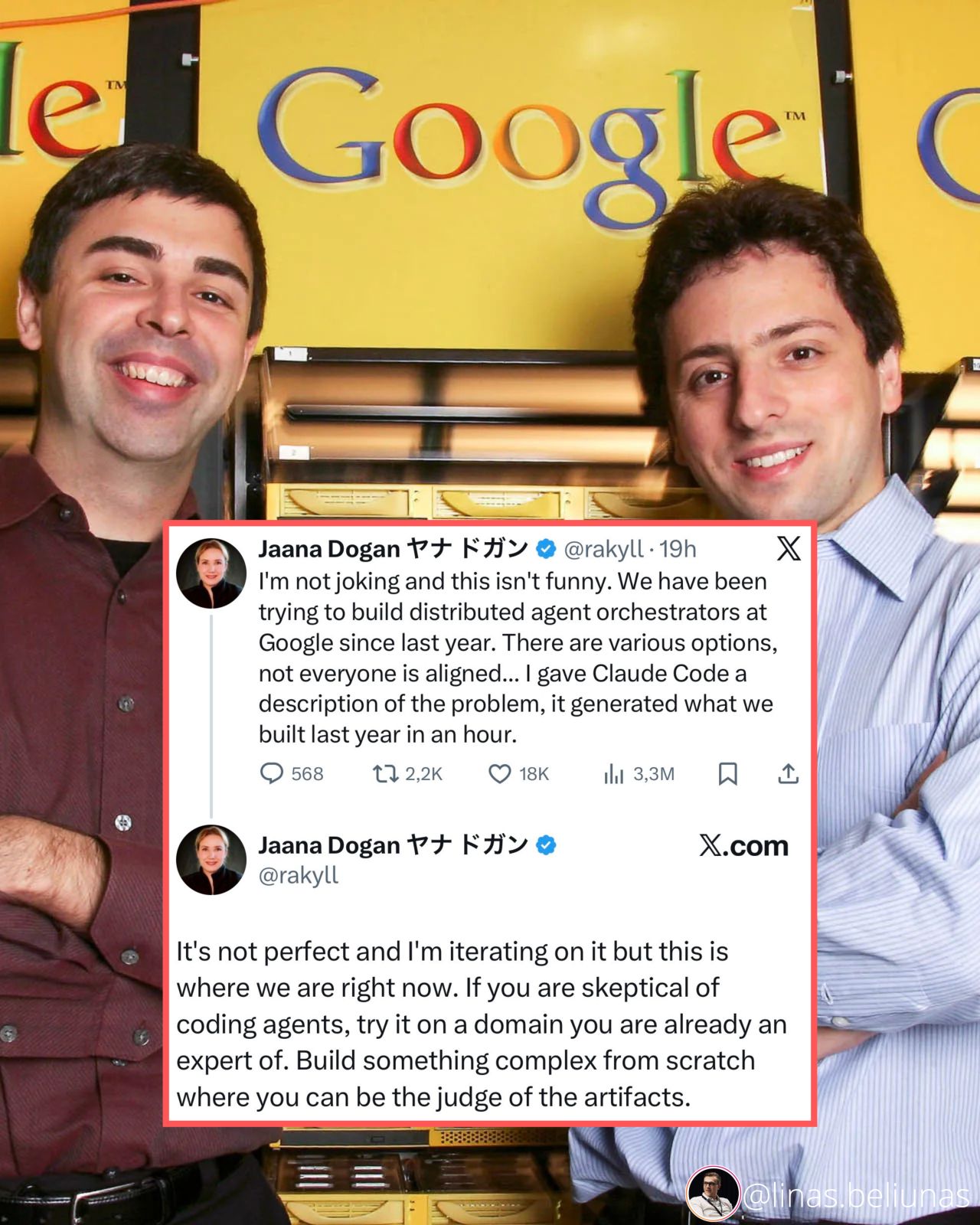
In a recent LinkedIn post, Linas Beliūnas discusses a striking anecdote involving Google engineers and Anthropic’s Claude Code, arguing that artificial intelligence’s ability to bypass bureaucratic hurdles is a more significant factor in its speed than raw coding power. Beliūnas highlights how Claude Code reportedly generated a working prototype of a distributed agent orchestrator in approximately 60 minutes, a task that had stalled a Google team for a year.
The AI vs. Bureaucracy Battle
Beliūnas questions the decision-making processes within large organizations, particularly Google’s reported stance on using internal tools like Gemini or Antigravity over external AI solutions such as Claude Code. He posits that the delay wasn’t due to a lack of engineering talent but rather the inherent slowness of large team processes.
“Big teams don’t move slow because engineers are bad. They move slow because: Alignment takes weeks, Reviews take months, Decisions get diluted.”
This observation leads Beliūnas to a critical point: AI’s immediate output forces a confrontation with existing debates. As he notes, quoting the legendary Paul Graham:
“A concrete thing beats endless discussion”.
The implication, according to Beliūnas, is that the existence of a working AI-generated prototype immediately shifts the focus from theoretical discussion to practical implementation, thereby collapsing lengthy deliberation periods.
Optimizing for Output, Not Politics
Beliūnas identifies an uncomfortable truth for many corporations: forcing the use of internal tools when superior external options exist can be a sign of optimizing for internal politics rather than genuine output. He argues that such a strategy stifles innovation and efficiency.
Empowering Builders with the Best Tools
The core message from Beliūnas’s analysis is that the most effective teams prioritize providing their engineers with the best available tools and then allow them the autonomy to use them. This approach, he suggests, is the sole differentiator for winning teams.
“If your company forces internal tools while better ones exist outside, you’re optimizing for politics – not output. The best teams will win by doing one thing and one thing only: Give builders the best tools, and then get out of the way.”
Beliūnas concludes that the real power of AI in this context isn’t necessarily that it’s a better coder than humans, but that it can act as a catalyst, rapidly producing tangible results that cut through the complex layers of corporate bureaucracy. This allows teams to move faster and focus on innovation rather than internal processes.
📝 About This Content
This article is based on insights shared by Linas Beliūnas on LinkedIn.
📅 Originally posted on January 3, 2026 | View original post on LinkedIn →