
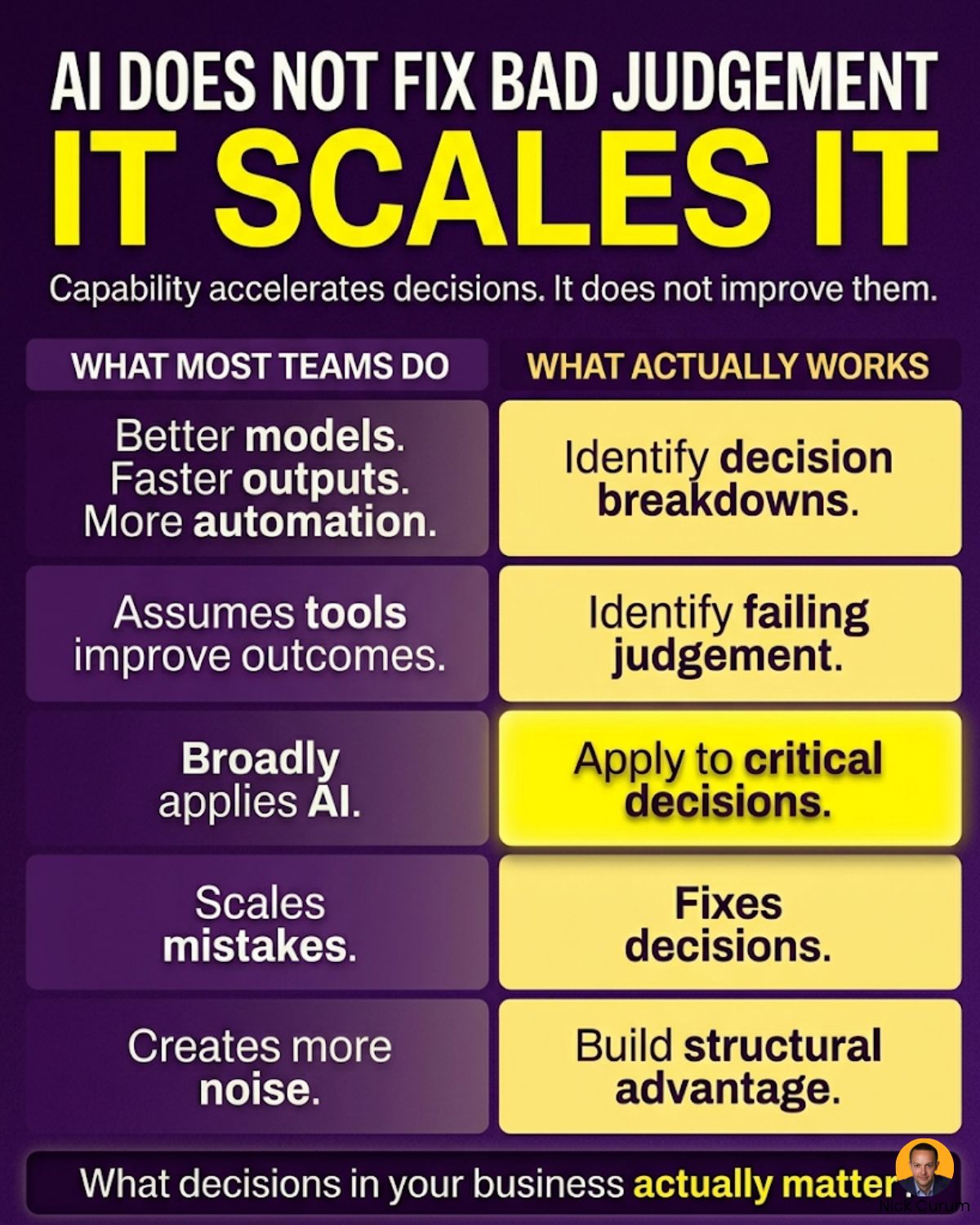
In a recent LinkedIn post, Nick Curum discusses a critical pitfall many organizations face when implementing Artificial Intelligence (AI). He argues that the primary mistake is not in the technology itself, but in how it’s applied. According to Curum, companies are often using AI to accelerate existing poor decision-making processes rather than to fundamentally improve strategic outcomes.
Curum highlights a common misconception about AI’s capabilities, stating:
“AI does not fix bad judgement. It scales it.”
This statement underscores his central thesis: AI is a powerful amplifier, and if the underlying decisions being made are flawed, AI will simply make those flaws more pronounced and impactful. He uses the energy sector as a prime example, where teams attempt to automate complex tasks like supply forecasting or workflow triage without first addressing the foundational strategy.
The Danger of Accelerating Flawed Strategies
Curum points out that many organizations approach AI with a focus on technical capabilities rather than strategic impact. This often manifests as a drive for:
- Better models
- Faster outputs
- More automation
While these are desirable outcomes, Curum contends that they are secondary to the core problem of where and why AI is deployed. He warns that if an organization already struggles with:
- Backing the wrong opportunities
- Prioritizing poorly
- Optimizing the wrong metrics
AI will inevitably exacerbate these issues. The result, in his view, is not enhanced performance but rather an increase in what he terms “faster noise.”
“The difference between real ROI and creating noise is not the model. It is where AI is applied.”
This distinction is crucial, according to Curum. The effectiveness of AI is directly tied to its application within the decision-making framework of a business.
Identifying the Right Application for AI
Curum suggests that the most effective AI implementations begin by identifying where decision-making processes are weakest. He contrasts the common approach with that of more successful teams:
- Common Approach: Focus on AI capabilities (better models, faster outputs).
- Best Practice Approach: Identify where decision-making breaks down.
This shift in perspective is fundamental. “That is where AI belongs. Everything else is experimentation,” Curum asserts. He frames the core question for any organization rolling out AI as identifying the decisions that truly drive business value.
“If you are rolling out AI right now, this is the only question that matters: What decisions in this business actually move the needle?”
By focusing on the critical decision points, businesses can ensure that AI is used to enhance strategic judgment and drive tangible ROI, rather than simply amplifying existing inefficiencies. Curum concludes by posing a critical self-reflection question for businesses:
“Where does AI break decisions in your business, and where does it improve them?”
This prompts a necessary evaluation of AI’s true impact, moving beyond the hype to focus on strategic, impactful implementation.
📝 About This Content
This article is based on insights shared by Nick Curum on LinkedIn.
📅 Originally posted on March 27, 2026 | View original post on LinkedIn →