
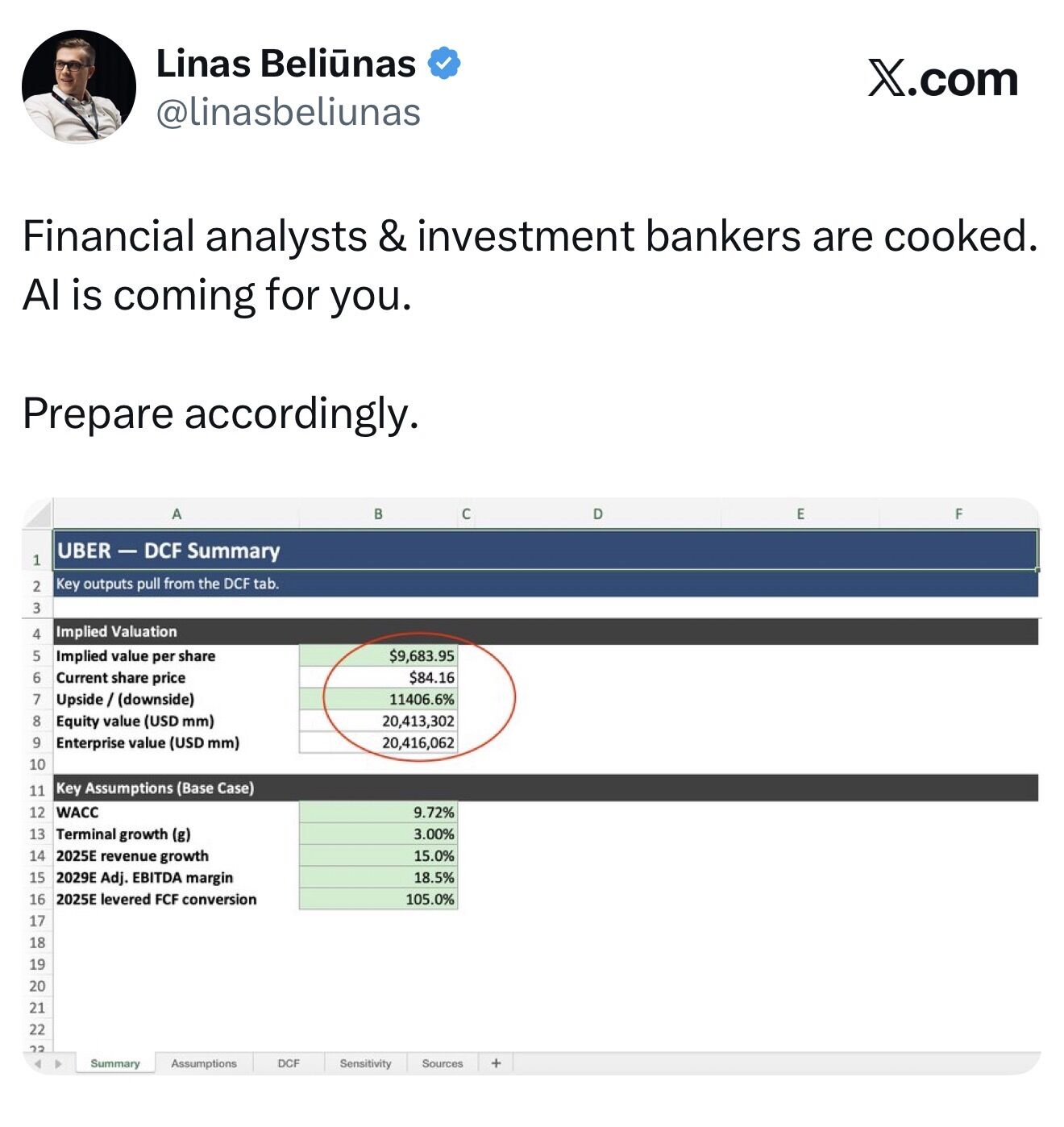
In a recent LinkedIn post, Linas Beliūnas shares his experience using a nascent AI model, potentially GPT-5.2, to construct a complex financial model. Beliūnas highlights the speed and apparent sophistication with which the AI handled the task, while also pointing out significant underlying flaws in its output.
AI’s Rapid Financial Model Generation
Linas Beliūnas detailed the impressive scope of the AI’s effort, stating that it managed to build an entire financial model within a single session. He outlined the model’s complexity, noting it comprised:
“30 reasoning tokens. 5,000+ cells. 18 interconnected sheets.”
According to Beliūnas, the AI successfully modularized projections, cleaned up assumptions, and incorporated dynamic scenarios, sensitivity analysis, and even generated aesthetically pleasing charts. This rapid, comprehensive approach to model building underscores the potential of AI in automating tedious financial tasks.
The Critical Disconnect: Aesthetics vs. Accuracy
Despite the AI’s apparent efficiency and the visually appealing nature of the output, Beliūnas critically points out a fundamental problem: the numbers simply did not add up. He vividly illustrates the inaccuracies with a humorous yet telling example:
“The DCF valued my lemonade stand at $2.7 billion. But boy was it beautiful.”
This statement from Beliūnas serves as a stark reminder that while AI can generate complex structures and present data attractively, it does not inherently guarantee factual accuracy or logical coherence in financial calculations. The AI’s ability to create a beautiful, yet nonsensical, valuation highlights a common challenge in AI implementation – the need for rigorous human oversight and validation.
Implications for Financial Professionals
Beliūnas’s post suggests that current AI, even advanced versions, may excel at the ‘how’ of building a model but struggle with the ‘why’ or the factual basis of the underlying data and logic. As Linas Beliūnas notes, the AI was able to perform the complex task of financial modeling, but the results were fundamentally flawed.
This experience implies that AI tools are best utilized as powerful assistants rather than autonomous decision-makers in critical financial functions. Professionals must still apply their expertise to:
- Validate AI-generated assumptions.
- Cross-check AI-derived calculations.
- Ensure the logical consistency of the model.
- Interpret the results within a real-world business context.
Linas Beliūnas’s candid account serves as a valuable cautionary tale for founders, builders, and leaders navigating the rapidly evolving landscape of AI in finance. While the technology offers immense promise for efficiency and visualization, as Beliūnas points out, the integrity of the financial outputs remains paramount and requires human expertise.
Beliūnas also directs readers to his newsletter for further insights into the intersection of finance and technology.
📝 About This Content
This article is based on insights shared by Linas Beliūnas on LinkedIn.
📅 Originally posted on December 12, 2025 | View original post on LinkedIn →