
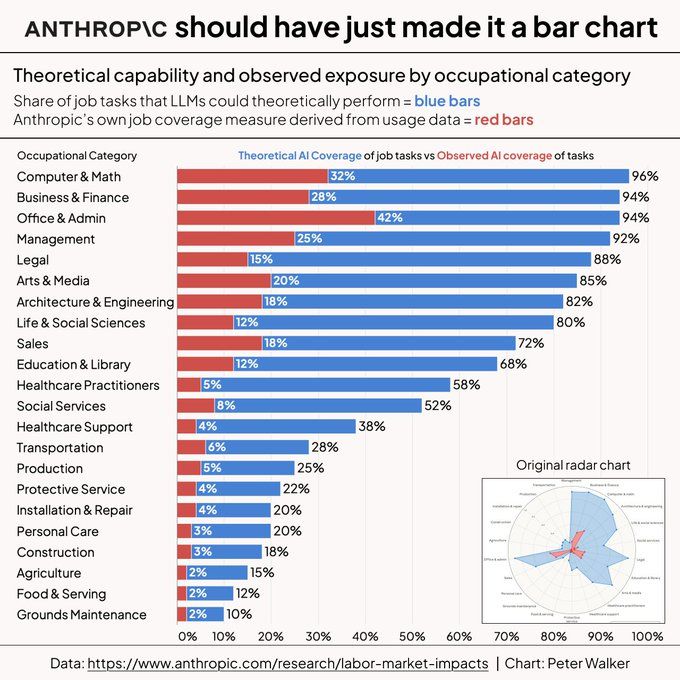
In a recent LinkedIn post, Liz Bradford discusses the significant theoretical capacity of Artificial Intelligence to automate tasks within business and finance, while cautioning that current low adoption rates represent a critical runway rather than a safety net.
Bradford highlights research from Anthropic that maps AI’s potential versus its actual deployment across major job categories, noting that management, business and finance, legal, and computer and math fields show the highest theoretical exposure to AI automation.
“The highest theoretical exposure? Management. Business and Finance. Legal. Computer and Math. Your world.”
The delay in AI adoption, Bradford explains, is not due to AI’s inability to perform tasks, but rather integration lags, legal constraints, and slow organizational cycles. She emphasizes that this delay is temporary and poses a direct challenge to senior professionals.
The Demographic Impact of AI Automation
A particularly stark point raised by Bradford is the demographic profile of workers most exposed to AI-driven automation. She states that these are not junior roles, but rather individuals who are older, female, highly educated, and higher-paid.
“The workers most exposed are older, female, highly educated, and higher paid. This isn’t a junior problem. It’s yours.”
Bradford criticizes the common misconception among senior executives that their seniority provides an inherent shield against AI. She argues that this is a false sense of security, and that true resilience comes from proactively building an “Irreplaceability Stack”—a deliberate set of capabilities that AI cannot easily replicate at the senior level.
Building an ‘Irreplaceability Stack’
Bradford outlines a five-step protocol for professionals to adapt and thrive in an AI-augmented future. She asserts that those who will succeed are not those who ignore the trend, but those who actively engage with it.
1. Audit Your Task Exposure
The first step involves identifying the core tasks that consume a significant portion of one’s work week and assessing whether a well-prompted AI could perform them. Bradford suggests that if AI can handle a task, it might represent a ‘commodity skill’ rather than a unique differentiator.
2. Move Up the Decision Stack
Bradford advises professionals to focus on areas where human judgment is indispensable. She notes that while AI excels at analysis, it struggles with making decisions amidst political ambiguity, navigating complex stakeholder dynamics, or operating under pressure with incomplete information.
“AI is excellent at analysis. It cannot make calls under political ambiguity, navigate messy stakeholder dynamics, or operate under pressure with incomplete information. That’s where you live. Stay there.”
3. Build AI Fluency Proactively
She encourages executives to develop a practical understanding of AI before it becomes a mandatory organizational requirement. Bradford suggests running at least one real AI workflow within the current month to gain hands-on experience.
4. Strengthen Unique Human Capabilities
Bradford emphasizes the importance of cultivating uniquely human assets such as one’s network, reputation, and the ability to interpret social cues—skills honed through years of accumulated context that are not replicable by AI models.
5. Enhance Visibility and Personal Brand
Finally, Bradford stresses the need for professionals to make their value undeniable, especially as hiring for entry-level roles in high-exposure categories begins to slow. She advocates for taking ownership of one’s personal brand to avoid potential irrelevance.
In conclusion, Liz Bradford’s post serves as a critical call to action for senior leaders and highly educated professionals, urging them to recognize the imminent impact of AI and to proactively build the skills and capabilities that will ensure their continued value in the evolving labor market.
📝 About This Content
This article is based on insights shared by Liz Bradford on LinkedIn.
📅 Originally posted on March 10, 2026 | View original post on LinkedIn →