
In a recent LinkedIn post, 🌀 Luca Rossi discusses the paradoxical effect Artificial Intelligence is having on software development workflows, suggesting it may be increasing the initiation of tasks while hindering their completion.
Drawing on a large report by Faros surveying over 20,000 developers, Rossi highlights a series of concerning trends that have emerged with the increased integration of AI coding tools. The data suggests a significant strain on development pipelines, with implications for efficiency and product quality.
“Developers touch 67% more PRs/day… but deployments per week are down 12%”
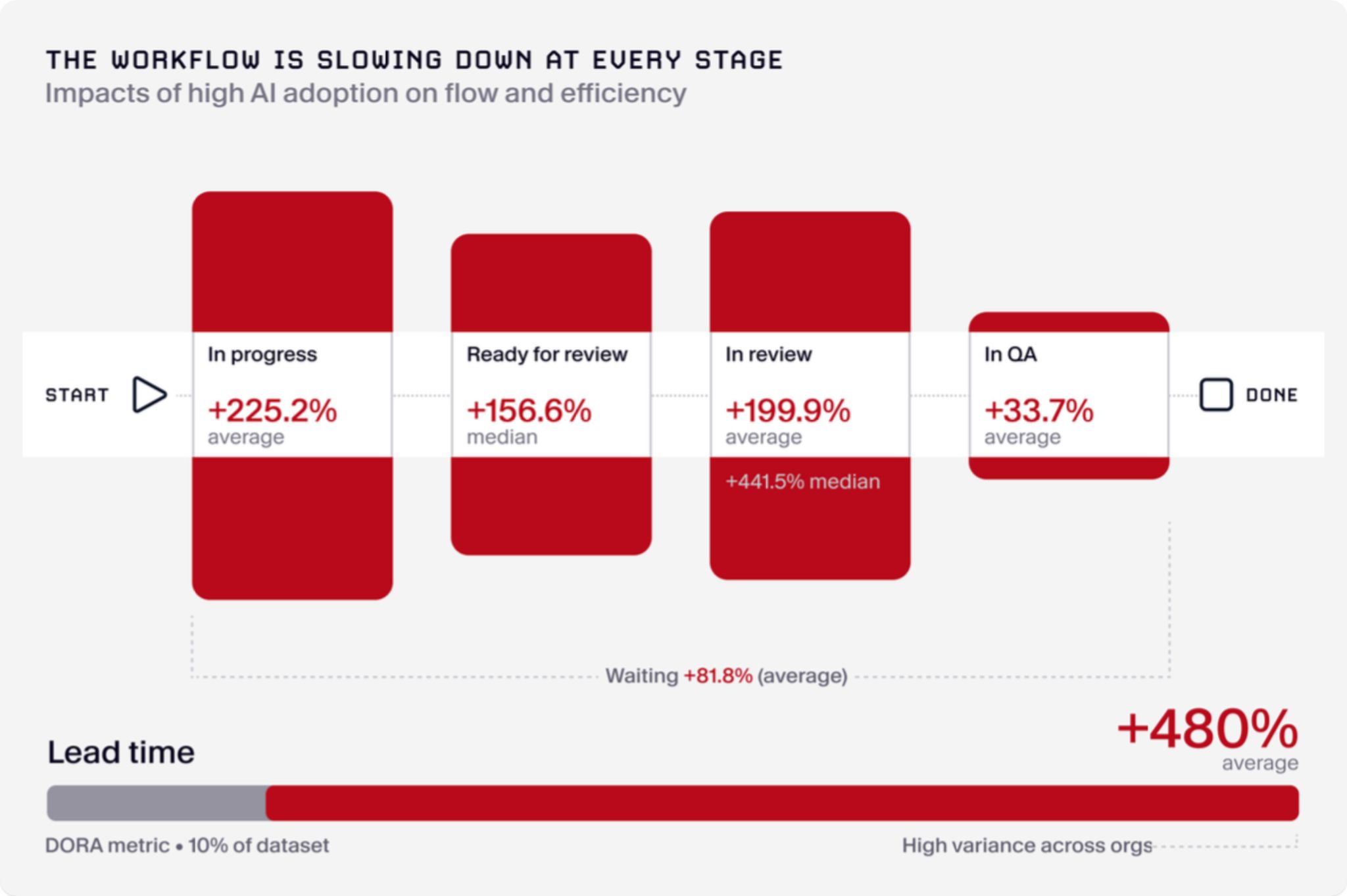
As 🌀 Luca Rossi points out, the metrics paint a stark picture of a development process under duress. Beyond the increased number of Pull Requests (PRs) and decreased deployments, the report indicates a substantial rise in stalled tasks, with those awaiting attention for over seven days increasing by 26%. Lead time, a critical indicator of development velocity, has reportedly skyrocketed by 480%.
Code Reviews Under Strain
🌀 Luca Rossi identifies code reviews as a particularly vulnerable bottleneck within the development pipeline. The data indicates that the median wait time for a PR review has increased by a staggering 156%, and the actual time spent in review has nearly tripled, up by 199%. This intensified scrutiny, however, does not appear to be catching more issues before they reach production.
Quality Leaks Despite Increased Effort
Despite the amplified effort in code reviews, 🌀 Luca Rossi notes that problems are still significantly impacting live environments. The report cited shows a 58% increase in monthly incidents and a 54% rise in bugs per developer. This suggests that the current review process, even with AI assistance, is struggling to maintain code quality.
“By now reviews look completely broken to me, and I don’t think the current process is salvageable in any way. AI coding scales with a different trajectory than human reviews — it’s just unreasonable to expect humans to keep reviewing every single line of code.”
In 🌀 Luca Rossi’s view, the fundamental issue lies in expecting human reviewers to keep pace with AI-generated code, a task that has become increasingly untenable. The traditional review process, as Rossi argues, is not equipped to handle the scale and speed introduced by AI.
Pathways Forward
To navigate these challenges, 🌀 Luca Rossi proposes three key strategies for organizations to consider:
1. Shift Quality Left
🌀 Luca Rossi advocates for moving quality checks earlier in the development cycle, reducing reliance on traditional code reviews as the primary safeguard. This involves leveraging automated tools for code health inspection, robust testing, and design review.
2. Instrument Everything
A strong emphasis is placed on comprehensive monitoring and observability. Rossi argues that in today’s environment, there is no excuse for not measuring the development pipeline and its outputs. Effective use of metrics, logs, and traces can significantly aid in identifying and resolving issues in production, and also enhance AI’s ability to triangulate problems.
3. Engage with Engineers
Finally, 🌀 Luca Rossi stresses the importance of direct communication with development teams. As Rossi notes, engineers on the ground are often aware of process issues. Engaging them in open dialogue can provide invaluable insights and foster a collaborative approach to finding solutions.
“Always start from there. Ask them! They’ll be happy to be heard, and you can design how to improve together.”
🌀 Luca Rossi’s analysis provides a critical perspective on the real-world impact of AI in software development, urging a re-evaluation of established processes to better align with the evolving technological landscape.
📝 About This Content
This article is based on insights shared by 🌀 Luca Rossi on LinkedIn.
📅 Originally posted on June 29, 2026 | View original post on LinkedIn →