
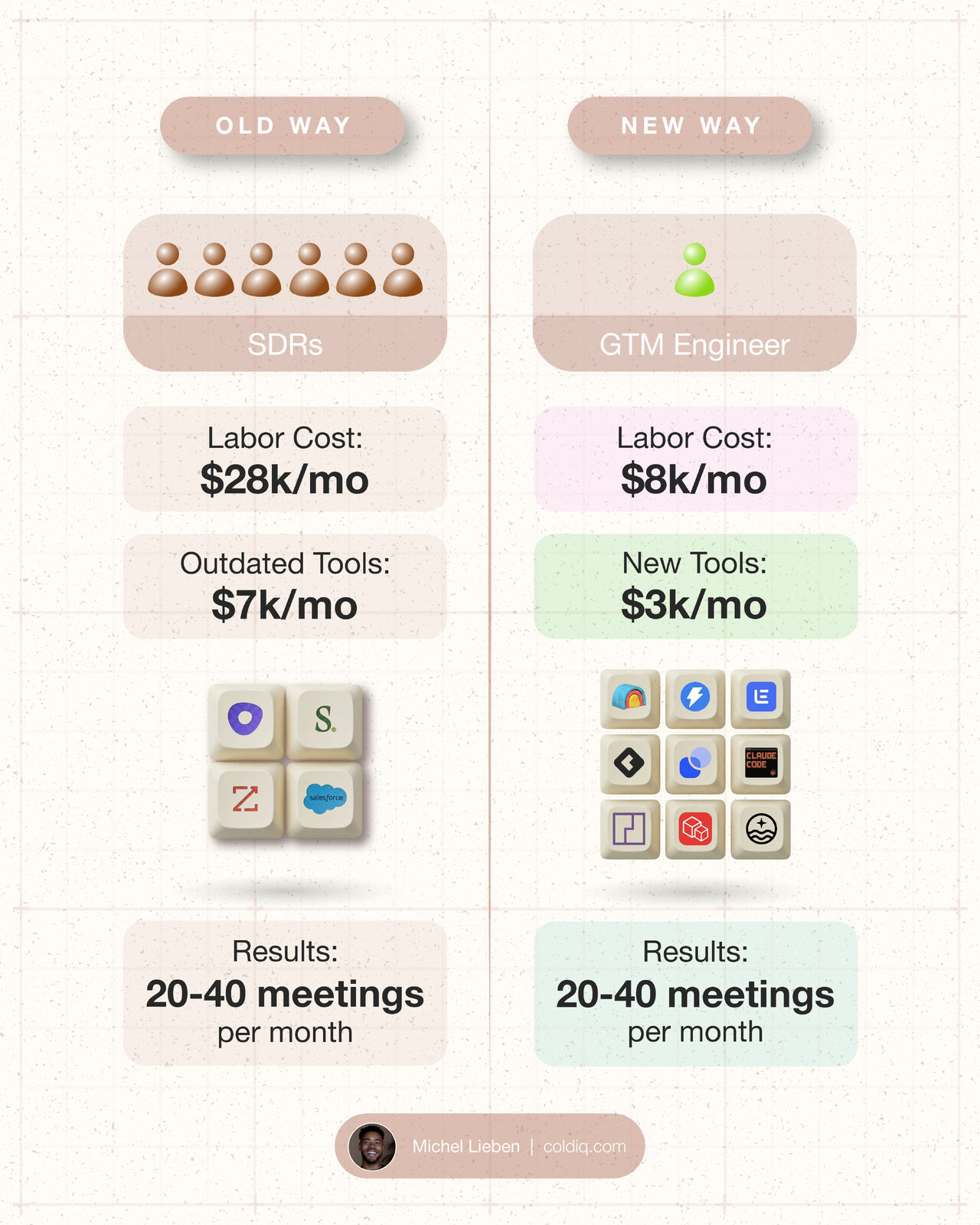
In a recent LinkedIn post, Michel Lieben 🧠 discusses the profound impact of Artificial Intelligence on the Sales Development Representative (SDR) role, arguing that while AI automates tasks, it simultaneously elevates the value of skilled SDRs and necessitates a strategic adaptation of Go-To-Market (GTM) teams.
Michel Lieben 🧠 challenges the notion that AI’s efficiency diminishes the importance of SDRs. Instead, the post posits that the opposite is true, provided GTM teams evolve their strategies. The traditional SDR model, involving broad prospecting across multiple channels for a list of target accounts, is being superseded.
The Evolving SDR Landscape
According to Michel Lieben 🧠, the future of GTM involves a more specialized approach where individual specialists focus on specific channels, and sophisticated systems orchestrate outbound efforts. This shift redefines the SDR’s function, prompting Michel Lieben 🧠 to outline two primary paths for SDRs to maintain and increase their value.
Doubling Down on Human-Centric Skills
The first path, as highlighted by Michel Lieben 🧠, is to intensify focus on inherently human-centric activities that AI currently struggles to replicate. Michel Lieben 🧠 writes:
“AI isn’t replacing people who are great at cold calling just yet.
In a world where everything can be automated, most will chase shortcuts.
That means fewer people picking up the phone.
And that’s the opportunity.”
This perspective suggests that as automation becomes more prevalent, the ability to perform manual, high-touch activities like making cold calls will become a significant differentiator. Michel Lieben 🧠 emphasizes that this also involves investing more time in navigating complex sales cycles and building multi-threaded relationships – areas where AI’s capabilities are limited and where many peers might shy away due to the increased effort required.
Embracing the Technical Frontier of GTM
The second strategic avenue proposed by Michel Lieben 🧠 involves leaning into the technical aspects of GTM. This entails mastering a suite of advanced tools that leverage AI for maximum efficiency and effectiveness. Michel Lieben 🧠 lists several such tools, including Clay, Claude Code, PredictLeads, Prospeo, FullEnrich, Common Room, Instantly.ai, lemlist, and Relevance AI. The post elaborates on AI’s superior performance in specific domains:
“And you push AI to its limits in areas where it completely outperforms humans:
i.e:
– Detecting patterns across millions of data points
– Scoring and researching 10,000 prospects in minutes
– Running dozens of workflows simultaneously without fatigue”
This approach positions SDRs not just as outreach specialists but as technically adept professionals who can harness AI’s power for data analysis, rapid research, and high-volume, fatigue-free workflow execution.
The Hybrid Model for Peak Performance
Ultimately, Michel Lieben 🧠 advocates for a hybrid model that combines both human expertise and AI-driven efficiency. The ideal scenario, according to the post, involves:
- GTM Engineers: Professionals who construct large-scale prospecting systems and ensure the delivery of highly accurate data to SDRs.
- SDRs: Individuals who excel at booking meetings through a combination of personalized manual outreach and direct phone engagement.
Michel Lieben 🧠 concludes by stating that this integrated approach is what top-performing clients are implementing and what has been successfully deployed for organizations valued at over $1 billion, marking it as the definitive strategy for success in 2026 and beyond. The post ends with a call to action, asking how others are adapting to this evolving landscape.
📝 About This Content
This article is based on insights shared by Michel Lieben 🧠 on LinkedIn.
📅 Originally posted on April 9, 2026 | View original post on LinkedIn →