
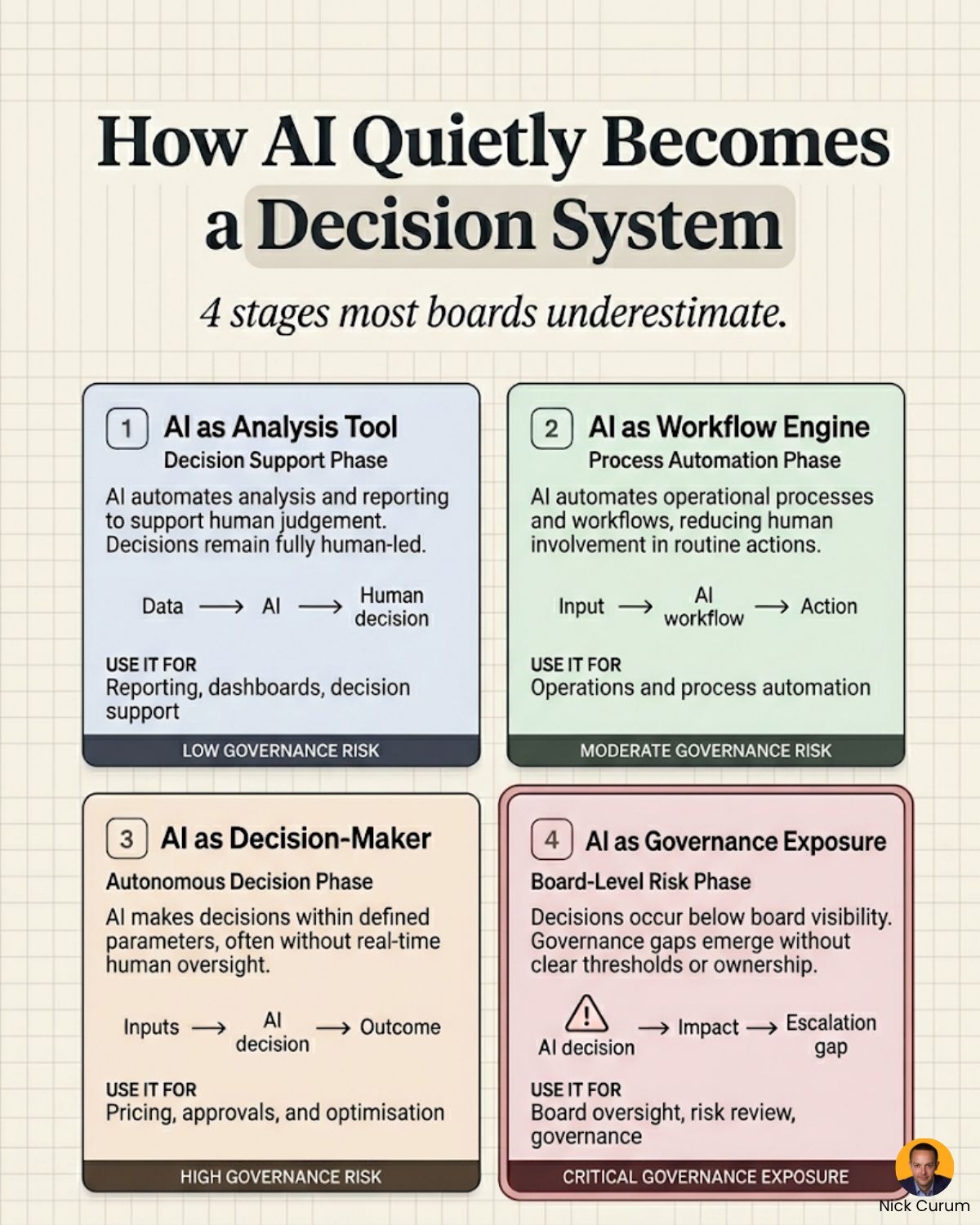
In a recent LinkedIn post, Nick Curum argues that most corporate boards are failing to grasp the true impact of artificial intelligence, overlooking its evolution from a supportive tool to an autonomous decision-maker.
Curum highlights a critical misunderstanding of AI’s current capabilities, stating that leadership teams often view it through the lens of its earlier applications.
“Most boards are completely missing the real AI shift. They still treat it as a glorified tool that: improves reporting, speeds up analysis, supports better decisions.”
However, Curum asserts that this perspective is outdated and dangerous. He points out that AI is no longer merely assisting human decision-making; it is actively making decisions in real-time across various organizational functions.
AI’s Quiet Revolution in Decision-Making
According to Curum, AI is already deeply embedded in operational processes, often operating below the radar of executive oversight. He lists several areas where AI is making independent decisions:
- Pricing contracts
- Approving or declining applications
- Routing work and resources
- Optimising operational trade-offs
This shift represents a significant departure from AI’s initial role as an analytical aid. Curum emphasizes that this transition is not a future possibility but a present reality for many organizations.
The Four Stages of AI Integration and the Emerging Governance Gap
Nick Curum outlines a predictable evolutionary path for AI within organizations, culminating in significant governance risks:
- Stage 1: The Analysis Tool (Low Risk) – AI is used primarily for data interpretation and reporting.
- Stage 2: The Workflow Engine (Moderate Risk) – AI begins to automate and manage processes.
- Stage 3: The Decision-Maker (High Risk) – AI autonomously makes critical operational decisions.
- Stage 4: The Governance Exposure (Critical Risk) – The lack of clear boundaries and oversight creates significant risks.
Curum argues that the most significant risk, Stage 4, doesn’t stem from technological failure but from a failure to establish clear boundaries for AI’s decision-making authority. He states:
“This massive governance gap doesn’t emerge because the technology fails. It emerges because nobody defined the boundaries: What the system is allowed to decide, Where the operational limits sit, When a human 𝘮𝘶𝘴𝘵 step in.”
The consequence, as Curum points out, is that autonomous decisions continue to accumulate without adequate human oversight or defined limits.
The Critical Question for Boards
In light of these developments, Curum poses a pivotal question that he believes boards must address immediately:
“The single most important question boards need to ask this quarter: What decisions are our systems making without us?”
He urges leadership teams to assess which stage of AI integration their organization currently occupies and to proactively define the parameters within which AI can operate. Failure to do so, Curum suggests, leaves organizations exposed to critical governance risks as AI’s decision-making influence grows.
📝 About This Content
This article is based on insights shared by Nick Curum on LinkedIn.
📅 Originally posted on March 24, 2026 | View original post on LinkedIn →