
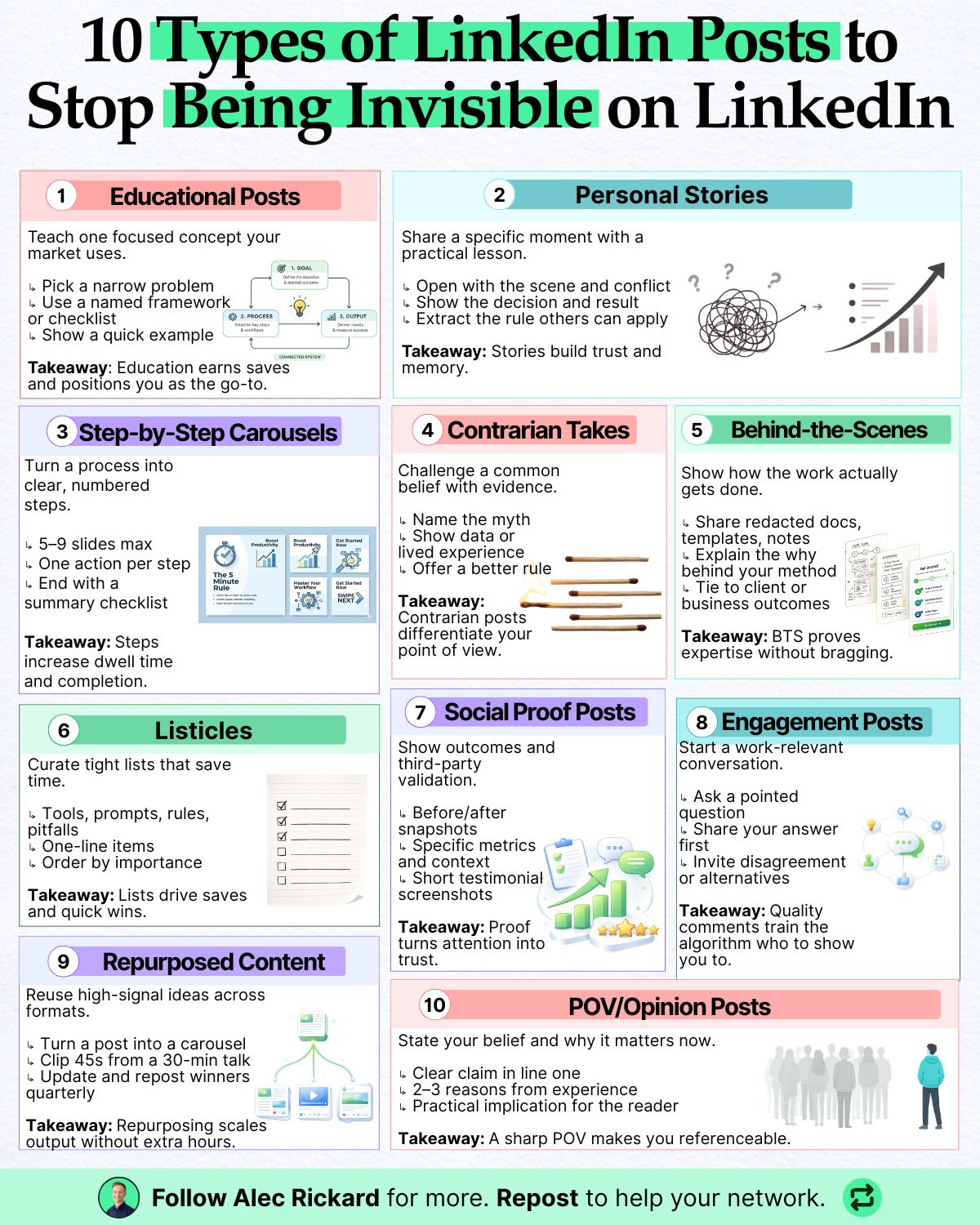
In a recent LinkedIn post, Alec Rickard challenges the notion that organic reach on the platform is dead, asserting instead that “Lazy content is.” Rickard, a recognized voice in professional development and careers, argues that the effectiveness of one’s presence on LinkedIn hinges on strategic content formatting, particularly as the platform’s algorithm evolves to prioritize usefulness, watch time, and saves.
According to Rickard, founders and executives often face visibility challenges due to format choices rather than a lack of reach. He emphasizes that the right approach can transform expertise into tangible business outcomes, including inbound deals, talent acquisition, and speaking opportunities. Conversely, ineffective content strategies, he warns, can lead to wasted time and continued obscurity.
Understanding LinkedIn’s Evolving Algorithm
Rickard highlights that the LinkedIn algorithm in 2026 is predicted to reward specific user behaviors. He states:
“LinkedIn’s algorithm in 2026 rewards usefulness, watch time, and saves.”
This algorithmic shift, as explained by Rickard, means that simply posting isn’t enough; the content must actively engage users and provide demonstrable value. He posits that format choice is a critical component of this strategy, enabling professionals to effectively translate their knowledge into measurable results.
Ten Post Formats for Gaining Attention
Rickard outlines ten distinct post types designed to capture attention and build authority on LinkedIn. Each format is presented with a specific objective and a clear takeaway:
1. Educational Posts
Rickard advocates for teaching a single, focused concept relevant to the target market. This involves identifying a narrow problem, utilizing a named framework or checklist, and providing a concise example. The takeaway, according to Rickard, is that education earns saves and establishes the author as a go-to resource.
2. Personal Stories
Sharing a specific personal moment with a practical lesson is another recommended format. Rickard suggests opening with the scene and conflict, detailing the decision-making process and its outcome, and then extracting an applicable rule for the audience. He notes that stories build trust and enhance memory retention.
3. Step-by-Step Carousels
For processes, Rickard recommends carousels with a maximum of 5-9 slides, focusing on one action per step and concluding with a summary checklist. This format, he argues, increases dwell time and user completion rates.
4. Contrarian Takes
Challenging common beliefs with evidence is presented as a way to differentiate a point of view. Rickard advises naming the myth, supporting the challenge with data or lived experience, and offering a superior rule.
5. Behind-the-Scenes (BTS)
Showing the actual work process, including redacted documents or templates, and explaining the methodology’s ‘why’ and its business outcomes, is a strategy Rickard suggests for proving expertise authentically. As Rickard puts it:
“BTS proves expertise without bragging.”
6. Listicles
Curating concise lists of tools, prompts, rules, or pitfalls, ordered by importance, can save the audience time and drive saves, according to Rickard.
7. Social Proof Posts
Displaying outcomes and third-party validation, such as before/after metrics or testimonials, is crucial for converting attention into trust. Rickard points out:
“Proof turns attention into trust.”
8. Engagement Posts
Initiating work-relevant conversations by asking a pointed question and sharing one’s own answer first can train the algorithm, Rickard explains, by inviting disagreement and alternatives, which leads to quality comments.
9. Repurposed Content
Reusing high-signal ideas across different formats, like turning a post into a carousel or clipping video content, is a method Rickard suggests for scaling output efficiently.
10. POV/Opinion Posts
Stating a clear belief and its current relevance, supported by personal experience and practical implications for the reader, makes one referenceable, according to Rickard’s framework.
Ultimately, Rickard concludes that most visibility issues stem from format problems. He asserts that authority is built by teaching, proving, and inviting dialogue. He encourages professionals to rotate these ten formats, measure their impact via saves, comments, and profile visits, and use this data to build visible authority.
📝 About This Content
This article is based on insights shared by Alec Rickard on LinkedIn.
📅 Originally posted on March 29, 2026 | View original post on LinkedIn →