
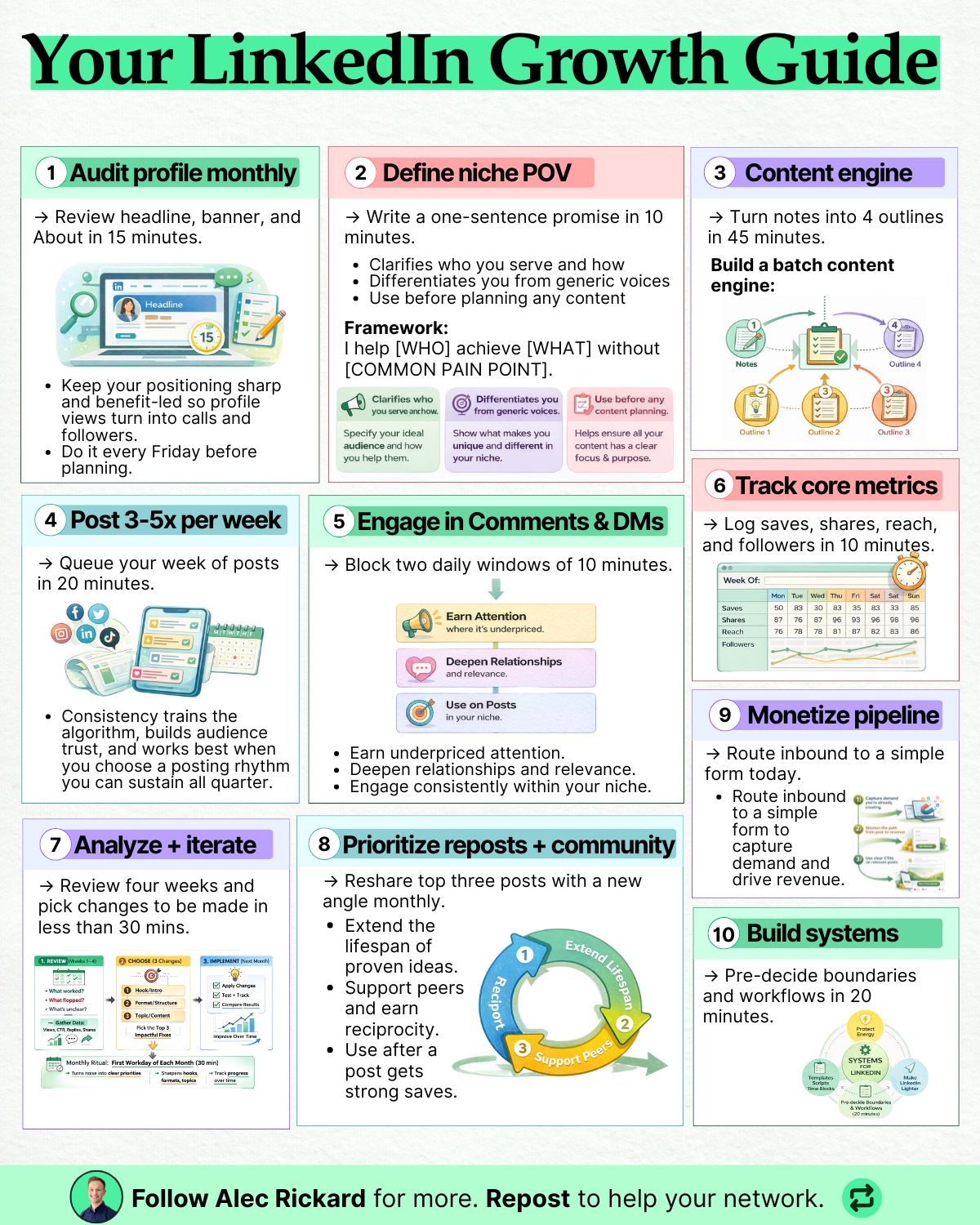
In a recent LinkedIn post, Alec Rickard outlines a strategic approach to growing a presence on the platform without succumbing to burnout. Rickard frames his methodology as an “anti-burnout growth plan” designed for busy professionals, emphasizing the creation of repeatable systems over sporadic, high-stress efforts.
“If you seriously want to grow on LinkedIn, you need a repeatable system that fits a busy calendar. Most stall because they guess, post, and burn out.”
The core of Rickard’s strategy is to treat LinkedIn as an operational function, which he believes leads to compound growth. He details a 10-part system aimed at building sustainable habits and focusing on impactful activities rather than sheer volume.
The Foundation: Profile Audit and Niche Clarity
Rickard begins by stressing the importance of regular profile maintenance. His first step involves a monthly audit of the headline, banner, and About section, a process he estimates takes only 15 minutes. As Rickard notes, this ensures:
“Keep positioning sharp and benefit-led. Converts views into calls and followers.”
Following profile optimization, Rickard advocates for defining a clear niche point of view (POV). This involves crafting a one-sentence promise that clarifies the target audience and the unique value proposition. This step, which Rickard suggests takes about 10 minutes, is crucial for differentiation in a crowded digital space.
Building a Content Engine and Engagement Strategy
A significant portion of Rickard’s system focuses on efficient content creation and distribution. He proposes building a “batch content engine” where users can turn notes into four outlines in 45 minutes, thereby reducing friction and the need for daily content ideation. He suggests posting 3-5 times per week, queuing up content in advance to maintain consistency without daily pressure.
Rickard also emphasizes the value of engagement, recommending two 10-minute daily windows for interacting in comments and direct messages. He argues that this is where attention is “underpriced” and helps deepen relationships and relevance within one’s niche.
“Earn attention where it’s underpriced. Deepens relationships and relevance.”
Measuring Success and Iterating for Growth
To ensure effectiveness, Rickard includes weekly tracking of core metrics such as saves, shares, reach, and followers. He cautions against focusing on vanity metrics, urging users to “Measure resonance, not vanity likes.” This data-driven approach allows for spotting patterns and identifying successful content formats and topics.
Monthly analysis and iteration are also key components. Rickard suggests reviewing the past four weeks of performance and deciding on three specific changes to implement. This process helps to turn data “noise into clear priorities” and sharpens content strategies.
Monetization and Burnout Prevention
Rickard’s system extends to monetizing the audience built through consistent effort. He advises routing inbound interest to a simple form, thereby capturing demand and shortening the path from content to revenue. This is facilitated by using clear calls-to-action (CTAs) on relevant posts.
Crucially, the final step in his system is dedicated to building systems specifically to avoid burnout. This involves pre-deciding boundaries and workflows to “Protect energy and maintain consistency.” Rickard believes that by using templates, scripts, and time blocks, LinkedIn can become a lighter, more manageable platform.
“Build systems, not stress.”
Rickard concludes by encouraging users to implement this 10-part system for 30 days, emphasizing that clarity and a light, sustainable system allow expertise to become visible without overwhelming the user. He posits that this approach is essential for long-term brand growth on the platform.
📝 About This Content
This article is based on insights shared by Alec Rickard on LinkedIn.
📅 Originally posted on March 6, 2026 | View original post on LinkedIn →