
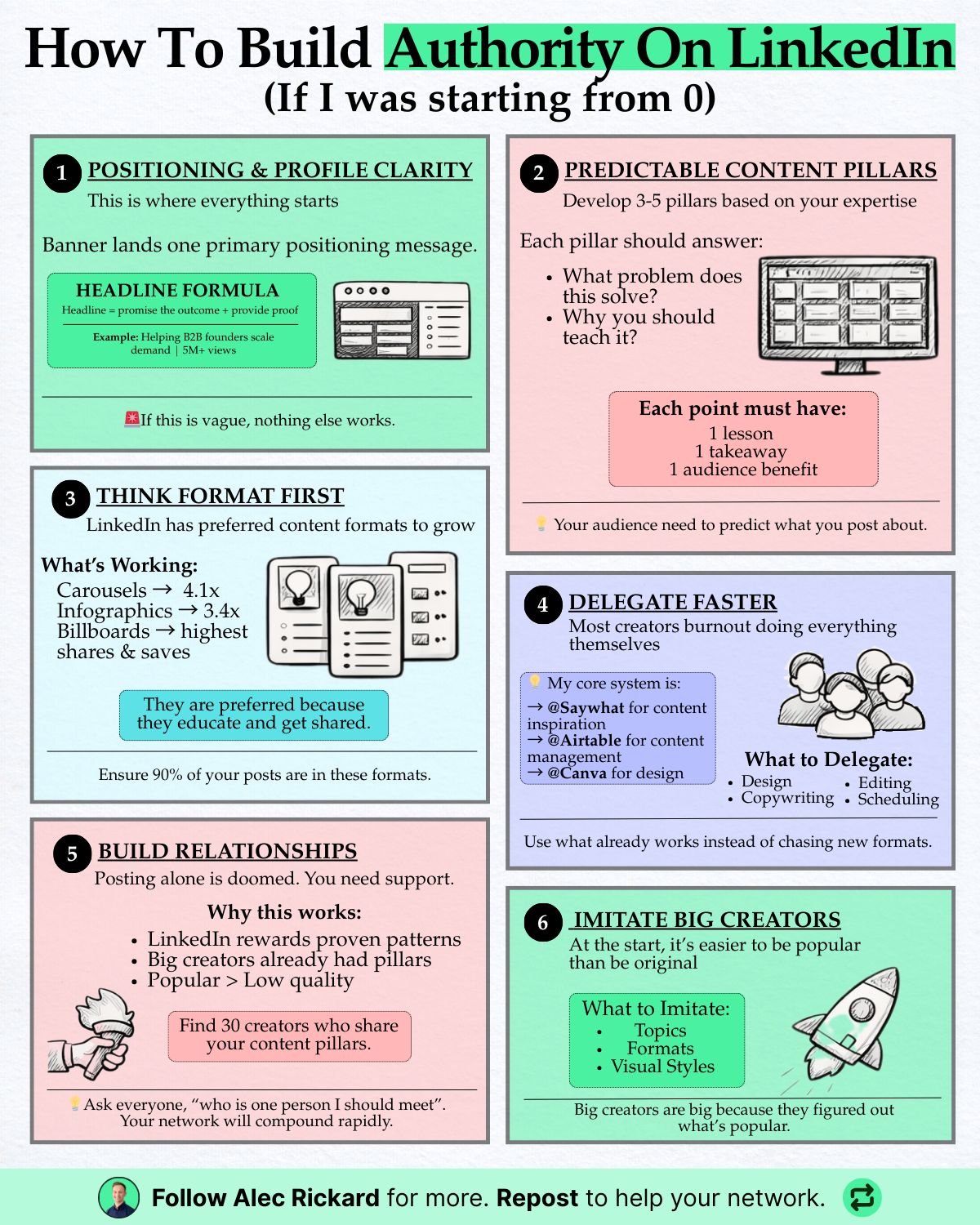
In a recent LinkedIn post, Alec Rickard shares the strategic shifts that propelled his follower count from 3,500 to over 90,000 in just 18 months, after three years of minimal engagement. Rickard emphasizes that his breakthrough came not from adhering to common LinkedIn advice, but by deliberately discarding it and resetting his approach.
Rickard details his initial struggles, noting:
“I posted for 3 years and got almost no engagement. Then in 18 months, I went from 3,500 to 90,000 followers. Here’s what actually changed.”
This stark contrast, as highlighted by Rickard, underscores the importance of a fundamental re-evaluation of one’s LinkedIn strategy. He explains that for three years, his efforts were characterized by intense posting, leading to burnout and stagnation.
The Core Pillars of Rickard’s Revamped Strategy
Rickard outlines a six-pillar framework that formed the basis of his successful pivot. He asserts that clarity and consistency are paramount, moving away from the often-generic advice found online.
1. Profile Clarity
According to Rickard, the foundation of any successful LinkedIn presence is a crystal-clear profile. He stresses that the banner and headline must immediately communicate the target audience and the promised outcome, backed by proof. The featured section, in his view, should guide the audience toward a specific next step. “If this is vague, nothing else works,” Rickard asserts, underscoring the critical nature of this initial impression.
2. Predictable Content Pillars
Rickard advocates for developing 3-5 consistent content pillars based on one’s expertise. This approach, he argues, allows the audience to anticipate the type of content they will see, fostering trust and predictability. Each post should offer a single, clear lesson and takeaway, fitting into a funnel designed to move followers from visibility to trust and ultimately to conversion.
3. Format First Approach
A significant shift Rickard implemented was prioritizing LinkedIn’s preferred content formats. He points out that for the past two years, formats like carousels and infographics have significantly outperformed text-only posts in terms of reach. “Carousels: 4.1x; Infographics: 3.4x higher reach than text posts,” he states, attributing this preference to their educational and shareable nature. He recommends that 90% of content should utilize these high-growth formats.
4. Strategic Delegation and Tool Use
To combat burnout, Rickard emphasizes the importance of delegation and efficient tool usage. He advises hiring support for repetitive tasks and leveraging AI to enhance, rather than replace, human writing. Rickard’s core system includes tools like @Saywhat for inspiration, Airtable for content management, and Canva for design. “Use what already works instead of chasing new formats,” he suggests.
5. Building Meaningful Relationships
Rickard contends that posting alone is insufficient for growth. He advocates for actively building relationships by engaging with content from creators who share similar pillars, offering valuable comments, and scheduling calls to connect on a deeper level. His strategy includes asking for introductions, which helps to rapidly compound one’s network.
6. Imitating Successful Creators
In the initial stages of building authority, Rickard suggests that imitating the topics, formats, and designs of established, successful creators can be more effective than striving for immediate originality. He notes that “LinkedIn rewards what’s popular. At the start, it’s easier to be popular than be original.” By analyzing what makes big creators successful, one can build content around proven, popular concepts.
In conclusion, Rickard’s insights, shared on LinkedIn, offer a practical roadmap for individuals seeking to grow their presence on the platform. His framework prioritizes clarity, consistency, strategic format selection, efficient delegation, relationship building, and learning from established success.
📝 About This Content
This article is based on insights shared by Alec Rickard on LinkedIn.
📅 Originally posted on February 15, 2026 | View original post on LinkedIn →