
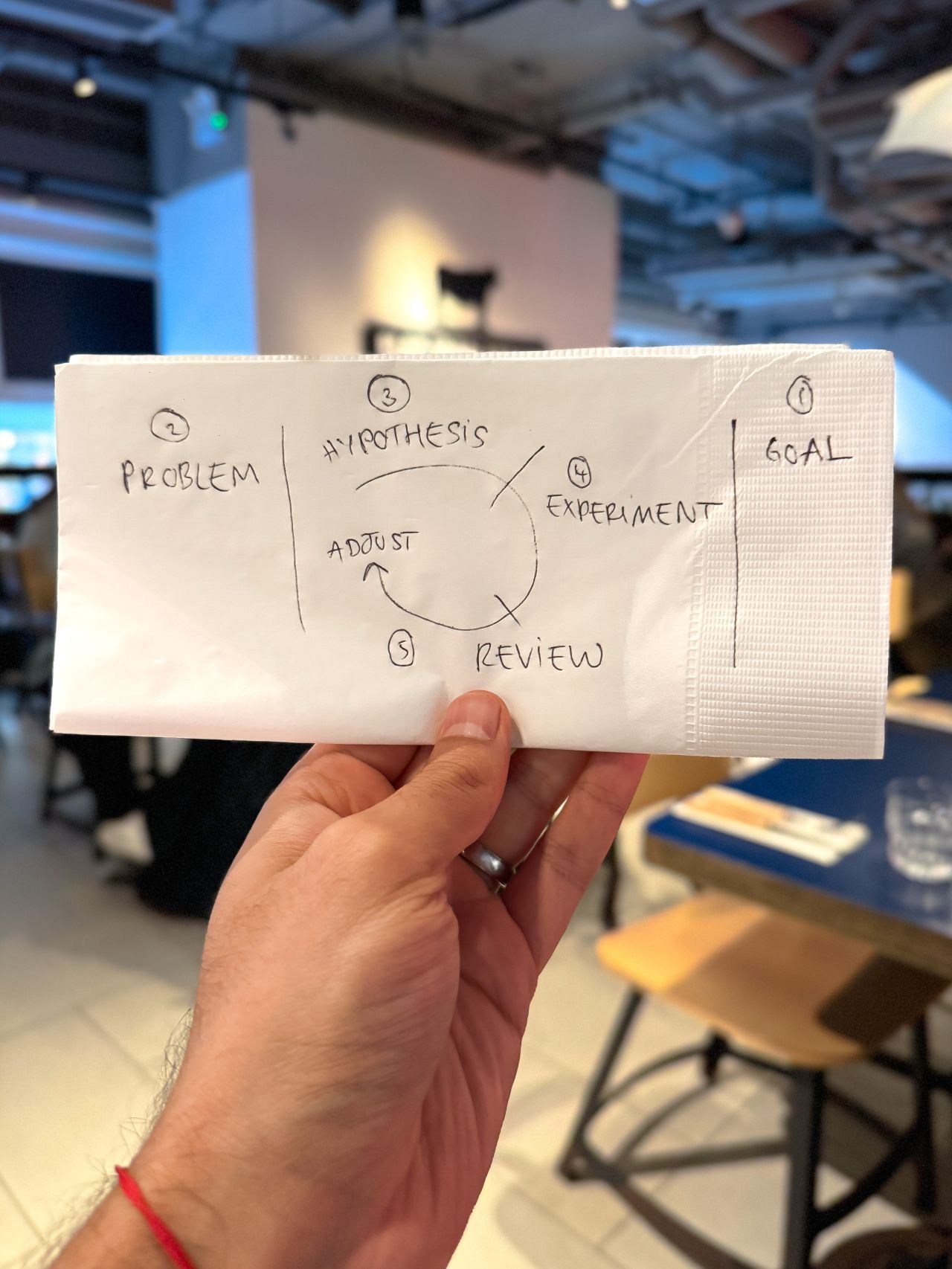
In a recent LinkedIn post, Ali Abdaal discusses a key framework he learned from an entrepreneur’s mastermind, emphasizing its potential to simplify complex business problems through rapid iteration. Abdaal, who invested $60,000 to attend the Boardroom Mastermind led by Taki Moore, highlighted what Moore calls the “Experiment Cycle” as a pivotal takeaway.
The “Experiment Cycle”: A Six-Step Approach
Abdaal breaks down Moore’s “Experiment Cycle” into six straightforward steps, designed for online coaching businesses generating over $1 million annually. He presents the cycle as:
1️⃣ Goal ↳ What does success look like? 2️⃣ Problem ↳ What’s blocking you right now? 3️⃣ Hypothesis ↳ What do you think might fix it? 4️⃣ Experiment ↳ Run a small test. Fast. 5️⃣ Review ↳ Did it work? What happened? 6️⃣ Adjust ↳ Keep, tweak, or kill it. Then repeat.
According to Abdaal, while these steps may seem elementary, their power lies in their ability to accelerate feedback loops, a critical element often overlooked in business strategy. He argues that many business challenges don’t require intricate solutions but rather a more agile approach.
Simplifying Complexity Through Iteration
“Might sound obvious, but most business problems don’t actually need complex solutions, they just need faster feedback loops,” Abdaal shared in his post. He elaborated on this by suggesting that individuals and businesses tend to overcomplicate matters, creating an illusion of progress when a simpler, faster testing method would be more effective.
Abdaal points out that this tendency to overcomplicate often stems from a desire to feel like progress is being made. However, he advocates for prioritizing quick experiments to gather real-world data and inform decisions.
Applying the Cycle to Content Creation
The entrepreneur shared how his own YouTube channel is currently implementing this methodology. The stated goal is to increase viewership, but current metrics are not meeting expectations. Abdaal explains their hypothesis:
Our hypothesis is that the videos aren’t valuable enough and more prep time might fix that.
To test this, Abdaal’s team is conducting an experiment comparing different preparation times for their videos. “The experiment is testing 3 hours vs 5 hours vs 10 hours of prep time,” he detailed. The team plans to review the results after 30 days to make informed adjustments.
The Value of Testing Over Guessing
Abdaal expressed a preference for active testing over passive speculation. “We’re mid-experiment so no results to share yet, but honestly I’d rather be testing than guessing,” he concluded. This sentiment underscores the core philosophy of the “Experiment Cycle”—that empirical evidence derived from rapid testing is superior to assumptions or guesswork in driving business growth and problem-solving.
The post concludes by inviting engagement, asking readers about their own experiences with business or life experiments and their outcomes.
📝 About This Content
This article is based on insights shared by Ali Abdaal on LinkedIn.
📅 Originally posted on January 12, 2026 | View original post on LinkedIn →