
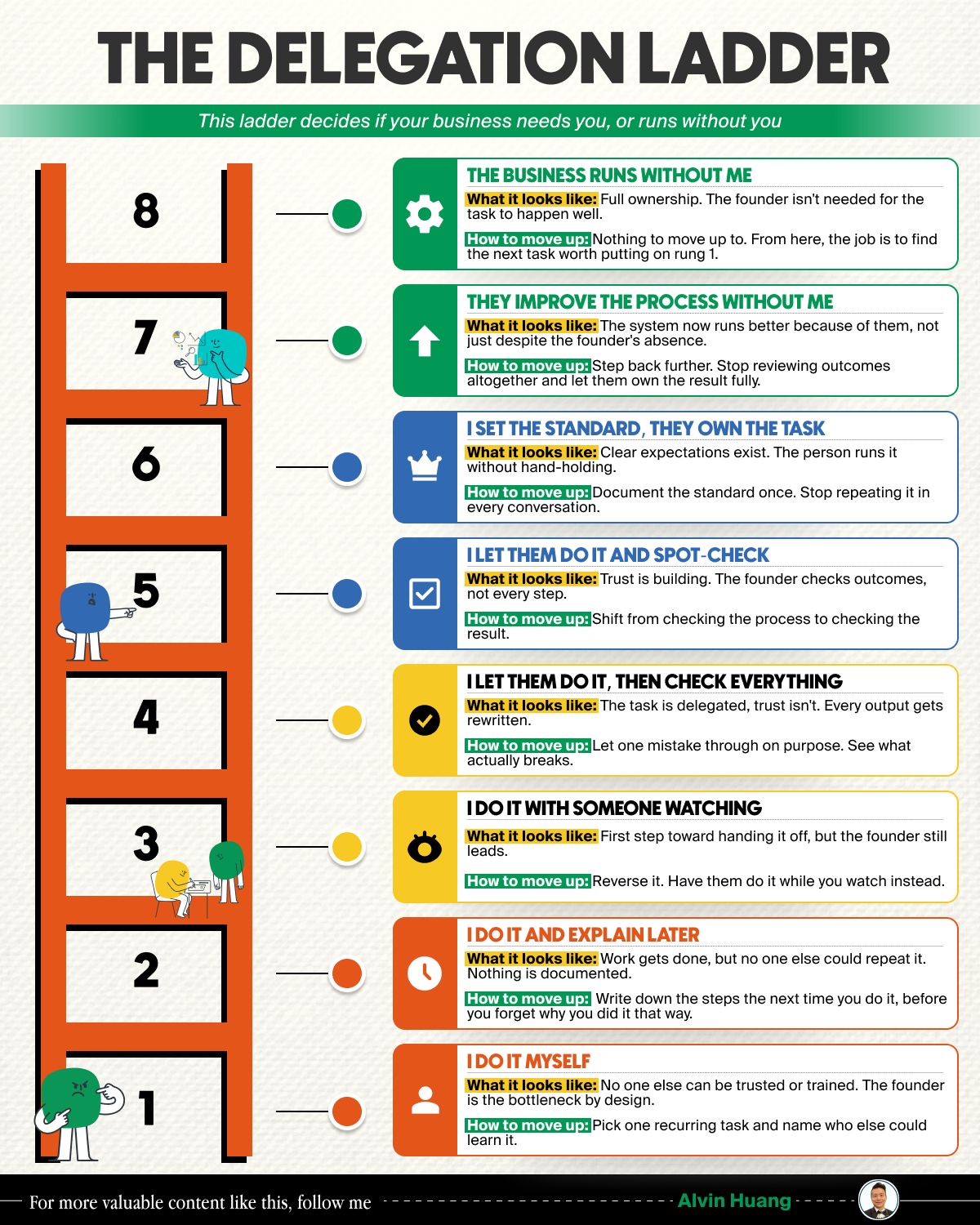
In a recent LinkedIn post, Alvin Huang discusses the critical challenge many founders face: becoming indispensable to their own businesses to the point of hindering growth. Huang argues that while feeling needed can be a positive reinforcement, it can quickly become a significant liability that prevents scalability. He shared his personal experience at Truegenics, where even minor functions required his constant involvement.
The Founder’s Dilemma: Indispensability as a Liability
Huang highlights the internal conflict founders experience, where the need for the business to function and the founder’s own need to feel essential can be easily confused. He suggests that this feeling of being indispensable, while perhaps ego-boosting, can trap a leader in the day-to-day operations, preventing them from focusing on strategic growth. As Huang puts it:
The business needing you and you needing to be needed feel identical from the inside. But only one of them is worth protecting.
This realization, according to Huang, was a turning point that allowed him to shift his focus from operational minutiae to the bigger picture, a necessary step for scaling. He emphasizes that letting go of the “founder instincts and ego” is a difficult but crucial part of this transition.
Huang’s 8-Step Delegation Framework
To overcome this common entrepreneurial hurdle, Alvin Huang presents a detailed, eight-step framework designed to guide founders through the process of delegating tasks effectively. This ladder of delegation, as he describes it, moves from complete founder control to full team autonomy. The steps are:
- I Do It Myself: The initial stage where no one else is trusted or trained to handle the task.
- I Do It and Explain Later: The work is completed by the founder, but the process is not documented or transferred.
- I Do It With Someone Watching: A transitional phase where the founder leads the task with another person observing.
- I Let Them Do It, Then Check Everything: The task is delegated, but the founder still meticulously checks every detail, indicating a lack of full trust.
- I Let Them Do It and Spot-Check: The founder begins to check outcomes rather than every individual step, signifying growing trust.
- I Set the Standard, They Own the Task: Expectations are clearly documented once, and the team member takes full ownership without repeated instruction.
- They Improve the Process Without Me: The system becomes more efficient due to the team’s contributions, not just in spite of the founder’s absence.
- The Business Runs Without Me: Full ownership is achieved, and the task or system operates effectively without the founder’s direct involvement.
Huang elaborates on the progression, noting the shift in trust and oversight throughout the stages. For instance, he explains the difference between stages 4 and 5:
I Let Them Do It, Then Check Everything – The task is delegated. The trust isn’t.
He contrasts this with the next step, where the focus moves from micro-management to outcome assessment, illustrating a key step in building true independence within the business.
The Path to Scalability
By systematically implementing this framework, Huang suggests that founders can move from being the bottleneck of their own company to becoming strategic leaders. He posits that the goal is not to become unnecessary, but to build a business that can operate and thrive independently of their constant, hands-on involvement. This allows founders the freedom to “focus on the bigger picture,” as he mentioned earlier in his post.
Huang concludes by inviting engagement on how others foster business independence and offers a weekly newsletter featuring scaling frameworks. According to Huang:
The system runs better because of them, not just despite me being gone.
This sentiment underscores the ultimate aim of his delegation strategy: creating a robust, self-sufficient business that benefits from the innovation and ownership of its team members.
📝 About This Content
This article is based on insights shared by Alvin Huang on LinkedIn.
📅 Originally posted on August 13, 2026 | View original post on LinkedIn →