

Analytics & AI represents the convergence of artificial intelligence with data analytics. AI enhances traditional analytics by automating complex data processing, uncovering deeper insights through machine learning, and enabling predictive and prescriptive actions, transforming raw data into strategic business intelligence.
To succeed in 2025, your business needs more than just data. It needs planning, accuracy, and the ability to adapt quickly. As global leaders face new challenges, the need to use the combined power of analytics & AI is clear. It is no longer an advantage—it is essential for growth and making smart decisions.
At EnterpriseZone.cc, we gathered key ideas from the world’s top CEOs and founders. They all agree: using analytics & AI together is the key to building a business that lasts. This 2025 guide goes beyond the basics. It offers deep insights and useful plans to help leaders like you. We turn complex technology into simple, practical steps that get real business results.
Learn how top companies are using these powerful tools to become industry leaders, work more efficiently, and find new ways to make money. First, we will break down why combining analytics and AI is so important for today’s business leaders.
Why is the Convergence of Analytics & AI Crucial for Today’s Enterprise Leaders?

Global business is moving faster than ever. Leaders face new, complex problems every day. To succeed in 2025, you need more than just data. You need to act on it with smart predictions. This is why combining Analytics & AI is no longer a choice. It is a key strategy for any smart executive.
Top CEOs agree. They know that analytics alone only shows what has already happened. And AI without good data has nothing to work with. Putting them together creates a powerful tool for foresight, efficiency, and a competitive edge. This mix turns raw data into actionable intelligence faster than ever before.
Unlocking Hyper-Speed Decision-Making and Strategic Advantage
Today’s market moves fast. You need to be agile to win. If you wait for weekly reports, you will fall behind. Combining analytics and AI gives you real-time decision intelligence [1]. This helps leaders act right away on market changes and new opportunities. Also, AI-powered analytics can process huge amounts of data, far more than any person could. It finds patterns and predicts trends with great accuracy.
Senior executives know this is a race. Those who master this combination will lead their industries. Others risk being left behind. As one top entrepreneur recently said, “Ignoring AI in your analytics is like trying to find your way blindfolded in 2025.”
- Accelerated Insight Generation: AI algorithms quickly sort through data. They find insights in minutes, not days.
- Enhanced Predictive Capabilities: machine learning models predict future results very accurately. This can include customer loss or market demand.
- Automated Strategic Recommendations: AI does more than just show you data. It suggests the best next steps, making decisions faster and easier.
Driving Tangible Business Outcomes: Efficiency, Personalization, and Innovation
The value of mixing analytics and AI is not just about better dashboards. It has a direct impact on your profits. It brings real improvements to every part of a business. From making supply chains better to creating custom experiences for customers, the benefits are huge.
Look at what the world’s top business leaders are saying. They often connect AI-powered analytics with operational excellence. As a result, companies save money and earn more. They also find new ways to innovate. This is not just a tech investment. It is an investment in your company’s future profits and success.
Key Areas of Impact for Executive Leaders:
- Operational Efficiency: AI finds problems and slowdowns. It improves how things work, from shipping to managing resources. This saves a lot of money and boosts productivity.
- Hyper-Personalized Customer Experiences: AI studies what each customer does and likes. This helps you create marketing, products, and support just for them. The result is happier, more loyal customers.
- New Revenue Streams: Smart analytics using AI can find unmet needs in the market. It spots new trends and chances for new products or services, creating big opportunities for growth.
- Enhanced Risk Management: Predictive AI models can predict future risks. These can be security threats, money problems, or supply chain issues. This lets you act early to prevent problems.
Future-Proofing Leadership in 2025 and Beyond
The world of business leadership is changing fast. Leaders must understand and predict changes in technology. Combining analytics and AI is a key part of future-proof leadership. It helps companies adapt and stay strong in a changing world. It also helps attract and keep the best employees, who want to work in modern, data-focused companies.
Smart leaders are making this a top priority. They are building teams that use data and smart automation. This smart planning keeps their companies competitive, agile, and relevant for 2026 and beyond.
In short, adding AI to your analytics is no longer just a goal. It is essential for leading your industry in the years ahead. Use this combination to turn your data into your most powerful strategic asset.
What is AI and analytics?
From Data to Decisions: A Foundational Overview
Business is changing fast. By 2025, using both Artificial Intelligence (AI) and analytics is no longer a choice. It is fundamental. Executive leaders must understand how they work together. Analytics looks at past data. It finds trends, patterns, and insights. This shows what happened in the past. AI, however, takes this much further.
AI includes many technologies, such as machine learning, natural language processing, and computer vision. Its main job is to help systems learn from data. AI can then think, see, and act on its own. When used with analytics, AI turns raw data into actionable intelligence. This leads to better decisions across the company. It helps organizations move beyond “what happened.” It lets them predict “what will happen” and know “what should be done.” Using AI and analytics together is key to a future competitive advantage.
Expert Insight: How CEOs Define the Synergy of Analytics & AI
Global leaders know the real power is in the harmonious integration of AI and analytics. They see it as key for growth and better operations. Top executives often say that AI makes analytics much more valuable. This helps companies move from simply reporting on the past to taking smart, proactive steps.
CEOs point to several key benefits of using them together:
- Enhanced Strategic Vision: “AI provides the foresight we need,” notes one influential CEO. “It moves us beyond hindsight into genuine predictive strategic planning.” This helps leaders predict market changes and what customers will need [2].
- Optimized Decision Velocity: Analytics provides insights. AI helps apply those insights faster. This greatly speeds up decision-making. As a result, business decisions are quicker and based on data.
- Unlocking New Value Streams: “The blend of advanced analytics and AI helps us identify entirely new business models,” explains an industry pioneer. “It highlights opportunities invisible to traditional methods.” This encourages new ideas and growth in new areas.
- Personalized Customer Engagements: AI-powered analytics helps businesses understand customers deeply. This allows for very personal experiences. These experiences build loyalty and increase revenue.
Because of this, leaders are creating integrated strategies. These strategies put AI at the center of their analytics work. They want to build an intelligent enterprise. In such a business, data constantly guides and improves every operational and strategic choice.
The Core Difference: Traditional Analytics vs. AI-Powered Analytics
Both traditional and AI-powered analytics use data. But their methods, abilities, and results are very different. Leaders need to understand this difference as they guide their companies through digital change. Traditional analytics shows what happened and why. AI-powered analytics can also predict what will happen and suggest what to do. It automates insights and recommends the best actions.
Consider the fundamental differences:
| Characteristic | Traditional Analytics | AI-Powered Analytics |
|---|---|---|
| Primary Goal | Understand past events; report “what happened” and “why.” | Predict future outcomes; prescribe “what should be done” and automate actions. |
| Methodology | Manual data gathering, statistical analysis, human review of dashboards. | Machine learning algorithms, deep learning, natural language processing, automated pattern recognition. |
| Data Processing | Mainly structured data; uses set queries. | Handles large amounts of structured and unstructured data (text, images, voice); learns all the time. |
| Insights Generated | Static reports, historical trends, backward-looking insights. | Dynamic forecasts, real-time alerts, proactive recommendations, adaptive learning. |
| Decision Support | Informs human decision-makers; provides context for choices. | Automates routine decisions; adds to human intelligence; suggests the best strategies. |
| Scalability | Limited by how much a person can analyze. | Grows easily with more data; learns and gets better over time. |
Switching to AI-powered analytics leads to new levels of efficiency and insight. It turns data from a simple record into a key business tool. For leaders, this means they can stop just reacting to problems. They can take a smart, proactive approach to run and grow their company in 2025 and beyond. Companies that add AI to their analytics are getting a major competitive edge [3].
How Are Global Leaders Leveraging Analytics & AI for Competitive Advantage?
Case Study: Driving Hyper-Personalization in Customer Experience
Generic customer experiences are no longer enough. Global leaders know this. By 2025, hyper-personalization is the gold standard. They use analytics & AI to move past old ways of grouping customers. Instead, they create truly personal interactions for everyone.
Top executives agree with this change [source: Forbes]. They say companies should be proactive, not just reactive. AI analyzes huge amounts of data. This data includes browsing history, past purchases, and current actions. Then, AI can accurately predict what each customer wants and needs.
This deep understanding drives a few key strategies:
- AI-Powered Recommendation Engines: These systems suggest products or content that people will like. They learn and get better with every interaction. This helps customers find new things.
- Dynamic Content Delivery: Websites and apps show different layouts and messages to each person. Every customer sees the content that is most relevant to them.
- Predictive Customer Service: AI spots potential problems before they get worse. It sends customers to the right support, often before they even ask for help. This lowers frustration and makes customers happier.
- Tailored Product Offerings: Companies can create custom product bundles or services. These offers are a perfect match for each customer’s profile.
The impact on business is huge. Leaders see big increases in customer loyalty. Conversion rates also go up. And customer lifetime value (CLTV) gets a big boost. For example, brands that use these strategies see revenue grow by 5% to 15% [source: McKinsey & Company]. This shows the real financial benefits of using AI smartly.
Case Study: Optimizing Supply Chains and Operations with Predictive Models
Unpredictable supply chains are a constant problem for businesses worldwide. Smart leaders are changing how they operate. They are using analytics & AI to move from reacting to problems to predictive foresight. This method makes their operations stronger and more efficient.
Big logistics companies point to this key change. Their leaders say it’s vital to see what’s happening in real time and to lower risks. AI-powered models offer a very clear picture. They study past data, market trends, and other factors. This helps companies accurately predict demand and improve their operations.
Some key uses of these models are:
- Accurate Demand Forecasting: AI handles many complex factors. It predicts future product demand with great accuracy. This prevents having too much or too little stock.
- Inventory Optimization: Analytics finds the best stock levels for a business. This lowers storage costs and improves cash flow.
- Predictive Maintenance: AI watches machinery and equipment. It predicts when they might break down before it happens. This avoids expensive delays and helps equipment last longer.
- Logistics and Route Optimization: Algorithms find the fastest and cheapest delivery routes. They look at traffic, weather, and delivery times. This saves money on fuel and makes deliveries faster.
- Supplier Risk Assessment: AI checks how reliable suppliers are and looks for possible problems. This helps companies build stronger supply networks.
These new abilities lead to big improvements. Companies have lower operating costs and faster delivery times. They also have less waste and become stronger overall. Companies that invest a lot in AI for their supply chain see costs drop by 15%. They also see inventory fall by up to 35% [source: Accenture]. This smart use of AI is key to staying ahead of the competition in 2025.
Unlocking New Revenue Streams Through AI-Driven Market Insights
It’s not just about saving money. Global leaders see analytics & AI as powerful tools for growth. These tools do more than cut costs. They create new ways to make money. Smart executives are turning data from an expense into a source of profit.
Chief Strategy Officers often say AI helps them stand out from the competition. They use AI to find new market trends. They also find customer needs that are not being met. This information helps them create new products and services. It even helps them find completely new ways to do business.
This smart approach includes a few methods:
- Identifying Emerging Market Trends: AI looks through huge amounts of data. It finds small changes in customer behavior and the market. This lets companies act before their rivals.
- Pinpointing Unmet Customer Needs: AI studies customer feedback, social media, and online searches. It shows what’s missing from current products. Businesses can then create solutions people really want.
- Predictive Product Performance: AI models predict how well new products will sell. This helps companies improve products before they are released. It also lowers the financial risk.
- Optimizing Pricing Strategies: AI-powered models change prices instantly. They base prices on demand, competitors, and different customer groups. This makes the most money and profit.
- Spotting Cross-Selling and Up-Selling Opportunities: AI finds the best time to make another sale. It suggests related products or upgrades to current customers.
The impact on business growth is clear. Companies launch new products successfully. They grow into new markets. They also find more ways to make money, which helps them stay strong for the long term. Companies using AI to understand the market see revenue from new products grow by up to 25% [source: IBM Research]. Using AI this way is essential to becoming a leader in the changing market of 2026.
What are the 4 types of analytics?
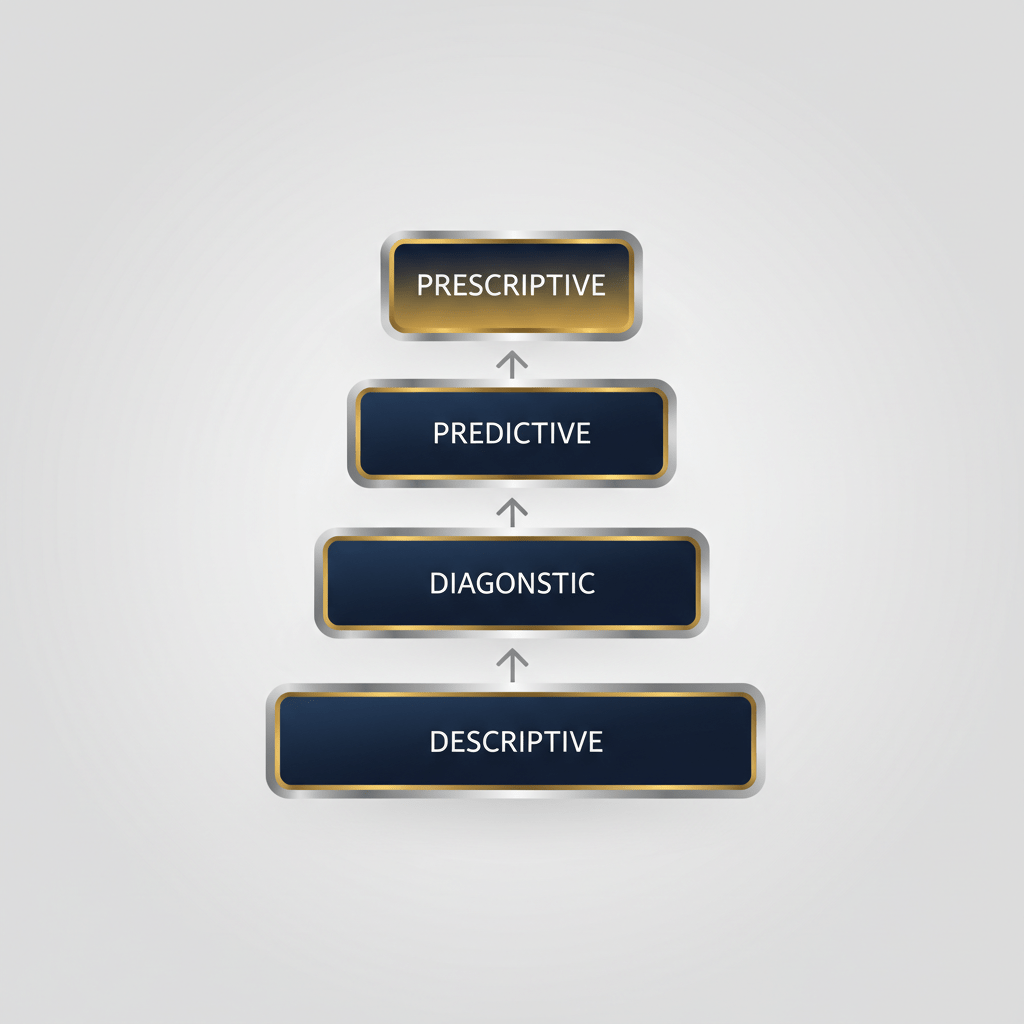
Descriptive Analytics: What Happened?
Descriptive analytics is the first step to understanding data. It answers the basic question: “What happened?” This analysis looks at past events. It gives you a clear view of performance. Leaders agree that strong data is crucial. As an executive, you use it for quarterly reports and market share analysis. It provides a snapshot of your company’s health.
Its main strength is its clarity. For example, a retail manager can look at last quarter’s sales. This shows which products sold well and how different regions performed. Tools like key performance indicators (KPIs) and dashboards are key. They make complex data easy to understand. By 2025, new AI tools will automate more of these reports. This will free up your team for more strategic tasks.
- Key Use Cases:
- Sales reports and revenue tracking.
- Customer demographics and market share analysis.
- Website traffic and user behavior summaries.
- Financial performance dashboards.
- Strategic Takeaway: Make sure your data is accurate and up-to-date. Use reporting tools that are easy to understand. This gives everyone a single source of truth.
Diagnostic Analytics: Why Did It Happen?
Diagnostic analytics goes a step further. It answers the key question: “Why did it happen?” This type of analysis finds the root cause of an event. Leaders like Satya Nadella stress the need to understand why things happen. Basic reports are not enough to solve real problems.
If sales drop, descriptive analytics shows you what happened. Diagnostic analytics finds out why. It looks for connections between different factors. For example, a drop in customer activity might be linked to a new product update. AI is a big help here. Machine learning tools can scan large datasets very quickly. They find hidden patterns and issues [source: https://hbr.org/2018/07/when-ai-creates-unexplainable-decisions]. This helps you find the root cause much faster. As a result, leaders can make better decisions, more quickly.
- Key Techniques:
- Drill-down and data discovery.
- Correlation analysis.
- Anomaly detection.
- Data mining to identify causal relationships.
- Strategic Takeaway: Give your teams tools to dig deep into the data. Use AI to find the exact reasons for business changes. This allows you to fix problems directly, without guessing.
Predictive Analytics: What Will Happen Next?
Predictive analytics is a big step forward. It answers the question: “What will happen next?” It uses past data to predict future events. Great leaders always look ahead. They use predictive models in their strategic planning. For example, Elon Musk’s companies rely heavily on planning for the future.
Machine learning models power predictive analytics. They find complex patterns in your data. Then, they make accurate predictions about the future. This technology is improving fast. For example, a bank can predict credit risk. A marketing team can predict which customers might leave. Businesses can get ahead of market trends and manage inventory better. Using these advanced tools gives you a major competitive advantage [source: https://www.mckinsey.com/capabilities/quantumblack/our-insights/the-future-of-analytics]. Being proactive helps leaders face uncertain markets with more confidence.
- Key Applications:
- Sales forecasting and demand prediction.
- Customer churn prediction and retention strategies.
- Fraud detection.
- Risk assessment and mitigation.
- Resource allocation and capacity planning.
- Strategic Takeaway: Invest in strong machine learning tools. Create clear plans based on these predictions. Weave these forecasts into your core business strategy to make proactive decisions.
Prescriptive Analytics: What Should We Do About It?
Prescriptive analytics is the most advanced form of data analysis. It answers the final question for leaders: “What should we do about it?” This analysis doesn’t just predict the future. It also recommends the best actions to take. It gives you the best way to reach your goals. Leaders want clear actions, not just information. Jeff Bezos built a culture around using data to act, which is the core of prescriptive analytics.
AI tools power prescriptive models. These systems test out many different options. Then, they recommend the best course of action. For example, a delivery company can use it to find the best routes. This saves both time and money. A marketing team could get AI suggestions on how to best spend their budget. By 2026, more business processes will become automated and optimized using this technology. This will create a major competitive advantage [source: https://www.gartner.com/en/articles/whats-the-future-of-analytics-and-business-intelligence].
- Key Advantages:
- Automated decision-making support.
- Optimization of complex processes.
- Identification of optimal resource allocation.
- Enhanced strategic planning through scenario optimization.
- Strategic Takeaway: Build prescriptive models into your daily operations. Give decision-makers AI-powered recommendations. Aim for smart, real-time actions across your entire business.
What is the Strategic Roadmap for Integrating AI into Your Analytics Framework?

Step 1: Establishing a Data-Driven Culture and Governance
Adding AI to your analytics starts with a foundational shift. Leaders agree that technology alone is not enough. A strong data culture, supported by clear rules, is essential. This creates the right environment for AI to succeed.
Many CEOs say that companies must treat data as a key resource. This requires focused work. Also, establishing clear ownership of data quality provides reliable information for AI models. Without good data, even the best AI will produce poor results. In fact, poor data quality costs the global economy trillions of dollars each year [4].
Key actions for this foundational step include:
- Define Data Ownership and Stewardship: Assign clear roles for managing and maintaining data across departments.
- Implement Robust Data Governance Policies: Set standards for how data is collected, stored, secured, and used. This ensures consistency.
- Foster Data Literacy Across the Organization: Help employees at all levels understand and use data well. Training programs are key.
- Prioritize Data Quality and Integrity: Invest in tools and processes to clean, check, and improve your data.
- Develop Ethical AI Guidelines: Create clear principles for fair and transparent AI use that match your company’s values.
This first step creates the groundwork you need. It makes your organization ready for data. This helps create an environment where AI can deliver real value.
Step 2: Identifying High-Impact Use Cases and Pilot Projects
With a good data foundation, the next step is to find where AI can help most. Many executives suggest a practical approach. Start with specific projects that can make a big impact. These projects should match your main business goals. This lowers risk and helps you learn more.
Leaders stress the need for clear wins early on. Small, controlled pilot projects can prove the idea works. They also build confidence and help get more funding. It is also key to find problems or opportunities in your current analytics. These are good places to start using AI. For example, improving churn prediction or fraud detection are common starting points.
Strategic considerations for pilot projects include:
- Conduct a Comprehensive Needs Assessment: Find specific business challenges or opportunities where AI can help.
- Prioritize Based on Potential ROI and Feasibility: Focus on areas where AI can create clear business value relatively quickly.
- Design Clear, Scoped Pilot Projects: Define specific goals, success metrics, and timelines for each project. Keep them small.
- Secure Executive Sponsorship and Cross-Functional Buy-in: Get support from top leaders and other business teams. This is key for success.
- Establish Measurable Success Metrics: Clearly define how you will track and measure the performance and ROI for each pilot.
By focusing on these projects, you can show real value quickly. This success helps spread AI use across the company. It turns ideas into real results.
Step 3: Scaling AI Capabilities and Fostering Talent
After a successful pilot, you need a strategy to scale up. Leaders know that scaling AI requires the right technology and people. The demand for AI talent is greater than the supply [5]. Because of this, developing talent inside your company is essential for growth.
Many experts suggest making AI tools available to more people. This can mean using low-code or no-code platforms. These tools help all business users, not just data scientists. Also, investing in good training programs is vital. This trains your current employees and helps them understand AI. Building scalable AI platforms also ensures things run smoothly as more teams use them.
To scale AI effectively, focus on:
- Invest in Continuous AI/Analytics Training Programs: Create internal training to teach your staff about AI concepts and tools.
- Recruit Specialized AI and Machine Learning Talent: Hire experts to lead complex projects and guide your internal teams.
- Implement Scalable AI Platforms and Infrastructure: Use cloud-based tools and MLOps to support your growing AI needs.
- Foster Cross-Functional Collaboration: Encourage data scientists, engineers, and business users to work together to speed up progress.
- Create an Internal Knowledge-Sharing Ecosystem: Share best practices, lessons, and reusable AI models across the company.
This approach helps your company adopt AI and keep growing. It turns small wins into company-wide skills. This builds a long-term advantage over competitors.
Step 4: Measuring ROI and Ensuring Ethical AI Implementation
The final step is ongoing. You must carefully measure the return on investment (ROI) and follow ethical rules. Leaders agree that AI projects must deliver real business value. They must also operate within clear ethical limits. So, it is key to define clear metrics from the start. Regular tracking will show this value.
Talk about AI responsibility has also grown. It is essential to ensure fairness, transparency, and accountability. An ethical AI review board can provide oversight. Using explainable AI (XAI) techniques helps build trust. It also helps you follow changing regulations. The future of AI depends on it being effective and trustworthy. In fact, 73% of executives believe ethical AI is a competitive advantage [6].
Key strategic imperatives for this stage include:
- Define Clear ROI Metrics for AI Initiatives: Measure the financial and operational impact of your AI projects.
- Regularly Track and Report Performance: Keep an eye on your AI models and their business results. Change your strategy if needed.
- Establish an Ethical AI Review Board or Framework: Ensure ongoing oversight and that you follow ethical rules for AI.
- Implement Transparency and Explainability Protocols: Make AI decisions easy for users and stakeholders to understand. This builds trust.
- Conduct Regular AI System Audits: Review AI models from time to time for bias, accuracy, and compliance with rules.
By carefully measuring ROI and including ethics, companies can ensure steady growth. This roadmap drives innovation and also builds confidence and trust. It sets up your company for long-term success with AI.
Future Forecast 2026: The Next Wave of Analytics & AI Innovation
The Rise of Generative AI in Business Intelligence
The world of Business Intelligence (BI) is changing fast. This change is driven by the rise of Generative AI. Leaders are moving past old dashboards and reports. They now want dynamic insights from conversations with their data. Global leaders see this major shift. They are using GenAI to make data available to everyone. It lets decision-makers use everyday language to work with data.
Imagine asking a hard business question in plain English. GenAI gives you a quick and detailed answer. It can even suggest new questions to ask. This helps people make decisions much faster. GenAI also creates reports and summaries on its own. This saves data analysts a lot of time. They can then work on more important projects. This efficiency is key to staying ahead of the competition.
By 2026, GenAI will be a core part of BI. It will change how companies get value from their data. Companies already report getting more work done. They are spending less time pulling data [7]. Leaders must invest in BI tools that use GenAI. This smart move helps companies stay innovative and adapt quickly.
Democratizing Data Science with Low-Code/No-Code AI Platforms
There are not enough skilled data scientists to meet the demand. This is a big problem for many companies. However, low-code/no-code (LCNC) AI platforms are helping to solve this problem. These tools create a new group of “citizen data scientists.” They let business users build advanced AI models. They don’t need to know much about coding.
Leaders see that LCNC is a great way to use AI more quickly. It means companies do not have to rely only on expert data scientists. Making these tools available to more people sparks new ideas in every department. It also speeds up the process of creating AI. Companies using LCNC platforms can often release new AI products much faster.
Key advantages for forward-thinking executives include:
- Faster Testing: Teams can quickly build and test AI ideas. This helps get new products and services to market sooner.
- Lower Costs: Companies save money by not needing as many expensive data science experts.
- More Flexibility: Teams can react fast to changes in the market. They can build specific AI tools as new needs arise.
- Better Teamwork: LCNC helps business and IT teams work together more closely. This makes sure technology supports the company’s main goals.
Gartner predicts that by 2025, LCNC will be used to build 70% of new apps [8]. Because of this, leaders should focus on training. This will teach current employees new skills. The goal is to make sure many people can use these simple AI tools.
The Future of Decision Intelligence for the C-Suite
Making the best decisions is the top priority for leaders. It’s not enough to just look at data or simple forecasts anymore. Decision Intelligence (DI) is the next step in making smart plans. It combines data, human behavior, and management ideas. This mix creates a better way to make tough business decisions.
DI is more than just standard analytics. It gives a fuller picture and clear steps to take:
- The Big Picture: DI looks at the market, customer actions, and business limits. This gives a complete view to help understand difficult problems.
- Clear Recommendations: DI does more than predict what might happen. It recommends specific actions to take. It also shows the possible results of each choice.
- Built-in Ethics: DI includes ethical AI rules from the start. This makes sure decisions are fair, clear, and match the company’s values.
- Always Learning: These smart systems learn all the time. They improve their advice using new data and changing situations. This keeps the advice useful.
By 2026, top leaders will use DI platforms a lot. These tools will help guide major business decisions. This includes things like mergers, entering new markets, and creating new products. Leaders must support building strong DI systems. This will give them a major advantage over competitors. Companies that use DI early will make better, fairer, and more profitable decisions. This helps the business grow faster and become a market leader [9].
Frequently Asked Questions
What is an Example of Analytic AI?
Analytic AI uses machine learning to find hidden patterns in large amounts of data. This gives leaders useful insights. It is more powerful than traditional analysis because it automates complex work and can spot connections that people might miss. This ability is essential for today’s executives.
A great example is predictive maintenance in advanced manufacturing. Many industrial CEOs see this as a game-changing tool. Instead of scheduled maintenance, AI watches sensor data from machines in real-time—like temperature, vibration, and pressure. It then predicts when a machine might fail before it happens.
- Data Source: Real-time sensor data, past maintenance records, and workplace conditions.
- AI Analysis: AI models find unusual patterns that signal a machine is about to break. For instance, a small rise in vibration and temperature could mean a bearing is failing.
- Strategic Outcome: Maintenance teams get alerts to fix specific problems during scheduled downtime. This prevents surprise shutdowns, makes equipment last longer, and cuts costs. Experts estimate that AI can reduce unplanned downtime by up to 50% [10].
This approach improves efficiency and leads to major cost savings. It helps companies move from simply reacting to problems to actively preventing them.
What is the 30% Rule for AI?
The “30% Rule for AI” is a guideline for leaders, though it can mean different things. It usually points to two main ideas: the difficulty of getting a good return on investment (ROI) and the need for human oversight.
- Getting a Return: Many leaders find that only about 30% of AI pilot projects actually grow into company-wide systems that provide a clear financial return. This is not because AI is weak. It is because getting data ready, integrating systems, and finding skilled people is hard. Projects also need to fit the company’s main goals. Many pilots fail because they do not align with the business strategy or the company is not ready for the change [11].
- Working with People: Another view is that even though AI can automate many tasks, about 30% of key decisions based on AI still need a person to review them. People must check AI’s suggestions for context and ethics. This ensures the advice fits the company’s goals and follows the law. AI helps people make better decisions; it does not replace them, especially for important strategy in 2025 and beyond.
Leaders should see the 30% rule as a planning tool, not a limit. To unlock AI’s full potential, focus on good data management, clear goals for ROI, and building a culture where people and AI work well together.
Which AI Analytics Tools Are Leading the Market for Enterprises?
For large companies in 2025, the best AI analytics tools are scalable, easy to integrate, and have many features. Leaders look for tools that help both data scientists and business users. The top platforms give companies a competitive edge.
Here are some of the key players:
- Cloud-Native AI/ML Platforms:
- Amazon Web Services (AWS) SageMaker: Provides all the tools needed to build, train, and use machine learning models. It works well with other AWS services, so it’s a top choice for companies that already use AWS.
- Microsoft Azure Machine Learning: A flexible platform for both beginners and expert data scientists. It offers simple drag-and-drop tools and advanced options. It connects smoothly with other Microsoft products.
- Google Cloud AI Platform: Known for its advanced AI tools and research. It offers powerful features for understanding images, text, and making recommendations. Companies often use it for large, complex AI projects.
- Unified Data & AI Platforms:
- Databricks (Lakehouse Platform): Combines data storage systems into one platform. This helps teams manage and analyze huge amounts of data for both basic reports and complex AI. Leaders like it because it connects data that was once separate.
- Snowflake (Data Cloud with Snowpark): Mainly a data storage tool, but its Snowpark feature adds more power. It lets data experts run code and machine learning models right inside Snowflake. This makes AI development faster and more secure.
- Business Intelligence & Advanced Analytics Platforms:
- Tableau (Salesforce): Is always adding new AI features. Users can ask questions in plain language, which makes data analysis easier for everyone in the business.
- Power BI (Microsoft): Works very closely with Azure ML. This lets companies add predictive models right into their dashboards. It helps everyone make decisions based on data.
When choosing a tool, leaders suggest focusing on a few key things. It should be easy to integrate, able to grow with your company, and secure. It should also help data experts and business teams work together. The best tool fits your company’s goals and current technology.
How Can I Get an AI Data Analytics Certification?
Getting an AI data analytics certification is a smart step for leaders and their teams. It helps them learn the basics, prove their skills, and stay competitive. A certification can help build a company culture that values data and expands its use of AI, which is important for 2025 and beyond.
Here is a guide to finding the right certification:
- Define Your Objective:
- For Technical Teams: Focus on hands-on skills in machine learning, data management, and coding languages (like Python or R).
- For Business Leaders: Look for certifications that focus on using AI for business strategy, managing AI projects, and understanding AI insights.
- Explore Reputable Certification Providers:
- University Programs: Many top universities (e.g., Stanford, MIT, Harvard Business School) offer online courses for leaders. They teach the core ideas behind AI and how to use them. [12]
- Industry Leaders: Companies like Google (Google Cloud Certified Machine Learning Engineer), Microsoft (Microsoft Certified: Azure AI Engineer Associate), and AWS (AWS Certified Machine Learning – Specialty) offer certifications for their own platforms. These are very useful for teams that use these specific cloud services.
- Specialized Platforms: Websites like Coursera, edX, and Udacity offer a wide range of courses created by schools and experts. They cover many different AI and data topics.
- Professional Organizations: Groups like INFORMS (The Institute for Operations Research and the Management Sciences) or the Data Science Council of America (DASCA) offer general certifications that are not tied to one company. They focus on core data science skills.
- Consider Key Areas of Focus:
- Data Fundamentals: SQL, data warehousing, data governance.
- Statistical Analysis: Hypothesis testing, regression, classification.
- Machine Learning: Supervised, unsupervised, deep learning algorithms.
- Tools & Platforms: Python, R, TensorFlow, PyTorch, cloud AI services.
- Ethical AI & Governance: Understanding bias, fairness, transparency, and regulatory compliance.
Investing in these certifications helps leaders and their teams handle the challenges of AI. They can turn data insights into real business results. This keeps the company ahead in using data to innovate.
Sources
- https://www.gartner.com/smarterwithgartner/what-is-decision-intelligence
- https://www.mckinsey.com/capabilities/quantumblack/our-insights/the-state-of-ai-in-2023-generative-ais-breakout-year
- https://hbr.org/2023/10/how-companies-are-using-ai-today
- https://www.forbes.com/sites/forbestechcouncil/2023/07/20/the-cost-of-poor-data-quality-why-your-business-needs-a-data-strategy/
- https://www.ibm.com/blogs/research/2023/10/the-ai-talent-gap-2023/
- https://www.capgemini.com/insights/research-library/ai-ethical-ai/
- https://www.ibm.com/blogs/research/2023/11/enterprise-generative-ai/
- https://www.gartner.com/en/newsroom/press-releases/2023-09-06-gartner-forecasts-worldwide-low-code-development-technologies-revenue-to-grow-20-percent-in-2024
- https://www.forrester.com/blogs/why-decision-intelligence-is-a-must-have-for-todays-businesses/
- https://www.mckinsey.com/capabilities/operations/our-insights/predictive-maintenance-the-way-of-the-future
- https://www.accenture.com/us-en/insights/artificial-intelligence/ai-investments-roi
- https://online.stanford.edu/programs/ai-executive-program