
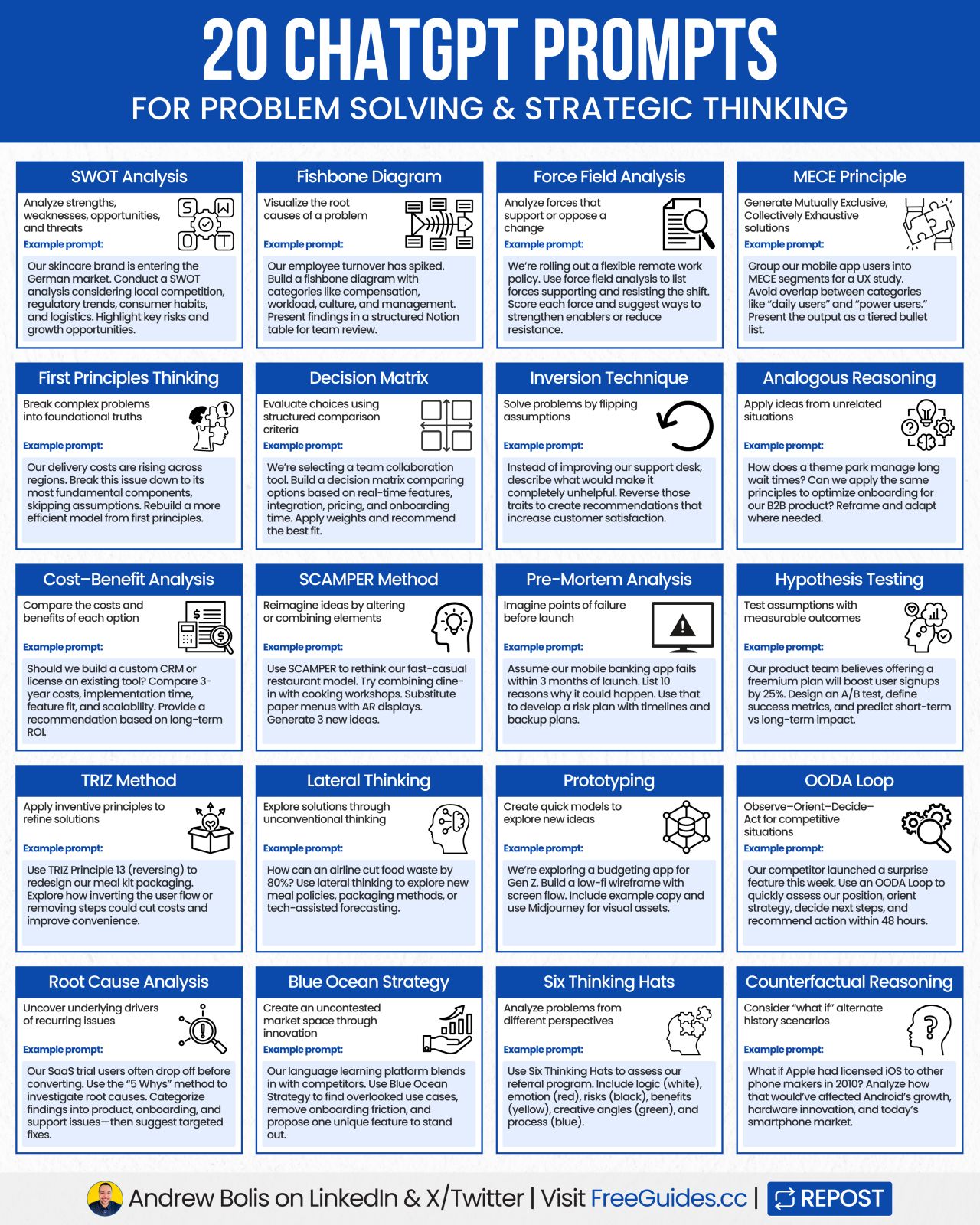
In a recent LinkedIn post, Andrew Bolis discusses strategies for significantly reducing the time spent on problem-solving by integrating proven analytical frameworks with the capabilities of ChatGPT. Bolis, a proponent of leveraging AI for efficiency, highlights how combining established methodologies with advanced AI tools can transform the problem-solving process.
Bolis opens by posing a direct question to his audience: “Are you spending hours on problem-solving?” He then immediately offers a solution, suggesting that the key lies in using “proven frameworks + ChatGPT instead.”
“Try this, it will save you hours: ✓ Pick one of these proven frameworks ✓ Add context in a ChatGPT prompt ✓ Refine the response until it clicks”
The core of Bolis’s message revolves around a practical, step-by-step approach. He emphasizes that the effectiveness of this method hinges on selecting an appropriate framework, providing sufficient context to ChatGPT, and then iteratively refining the AI’s output until it meets the user’s needs. This iterative refinement process, according to Bolis, is crucial for achieving a satisfactory and actionable solution.
Leveraging Established Frameworks with AI
Andrew Bolis identifies five specific problem-solving frameworks that he believes are particularly well-suited for integration with ChatGPT. He outlines these methods, suggesting they provide a structured foundation upon which AI can build.
Key Frameworks for AI-Assisted Problem-Solving
According to Bolis, these frameworks offer distinct advantages when combined with AI:
- SWOT Analysis: This classic framework helps in analyzing internal strengths and weaknesses, as well as external opportunities and threats. Bolis suggests that ChatGPT can quickly compile and even offer initial strategic recommendations based on these factors.
- Decision Matrix: For situations involving multiple options, a decision matrix allows for comparison based on weighted criteria. Bolis implies that ChatGPT can assist in setting up the matrix and evaluating options based on the defined parameters.
- First Principles Thinking: This method involves breaking down complex problems into their most fundamental components. Bolis suggests that AI can be a powerful tool for identifying these core elements, especially in novel or highly complex scenarios.
- Force Field Analysis: This technique is used to identify the forces that support or resist a particular change. Bolis posits that ChatGPT can help in brainstorming these forces and assessing their potential impact.
- MECE Principle: This principle ensures that ideas or solutions are organized without overlap or gaps. Bolis indicates that AI can aid in structuring information logically and comprehensively.
Bolis also shared an infographic (not included here) that provides a more detailed breakdown of these methods. He encourages engagement by asking his audience to share their own favorite problem-solving frameworks in the comments section of his post.
“These 5 problem-solving methods work well with ChatGPT.”
Driving Efficiency and Sharing Knowledge
Beyond the practical application of these frameworks, Andrew Bolis also uses his post as an opportunity to promote his resources and encourage community interaction. He offers a free “Advanced ChatGPT Guide” via a provided link and urges followers to share his post to help others benefit from this AI-driven approach.
“Remember to 🔖 save this post for later”
Bolis’s approach underscores a growing trend in professional development: the synergistic use of human expertise and artificial intelligence. By advocating for the combination of established analytical tools with AI, he positions himself as a thought leader helping others navigate the evolving landscape of productivity and problem-solving in the business world.
📝 About This Content
This article is based on insights shared by Andrew Bolis on LinkedIn.
📅 Originally posted on January 20, 2026 | View original post on LinkedIn →