
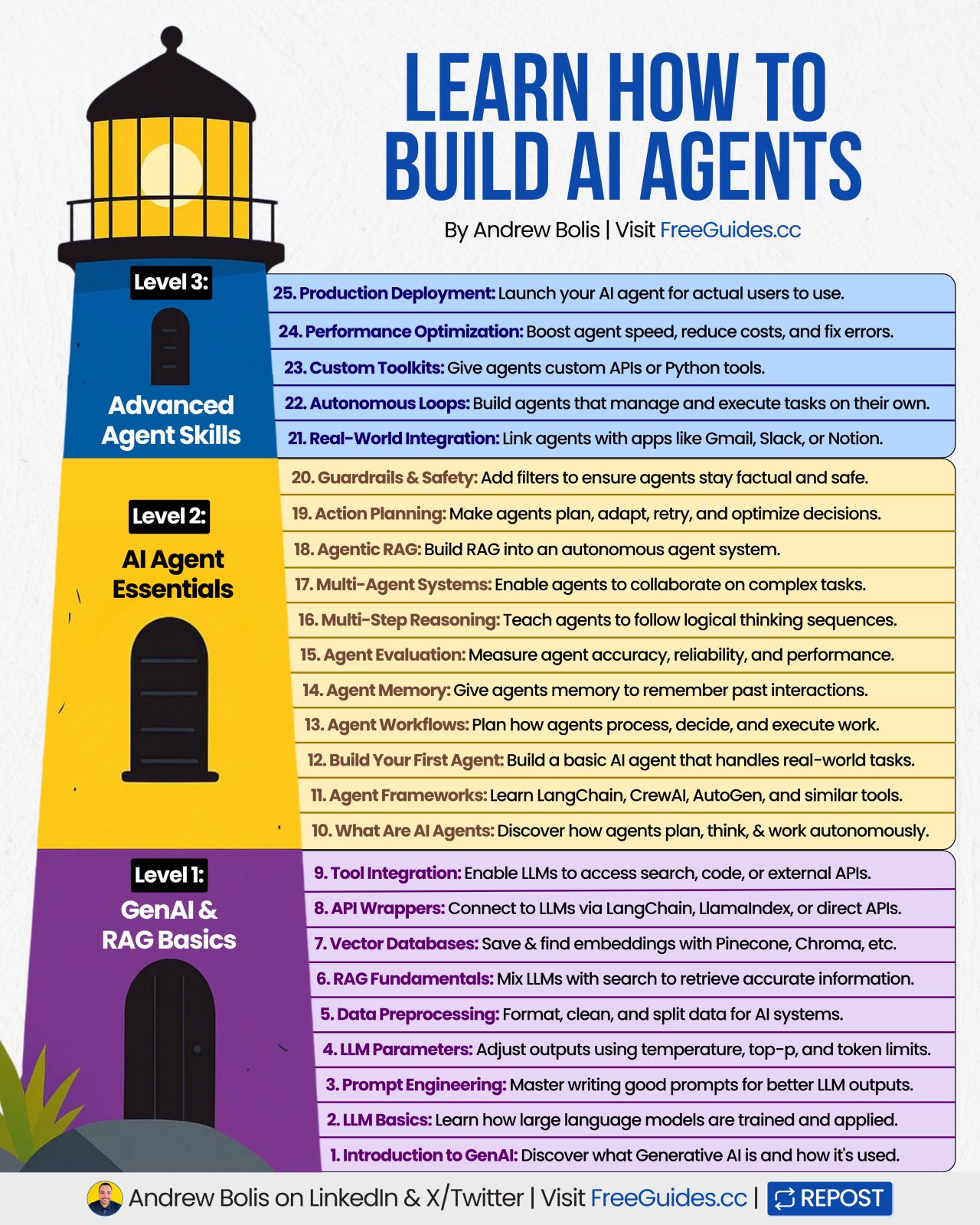
In a recent LinkedIn post, Andrew Bolis provides a structured, three-level roadmap for individuals looking to learn how to build AI agents. Bolis, a proponent of accessible AI education, breaks down the complex field into manageable stages, starting with foundational concepts and progressing to advanced integration and deployment.
Bolis emphasizes that the learning curve for AI agents is not as steep as some might believe. He outlines the journey, stating:
Learning how to build AI agents isn’t difficult. Here’s a roadmap divided into 3 levels.
Level 1: Foundational Generative AI and RAG Knowledge
The initial stage, as detailed by Bolis, focuses on the core technologies underpinning AI agents. This includes understanding the basics of Generative AI (GenAI) and Large Language Models (LLMs). Key areas covered in Level 1 are:
- Introduction to GenAI and LLM fundamentals
- Prompt Engineering for effective LLM interaction
- LLM parameters like temperature and token limits
- Data preprocessing for AI systems
- Retrieval-Augmented Generation (RAG) principles
- The role of Vector Databases (e.g., Pinecone, Chroma)
- Connecting to LLMs using API wrappers (e.g., LangChain, LlamaIndex)
- Integrating tools for LLMs to access external functionalities
According to Bolis, mastering these elements is crucial before diving into agent construction. He notes the importance of RAG for ensuring information accuracy by combining LLMs with search capabilities.
Level 2: Essential AI Agent Concepts and Frameworks
Moving into the second level, Bolis shifts the focus to the architecture and mechanics of AI agents themselves. This stage delves into what makes an AI agent autonomous and how to build and manage them.
Bolis highlights the significance of understanding agent frameworks and their capabilities. He lists several key topics:
What Are AI Agents? Discover how agents plan, think, and work autonomously.
- Understanding the autonomous nature of AI agents
- Exploring popular agent frameworks such as LangChain, CrewAI, and AutoGen
- Building a first functional AI agent for real-world tasks
- Designing agent workflows and memory systems
- Evaluating agent performance and reliability
- Implementing multi-step reasoning and multi-agent collaboration
- Integrating RAG into agent systems (Agentic RAG)
- Developing action planning and guardrails for safety
As Andrew Bolis points out, giving agents memory and the ability to perform multi-step reasoning are vital for tackling complex problems. He also stresses the importance of safety guardrails.
Level 3: Advanced Agent Skills and Production Readiness
The final level, as outlined by Bolis, prepares learners for integrating AI agents into practical, real-world applications and ensuring their successful deployment.
This advanced stage covers:
- Integrating agents with popular applications like Gmail, Slack, and Notion
- Creating autonomous loops for continuous task execution
- Developing custom toolkits and APIs for agents
- Optimizing agent performance for speed and cost-efficiency
- Strategies for production deployment and user access
Bolis concludes his post by offering a free guide on advanced ChatGPT, directing interested readers to a provided link. His comprehensive roadmap aims to demystify AI agent development, making it an accessible skill for a broader audience.
📝 About This Content
This article is based on insights shared by Andrew Bolis on LinkedIn.
📅 Originally posted on December 7, 2025 | View original post on LinkedIn →