
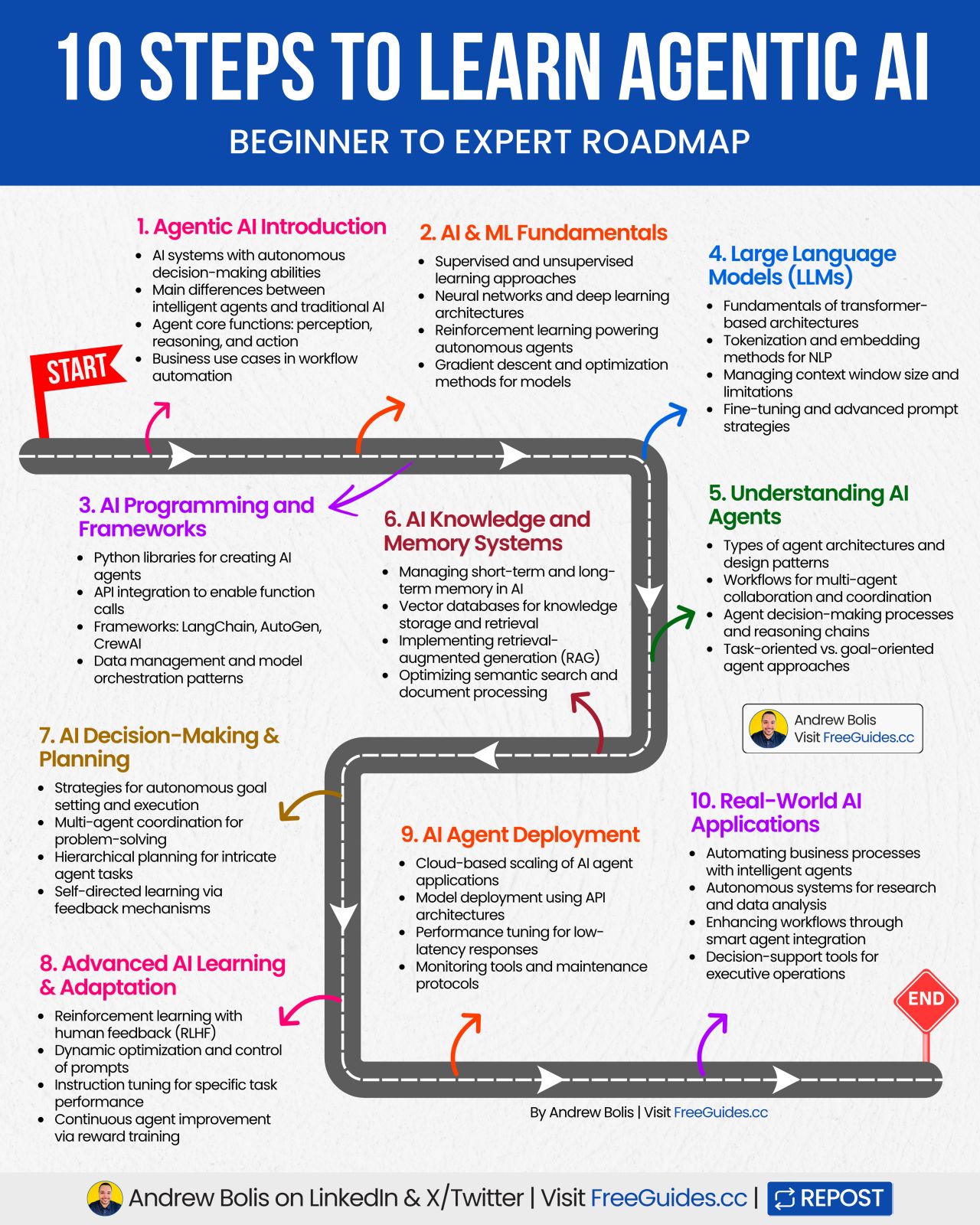
In a recent LinkedIn post, Andrew Bolis offers a structured roadmap for professionals looking to understand and build skills in Agentic Artificial Intelligence (AI). Bolis frames Agentic AI not merely as a fleeting trend, but as a critical, emerging skill gap that individuals should proactively address to future-proof their careers.
“Agentic AI is advancing rapidly, and its use is growing. Here’s a helpful framework to learn Agentic AI. It’s a logical roadmap to build real skills, step by step.”
Bolis’s framework breaks down the complex field of Agentic AI into ten progressive stages, beginning with foundational concepts and moving towards advanced applications and deployment strategies. He emphasizes that understanding these systems requires a multi-faceted approach, integrating core AI/ML principles with practical programming skills and a deep dive into Large Language Models (LLMs).
Foundational Knowledge in AI and ML
The initial stages of Bolis’s framework focus on establishing a solid understanding of AI and Machine Learning (ML) fundamentals. This includes grasping concepts like supervised and unsupervised learning, neural networks, and the role of reinforcement learning in powering autonomous agents. According to Bolis, understanding these underpinnings is crucial before delving into the specifics of agent programming.
Core Components of AI Agents
Bolis highlights that Agentic AI systems are characterized by their autonomous decision-making abilities. He identifies key differences between intelligent agents and traditional AI, pointing out that agents possess core functions of perception, reasoning, and action. This distinction is vital for comprehending how these systems operate independently in various business contexts, particularly in workflow automation.
Programming and Advanced Concepts
Moving beyond theory, Bolis dedicates sections to the practical aspects of building AI agents. This includes proficiency in programming languages and frameworks essential for AI development, such as Python libraries and popular tools like LangChain, AutoGen, and CrewAI. He stresses the importance of API integration for enabling function calls and managing data effectively.
“Python libraries for creating AI agents, API integration to enable function calls, Frameworks: LangChain, AutoGen, CrewAI, Data management and model orchestration patterns.”
Furthermore, Bolis delves into the intricacies of Large Language Models (LLMs), covering transformer architectures, tokenization, and strategies for managing context window limitations. He also explores advanced prompt engineering techniques, which are critical for eliciting desired behaviors from AI models.
Understanding and Implementing AI Agents
A significant portion of Bolis’s framework is dedicated to understanding the architecture and behavior of AI agents themselves. He outlines various agent design patterns and discusses the complexities of multi-agent collaboration and coordination. Bolis argues that comprehending agent decision-making processes and reasoning chains is key to leveraging their capabilities effectively.
“Workflows for multi-agent collaboration and coordination, Agent decision-making processes and reasoning chains, Task-oriented vs. goal-oriented agent approaches.”
Memory and knowledge systems are also central to Bolis’s guide. He explains how AI agents manage short-term and long-term memory, the role of vector databases for knowledge storage, and the implementation of retrieval-augmented generation (RAG). Optimizing semantic search and document processing are presented as crucial for enhancing agent performance.
Deployment and Real-World Applications
The final stages of Bolis’s framework address the practicalities of deploying and utilizing Agentic AI in real-world scenarios. This includes strategies for autonomous goal setting, hierarchical planning for complex tasks, and continuous improvement through feedback mechanisms and reward training. As Bolis notes, advanced learning techniques like Reinforcement Learning with Human Feedback (RLHF) are vital for refining agent capabilities.
Finally, Bolis touches upon the deployment aspects, including cloud-based scaling, model deployment via APIs, and performance tuning for low-latency responses. He concludes by highlighting the transformative potential of Agentic AI in automating business processes, enhancing research and analysis, and providing sophisticated decision-support tools for executive operations.
“Automating business processes with intelligent agents, Autonomous systems for research and data analysis, Enhancing workflows through smart agent integration, Decision-support tools for executive operations.”
Bolis’s comprehensive post serves as a valuable guide for anyone seeking to navigate the rapidly evolving landscape of Agentic AI, emphasizing its growing importance as a core skill for the future workforce.
📝 About This Content
This article is based on insights shared by Andrew Bolis on LinkedIn.
📅 Originally posted on December 25, 2025 | View original post on LinkedIn →