
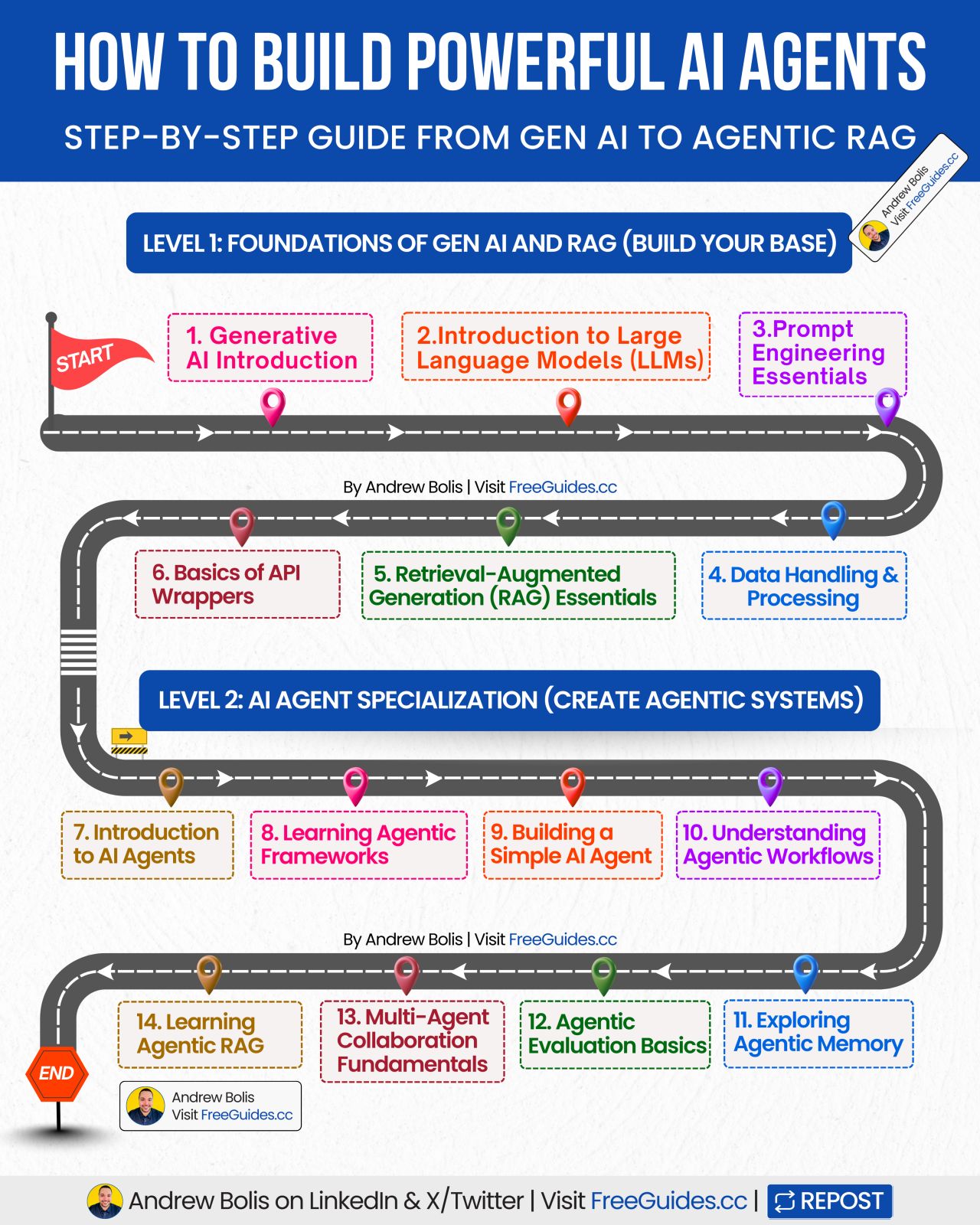
In a recent LinkedIn post, Andrew Bolis offers a comprehensive roadmap for professionals looking to understand and build AI agents, a technology he identifies as the future of work automation. Bolis addresses a common barrier to adoption, noting that a significant portion of the workforce remains unsure how to begin their journey into this field.
Deconstructing the Path to AI Agent Expertise
Bolis breaks down the learning process into two key levels: Foundations of Gen AI and RAG, and AI Agent Specialization. This structured approach aims to guide individuals from basic understanding to advanced application development.
AI agents are the future of work automation. But 90% of people still don’t know where to start. Here’s the complete roadmap from beginner to expert:
The first level, according to Bolis, focuses on the essential building blocks of contemporary AI systems. This includes foundational knowledge in Generative AI and Retrieval Augmented Generation (RAG). Bolis provides a curated list of resources, featuring courses from renowned institutions and platforms like Andrew Ng’s Generative AI for Everyone, H2O AI’s LLMs – Level 1, and DeepLearning AI’s Prompt Engineering for Developers.
Core Concepts in Generative AI and RAG
Bolis emphasizes the importance of understanding Generative AI principles, Large Language Models (LLMs), prompt engineering, and the preprocessing of unstructured data. He also highlights introductory courses on Generative AI API Specialization and the basics of RAG, positioning these as critical first steps.
Advancing to AI Agent Specialization
The second level, as outlined by Bolis, delves into building systems capable of autonomous thought, decision-making, and action. This stage requires a deeper dive into specialized tools and frameworks.
Build systems that can think, decide, and act autonomously.
Bolis recommends courses covering AI agent fundamentals using RAG and LangChain, with specific mention of IBM’s offerings. He further points to resources for mastering LangChain for LLM application development and building autonomous AI agents from scratch using Python, citing Udemy as a platform for such practical training.
Developing Sophisticated Autonomous Systems
Further into the specialization phase, Bolis directs learners towards understanding AI agentic design patterns with AutoGen, exploring LLMs as operating systems with a focus on agent memory, and building intelligent troubleshooting agents. The curriculum extends to multi-AI agent systems using CrewAI and advanced RAG application development and evaluation, with resources from LlamaIndex and TruEra.
Bolis concludes his post with a clear call to action, encouraging readers to save the post, study the steps, and begin building. He also offers a free advanced ChatGPT guide and invites engagement by asking followers to repost his insights to help others learn and utilize AI.
📝 About This Content
This article is based on insights shared by Andrew Bolis on LinkedIn.
📅 Originally posted on December 7, 2025 | View original post on LinkedIn →