
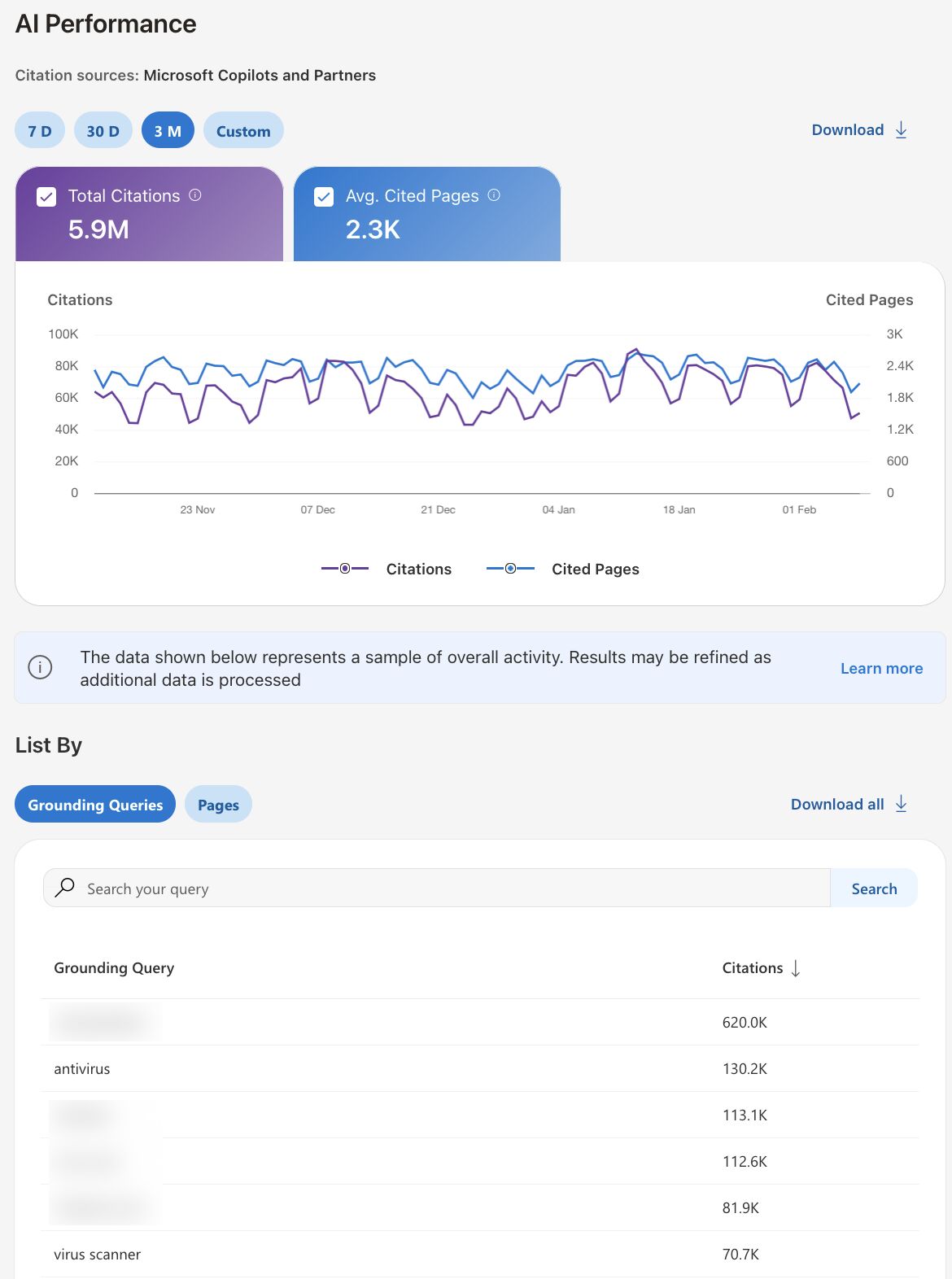
In a recent LinkedIn post, Ann Smarty discusses the launch of the first-ever AI visibility report from Bing Webmaster Tools, offering a critical and nuanced perspective on its initial utility for content creators and SEO professionals.
Smarty highlights the novelty of this report, noting that while it’s a step towards understanding AI’s impact on search, its current actionability is limited. She shares her initial observations about the data provided:
“Our very first AI visibility data source is here. 😱 Are you excited? Don’t be 🙂 Bing Webmaster Tools just launched the very first AI visibility report we are seeing from a search / LLM platform, which, admittedly, is not very actionable (they promise to work more on that).”
Understanding Bing’s AI Visibility Report
Ann Smarty breaks down the key components of the new report, emphasizing what information Bing is making available. According to Smarty, the report includes data on ‘AI surfaced’ content, such as Microsoft Copilot, AI-generated summaries in Bing, and select partner AI integrations. While these are the areas being tracked, Smarty points out that there’s currently no way to distinguish between them within the report itself.
Key Data Points and Initial Reactions
The report offers two primary data points: ‘Grounding queries’ and ‘Cited pages.’ Smarty explains the former as the phrases used by AI when retrieving content for its answers, clarifying that these are not direct user prompts. She expresses a degree of intrigue, remarking on the simplicity of these queries:
“Grounding queries” (“the key phrases the AI used when retrieving content that was cited in its answer”, so these are not prompts. I am a little intrigued by how simple these are.)
The second data point, ‘Cited pages,’ reveals which URLs are most frequently cited by Bing’s AI. However, Ann Smarty voices skepticism about the presented numbers, questioning their magnitude and the underlying methodology. As she notes:
“I am not sure what those numbers are. Bing explains them as “how often a specific URL from your site is visibly cited in an AI‑generated answer,” which, looking at the number, is a little unbelievable)
The ‘GEO’ Designation and Future Implications
Smarty also points out a peculiar naming convention used by Bing, referring to the report as ‘GEO.’ While the exact reasoning behind this designation isn’t fully explained, it adds another layer of ambiguity to the report’s interpretation. Despite the current limitations, Ann Smarty expresses appreciation for Bing’s initiative in providing this data. She concludes her analysis with a forward-looking statement:
“Again, I am not sure what to do with this data, but I still appreciate Bing doing something here.”
The introduction of this AI visibility report, even in its nascent stage, signals a significant shift in how search engines are measuring and potentially ranking content influenced by AI. While creators and SEOs will need to wait for more actionable insights, Smarty’s analysis provides a crucial early look at what to expect and how to begin thinking about this new landscape.
📝 About This Content
This article is based on insights shared by Ann Smarty on LinkedIn.
📅 Originally posted on February 11, 2026 | View original post on LinkedIn →