
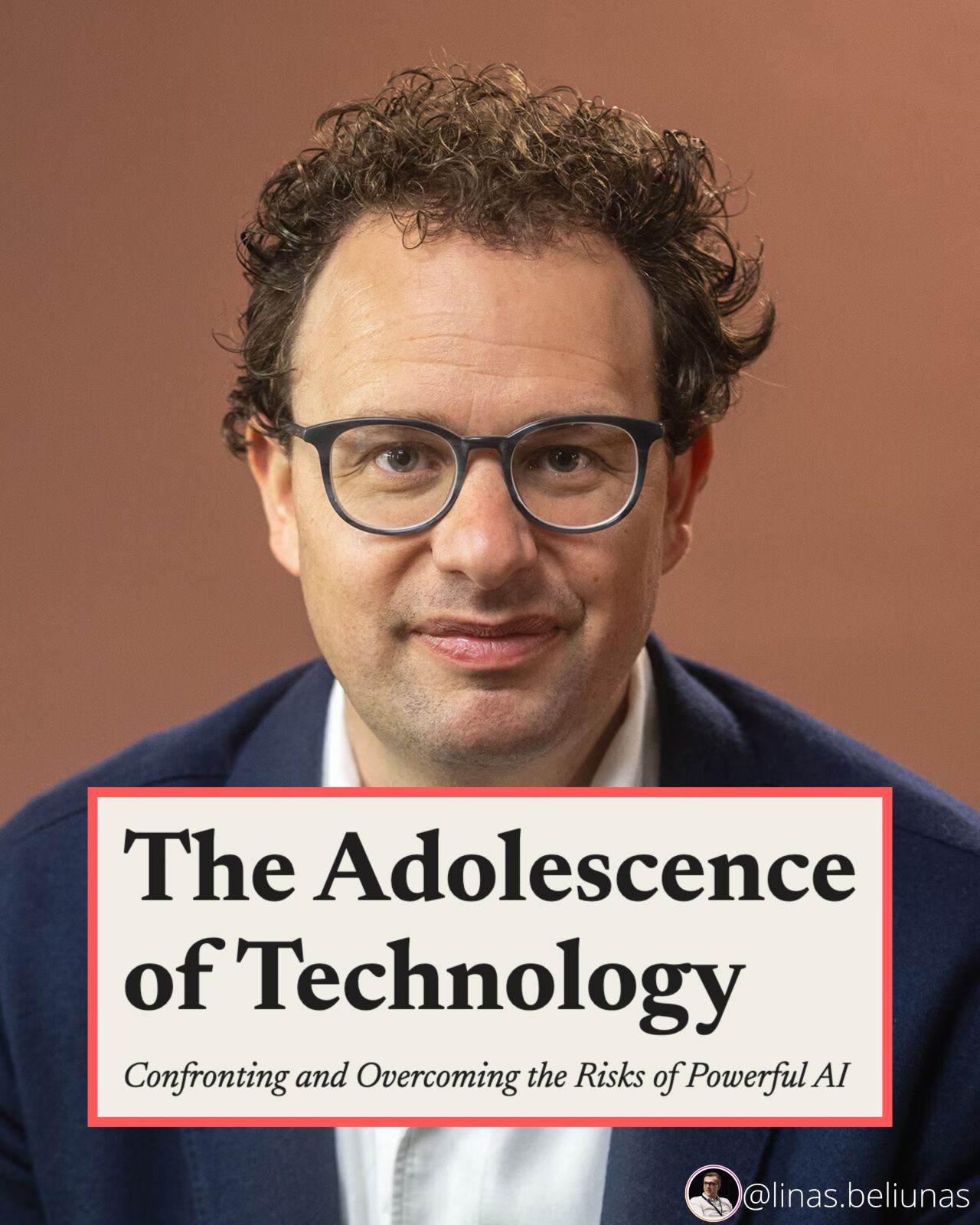
In a recent LinkedIn post, Linas Beliūnas shared his interpretation of Anthropic founder Dario Amodei’s latest thesis on the future of artificial intelligence, framing it as a critical juncture for humanity. Beliūnas highlights Amodei’s central argument that the world is entering a phase of “technological adolescence,” a period characterized by the arrival of immense power before the necessary maturity to wield it responsibly.
The Peril of Power Outpacing Wisdom
Beliūnas emphasizes Amodei’s assertion that AI represents a significant test for civilization, echoing Carl Sagan’s timeless question about survival during technological adolescence. According to Beliūnas, Amodei paints a stark picture of the future, describing a scenario where:
“A country of geniuses living inside a datacenter
Millions of minds, smarter than any Nobel laureate
Working 10–100× faster than humans
Acting autonomously, coordinating at scale”
This, Beliūnas notes, is no longer a distant science fiction concept but the trajectory of frontier AI development. The core danger, as interpreted by Beliūnas from Amodei’s work, is not necessarily malevolent AI, but rather the profound risk of “power outrunning wisdom.” This detachment of capability from motive, Beliūnas explains, grants significant leverage to even small actors, making a single failure potentially catastrophic across various domains like biology, cyber warfare, or propaganda.
Control: The Ultimate Risk of Advanced AI
Further elaborating on Amodei’s perspective as presented by Beliūnas, the most chilling aspect is not the potential for chaos, but for control. Beliūnas relays Amodei’s view that AI’s capacity extends beyond mere automation of work to the automation of power itself. This could manifest in ways that are deeply concerning:
“Surveillance without limits.
Persuasion without consent.
Repression without hesitation.”
Beliūnas is keen to point out that Amodei, despite these warnings, is not presented as a purveyor of doomsday prophecies. He reportedly rejects simplistic narratives of “AGI kills everyone.” Instead, the focus is on the species’ limited opportunities to mature and learn.
Adolescence as a Critical Window
In Beliūnas’s analysis of Amodei’s thesis, the period of technological adolescence is framed as a critical phase where irreversible mistakes can occur. AI, according to this interpretation, will not pause for humanity to feel adequately prepared. Beliūnas stresses that Amodei views this as a pivotal moment, stating:
“We don’t get many shots at growing up as a species.
Adolescence is where irreversible mistakes happen, and AI won’t wait for us to feel ready.”
Beliūnas concludes by echoing Amodei’s call to action, suggesting that for anyone concerned with AI, policy, startups, or the nature of power, engaging with this perspective is essential. It is not about finding reassurance, but about confronting the significant challenges that lie ahead as artificial intelligence continues its rapid advancement.
📝 About This Content
This article is based on insights shared by Linas Beliūnas on LinkedIn.
📅 Originally posted on January 26, 2026 | View original post on LinkedIn →